Kind of, sort of, at least in one specific instance by the reporting I linked:
What the latest test shows — and what it doesn’t
The newest VTT report (VTT-CR-00178-26), authored by Research Team Leader Ari Hentunen and reviewed by Research Professor Mikko Pihlatie, describes a 5C cycling test on a cell labeled DL2.
…
Donut Lab Damaged Cell Test
The critical context: this cell was already damaged. During a previous 100°C high-temperature discharge test, the cell’s pouch lost its vacuum — a significant structural compromise for a solid-state cell that relies on tight mechanical contact between layers. The purpose of this test was specifically to assess whether the damaged cell could still function under high charge and discharge currents.
So yes, for at least one test, where the function once the battery has been compromised was being tested, we have continuity of battery.
I have no more than the average PHEV/BEV owner’s appreciate for the emerging battery technology, so I don’t pretend to be qualified enough to evaluate the independent testing. Just that the last minute or non-reveal of the two most challenging claims certainly implies something about the success of the tech, and thus my theory that it’s possibly not false, but an issue of overpromises they really don’t know how to back out of without compromising the success they’ve apparently already had.
[please note, lots of provisos mentioned, and weasel words like apparently, seems, etc.]
One bizarre thing is that they didn’t have the independent lab simply weigh the cells that were tested, which would have verified the energy density claims and lent a lot more credence to this trickle of semi-interesting testing results. The test lab didn’t have any scales?
I read someplace that the testing lab that was employed will test exactly what they’ve been asked to. They are not going to prove that the battery is legitimate or what it claims to be.
Right, they were hired to perform specific tests. What’s curious to me is that they weren’t hired to weigh one of the cells they’d confirmed capacity on to verify the energy density claims. It’s almost as if Donut Labs doesn’t want us to have that datum.
Why is Donut Lab even getting this amount of press? It reminds me of MagicLeap, the much-hyped fake VR company.
A random startup company makes an impossibly grandiose claim in a market full of researchers who’ve been trying to do the same for decades… shouldn’t the default be skepticism, not hype, until proven otherwise?
They’re not paying the lab to do any tests they haven’t already done themselves and don’t know how they’ll turn out. They’re paying the lab because it’s a respected third party whose results will be trusted by the wider public. It’s supposed to be independent third party verification of Donut Labs’ claims about this supposed solid-state battery. Energy density is one of the key claims, and would have been trivial for the lab to confirm. But it didn’t happen.
I’m sure that there are labs that can weigh batteries. But the one we used can’t. They are certified to do certain kinds of measurements. They don’t do other kinds of measurements.
If what you want is a notary public, a measurement lab is not that. They aren’t in that market.
At this point, yes, I’m expecting a pivot soon to an Elon Musk style “We shoot high and sometimes don’t reach out goals, but that’s because we aim so high…”
The fact that there is no evidence they’ll be in production vehicles at this date doesn’t bother me in particular - these days many creators and tech CEOs overpromise and underdeliver.
The fact that we don’t have any independent tests for the two most aggressive claims… that bothers me. That makes me… distrustful. I smell hype - I smell a triumph in hope vs. facts. Or, rather, some theoretical “well, if everything went perfect…” belief that failed before facts.
Where have you seen a company allow proprietary secrets “torn down” to satisfy curiosity?
Neither Apple nor nVidia give up their secrets….I watched them both become the most valuable companies on the planet and they both played their cards close to their chest. There is skepticism and then there is informed skepticism.
The former is a waste of electrons.
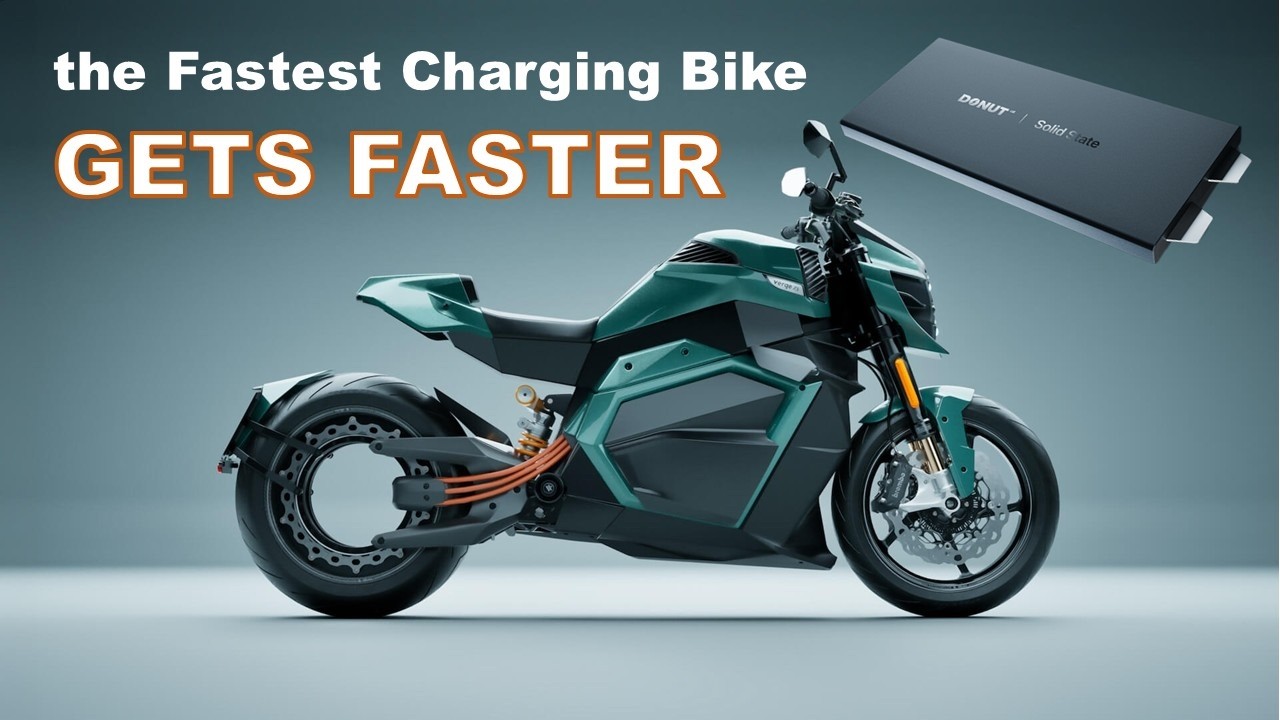
Verge has a ground breaking product and is allowing testing by an independent, well respected national agency to confirm its claims and so far answered some of those claims and promises more.
AI Overview
As of
April 2, 2026
Verge Motorcycles has officially begun shipping its first production solid-state battery motorcycles, marking the start of customer deliveries. A video published on March 31, 2026, confirmed the first second-generation Verge TS Pro units were crated and ready for shipment, following a Q1 2026 production target.
Verge Motorcycles +2
Latest Shipments: The first customer units were produced and crated for shipping on March 31, 2026.
There are a variety of chemistries the batteries COULD be, lots of speculation some of which is informative.
No company in their right mind will reveal their secrets….why do you think Verge should?
Where’s the “tear down” of the Golden Bell battery the Rhino series with 600 Wh/kg???….don’t hold your breath.
I mean, nobody doubts that they have actual batteries. We just think they’re lying through their teeth about what those batteries are. So they’ll sell a bunch of cheap, crappy motorcycles, and make some profit, before anyone realizes how cheap and crappy they are.
Wait, so you don’t think they’re actually going to deliver any product? Because never delivering any product at all is the only way they can prevent anyone from tearing down the batteries.
About 15 minutes after any notable product goes on sale every serious competitor has bought one and started disassembling. Sometimes it’s quiet, like when auto maker buys a vehicle and breaks it down to the last bolt in a test facility. Sometimes it’s public, like how iFixit publishes a complete teardown of every new Apple product calling out every discoverable fact and spec about the components in the device. But either way, it happens every time.
And it solely the extreme difficulty (read “nigh impossibility”) of disassembling a modern integrated circuit “chip” that has protected Apples, Intel’s, and NVidia’s IP. @Voyager could speak to this in more detail; that was his industry.
We used to have several posters in the auto industry, but they’re dwindling in number. But there was somebody who was directly involved in the post-teardown analysis of competitor’s cars. They’ve written a bit about their work.
Honestly my skepticism doesn’t need a full tear down to be drastically reduced. Just actually getting the battery and testing the key claims about it that have made so many who know much more than me have their bulllshit alarms ring so loud.
I’m no battery expert but those who are have been considering the company’s claims as extraordinary. The specific claims labeled as extraordinary have not yet had evidence of support, of any quality.
It may be a good product. Maybe a great product. Even if the claims are false. And then the hype worked to get attention to the product even if they spin that this isn’t the full battery version yet, blah blah.
Yep. Take delivery. Charge it up fully. Ride it until it’s flat & note the mileage. Charge it up again & note the time taken and amperage / wattage delivered by the charger. Measure the gross dimensions of the battery or battery compartment. If practical weigh the battery unit, but don’t bother if that’s too hard.
All that info will either be pretty much ordinary Li-ion numbers, or they’ll be obviously majorly better numbers in whichever direction, larger or smaller, is better.