Both lines are moving smoothly at the same rate. Or so is the claim. I’m sure it’s true but I can’t think of a way to test.
I can say this much: their explanation doesn’t seem sufficient. I can cover up the blue or yellow part with my finger, and it doesn’t make the other rectangle appear to move smoothly. That only happens when they gray out the background.
Whenever I attempt to pause the video, the yellow and blue rectangles do not seem to be as far apart as they seem when I see them moving, so I suspect they are in fact moving smoothly at the same rate throughout the video.
If it were on YouTube, I’d use frame advance to check for sure.
I do know that the idea that we detect movement separately from identifying color is true. It’s in fact possible for brain injurty to result in losing the ability to detect movement. And, of course, there are all those animals which who are better at seeing movement than other forms of vision.
It is, look up the “stepping feet illusion”.
Here’s one I found without someone talking over it…there’s music, but no talking.
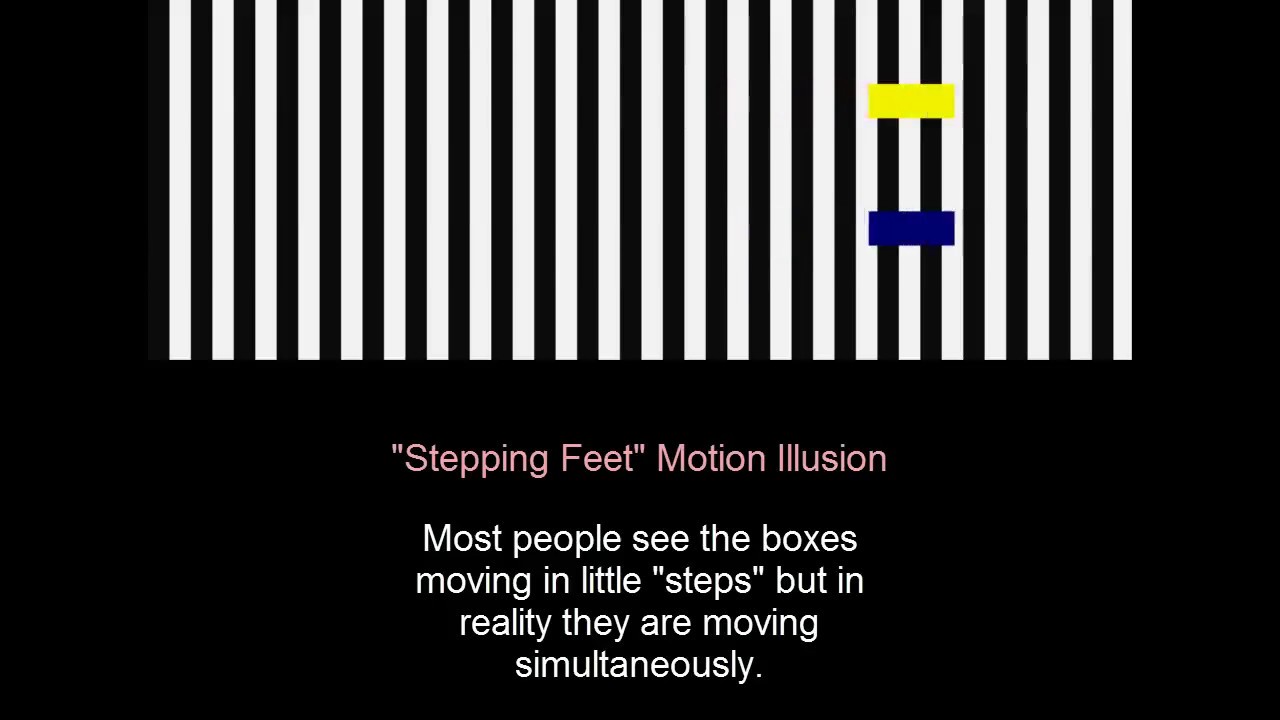
If you’re blocking part of it with your hands, I found it helps to zoom way in.
The explanation given in the Wiki link makes a lot more sense to me than the (at best) incomplete one in the TikTok video and description.
And I confirm the two rectangles remain aligned in the frame by frame. I even see the yellow one move first over black, with the blue one seeming to move a bit later.
They’re making the explanation way too complicated. All this is is that our eyes don’t easily see contrast between yellow and white, and likewise we don’t easily see contrast between blue and black. When the yellow “bus” is moving, half the time, the ends (where the motion is) are over the white where we have a hard time seeing them. Likewise, when the blue bus is moving, half the time, the moving ends are over the blue. The “illusion” would be even more complete if you used a white bus and a blue bus, except then it wouldn’t even be an illusion at all; there’d just be no way to distinguish between moving and not-moving.
I don’t find that sufficient compared to the fuller explanation on Wikipedia. Yes, in this video, the blue is a bit hard to see against the black. But the Wiki version has a brighter blue, and it not only still works, but is more striking. (And the yellow is easy to see in both.)
It seems not so much that we can “hardly see them” but more that we perceive higher contrast motion as faster, perhaps because it is more quickly processed by the brain. It also seems possible that our motion vision ignores or is less sensitive to chroma.
Look at this version of the illusion. We don’t just “not see” the motion, but it looks like it’s changing shape and size as it goes.
I asked AI to make this smoother, interactive version that lets you pause and step through the animation:
(edit: of the original yellow/blue illusion, not the pigeons)
It includes a red line that you can toggle on and off… with it turned on, the leading edge is more visible and the entire illusion is destroyed.
Frame by frame analysis shows them moving separately.
I think that might be an encoding artifact due to heavy compression and a low framerate. The illusion doesn’t depend on that (see the version I posted, which is an SVG animation).
But your link does the same thing. Tapping frame by frame, each block moves independantly for 12 taps (frames), then the other block moves 12, then the other. Turning off the stripes makes them move together.
Not so; both blocks move when you tap Step fwd. It’s just hard to see the movement in the block whose leading edge is in a semi-matching stripe (yellow on white or blue on black). If you zoom the image larger it’s a bit easier to see the movement.
No, but it’s a powerful illusion! Look at the version posted by @Reply. Press “Step Forward” and/or “Step Back” and if you watch very carefully you can see that the blue and yellow bars enter and exit the white spaces at exactly the same time. The yellow bar is hard to see on white and the blue is hard to see on black, and that’s the whole point, but if you look carefully both bars are exactly in sync.
Turning on the red line makes this even clearer but it makes the illusion disappear, but the motion is exactly the same.
For your version,
When I focus on the vertical stripes, the blocks appear to be stepping.
When I focus on the blocks, the blocks move together, and move smoothly.
I see. Wow, that’s neat.
Right; I can confirm that in the original instagram video, I was able to pause at points where one block has a sliver of white pixels between it and the next black section, and the other didn’t, due to smoothing / MPEG compression / whatever.
I would share but still find image sharing here a pita.
So the illusion is real, but the instagram video has potential issues that might exaggerate it a bit.
Lol, I woke up this morning, saw your comment, tried it again myself… and indeed, saw the same thing and thought there was a bug in the code. Oh no!
Except… there isn’t! The illusion really just is that strong. Even when I know how it works AND can step through it AND can toggle the background and leading red line, it still fools me.
It’s like @Chronos said, the contrast really does a number on the brain. Crazy stuff.
Toggling forward with stripes on really allows you to understand the effect better. Thanks for this.
I’m amazed that AI could create that.
It helps, doesn’t it? Still a really neat illusion, even with the visual aids.
Aside:
Google’s been hard at work teaching their AI to animate better SVGs. Unlike image and video generation, these are mathematically-defined vector shapes and keyframes written in HTML-like code, making them great for cartoons and simple animations.