Why from roughly about the mid 70’s to the mid '80’s were Ovation acoustics so popular?
As opposed from then till now, where standard shaped acoustic guitars seem to dominate.
Why from roughly about the mid 70’s to the mid '80’s were Ovation acoustics so popular?
As opposed from then till now, where standard shaped acoustic guitars seem to dominate.
I’m not in the guitar business, but I’ve been playing guitar (badly) since the mid-seventies. Here are a couple of guesses:
First, things go in fashions. We’ve all seen electric guitars that were the flavor of the moment, but when was the last time you saw anyone play a Travis Bean guitar, or a B.C. Rich? And they were perfectly well-made instruments. So maybe Ovation had it’s moment in the sun, and it’s over now (although Ovation is definitely still in business).
Second, the quality of relatively inexpensive, usually Asian-manufactured, accoustic guitars has increased substantially. It may have been true in the past that Ovation’s composite bodies allowed them to make a decent-sounding guitar that played well and stayed in tune, while all-wood guitars at similar price points back in the 70s tended to be awful, but now you can buy a really nice all-wood guitar (and all solid wood, no laminates!) from Epiphone or Blue Ridge or a bunch of other companies for quite a bit less than $1,000. So this may have taken away Ovation’s market niche.
Just my guesses.
Afterthought – I hope Wordman chimes in here – he’s always got useful things to say about guitars.
Holdouts from the 70s music scene still use them, making interested young-uns want them as well.
Moderator Action
Moving thread from General Questions to Cafe Society.
At the time Ovations had a unique sound. I would describe it as ‘clarity’. That’s in comparison to other relatively inexpensive guitars. But the quality of cheaper guitars is now such that I don’t think the ovations really stand out any more.
My acoustic guitars are standard shaped, but a friend of mine had an Ovation and I played it a lot in the 80s.
One thing I liked about it was that it played well. I really liked the feel of the neck and the action. It also had a really good sound.
Probably the reason I used it the most though was that it had a built in pickup, and this pickup sounded really good in both recording and on stage. All you had to do was plug it in and go, like an electric. There was no fiddling with clip on pickups like I have for my acoustics and you didn’t have to stand still next to a microphone (which was the other option for mine if you didn’t use the clip-on).
Modern microphones and PA systems give you less problems with feedback, which was an issue using a standard acoustic back then.
They were popular because they were the first “acoustic” guitars designed to be used in loud onstage settings alongside regular rock instruments.
They sounded terrible and when better instruments became available their popularity plummeted.
Yeah but the most expensive are those which have been manufactured well before Ovations came on the scene. So I wonder If it’s a matter of fashion in part.
Here’s a round up of high-end acoustics according to ‘Guitar Player’,
http://urlmin.com/4qjh9, no sign of Ovations.
Here’s Paul Weller playing one: http://urlmin.com/4qjhb
I played one back in the 80’s at a music store. Didn’t like that big bowl shape. It pushed the guitar too far away from my body. I lost any interest in buying one that day.
Hey - thanks. You and Shakester have it pretty much covered: they were considered innovative at the time because they handled stage settings with less feedback, because they were a cool new thing, and because the new guitars being made by the traditional makers were not great during that era*. It is also during this time that the Japanese-made guitars got popular** and also Taylor guitars***
The Ovation brand still has its adherents, but the brand was just dealt basically a death blow, along with Guild - the US factory was shut down, so only the lower-end ones made in Asia will still be made. Here’s the thread on it in the Acoustic Guitar Forum: FENDER CLOSING NEW HARTFORD FACTORY!!!!! USA Ovation and Adamas are officially DEAD! - The Acoustic Guitar Forum
*By the late 60’s and through the 70’s, Gibson acoustics were pretty awful - poor designs with “innovative” adjustable bridges that sucked out tone, poor manufacturing, etc. Martin, even, had issues - they wanted to reduce the number of Lifetime Warranty repairs that were costing them $$, so they swapped in a thicker, bigger maple bridgeplate (the wood under the top below the bridge providing reinforcement), thickened up the bracing, etc. which killed tone. They also had at least one mistake (which for Martin is Gasp! territory - they are known for the precision) - some jig had gotten so worn that it had some play in it and so bridges were mounted on some guitars 1mm off or more, affecting intonation. And while we are discussing acoustics, don’t get me started about Fenders electrics in the 70’s - the fact they are up in value these days is a head-shaker for me.
**This era of poorly-made new US guitars was perfectly timed to inspire the start of vintage guitar collectors - they didn’t build them like they used to, literally. And Japanese makers reverse-engineered those older Gibsons, Fenders and Martins and were able to “make them like they used to” much better. This sent the US makers back to their old designs and ushered in an era of better quality we are still enjoying today. Really a great time to be buying a guitar if you know what to look for…
***Bob Taylor and Kurt Lustig founded Taylor guitars kinda like Target positions its brand - affordable with an emphasis on top design and an eye towards manufacturability. They brought in computer routers and their designs focused on consistent manufacturability, with less focus on the variability of wood type. They, like Ovations, ushered in the “modern tone” - brighter, less lows, even, separated mids - they amplify well and were perfectly suited, along with Ovation and Takamines, for the era of “barn-door” acoustic-electrics (that big plastic panel on the side of the guitar with all the tone controls on it that came out in the 80’s). There has been a backlash - part retro trendiness, part legit - going back to good, basic acoustics - Taylor has evolved to include these types of designs; Ovation never really caught up.
Okay, geekiness covered. I feel better 
I remember when they first came out. They spent a lot on magazine ads which featured photos of oscilloscope displays to prove the plastic bowl shape had the exact same frequency response as a traditional wooden guitar. And they provided guitars for Glen Campbell and the Partridge Family to play on television.
The main thing Ovation had going for them was that they were the first acoustic guitars that came with built in transducer pickups. And, unlike the Barcus Berry stick on transducer pickups or the Hot Dots that came out in the 70s, you could plug an Ovation directly into an amplifier; no pre-amp was needed.
I had a friend who had an Ovation that I spent some time playing. It didn’t have the pickup. I thought it sounded okay with new bronze strings on it. I also found after about 10 hours of playing the strings sounded like dead nylon strings (by comparison, on a wood guitar, I’d find bronze strings were great for 40 hours of playing and weren’t terrible for over 40). There were no overtones, undertones, whatever that I got from a wood guitar. I suspect if it had the pickup and I was playing through an amplifier, I wouldn’t notice that, though, because transducer pickups pick up the vibrations directly from the bridge. This was a mid range Ovation, not a low end Applause or high end Adamas. And the “mother of pearl” rosette around the sound hole looked like it was just a plastic ring glued onto the surface of the sound board.
I also spent some time playing an Applause model. Besides the loss of tone on older strings, the frets tore up my calloused fingertips and the fretboard turned them black. That was because the fretboard was metal and the frets were just machined into it. Or, should I say, the spaces between the frets were machined out.
And there’s that bowl shape. Whether I was sitting or standing playing one, I found the body seemed to slant so the sound board was tilted upward rather than straight ahead as on a standard guitar. That meant the fretboard would tilt also, so it was more of a strain on my left hand making chords on it as I’d have to curl my hand a bit. It’s a subtle difference, but it’s there. After playing a while, I’d get a sore wrist and thumb.
Back in the early 80s, I wanted a good second guitar for friends to play when they were visiting me while I’d play my D-28. After seriously trying out an Ovation, I decided the best thing to do was get a custom D-35 from the Custom Shop via Mandolin Brothers and let my visitors strum the D-28. And that’s what I did.
Great point about the transducer Ranger Jeff - added to the on-stage appeal.
Gotta ask: what year is your D-28? Pre-1969? Pre-1964?
And yeah, those Applause guitars…eesh.
This. I just could never get used to the feel of that potbelly shape.
I remember liking Ovations (they were loud and bright, which did not necessarily mean they sounded good, but they appealed to a mind drawn to shiny things). They also sounded good on paper; a bowl shape designed to reflect more sound back to vibrate the top. Supposedly they could get more consistency in manufacture since the dimensions of the bowl were consistent.
The big knock on them was that the top was likely to separate from the bowl (the wood shrank and expanded with humidity while the bowl did not). I don’t know that this was true, just that I heard it.
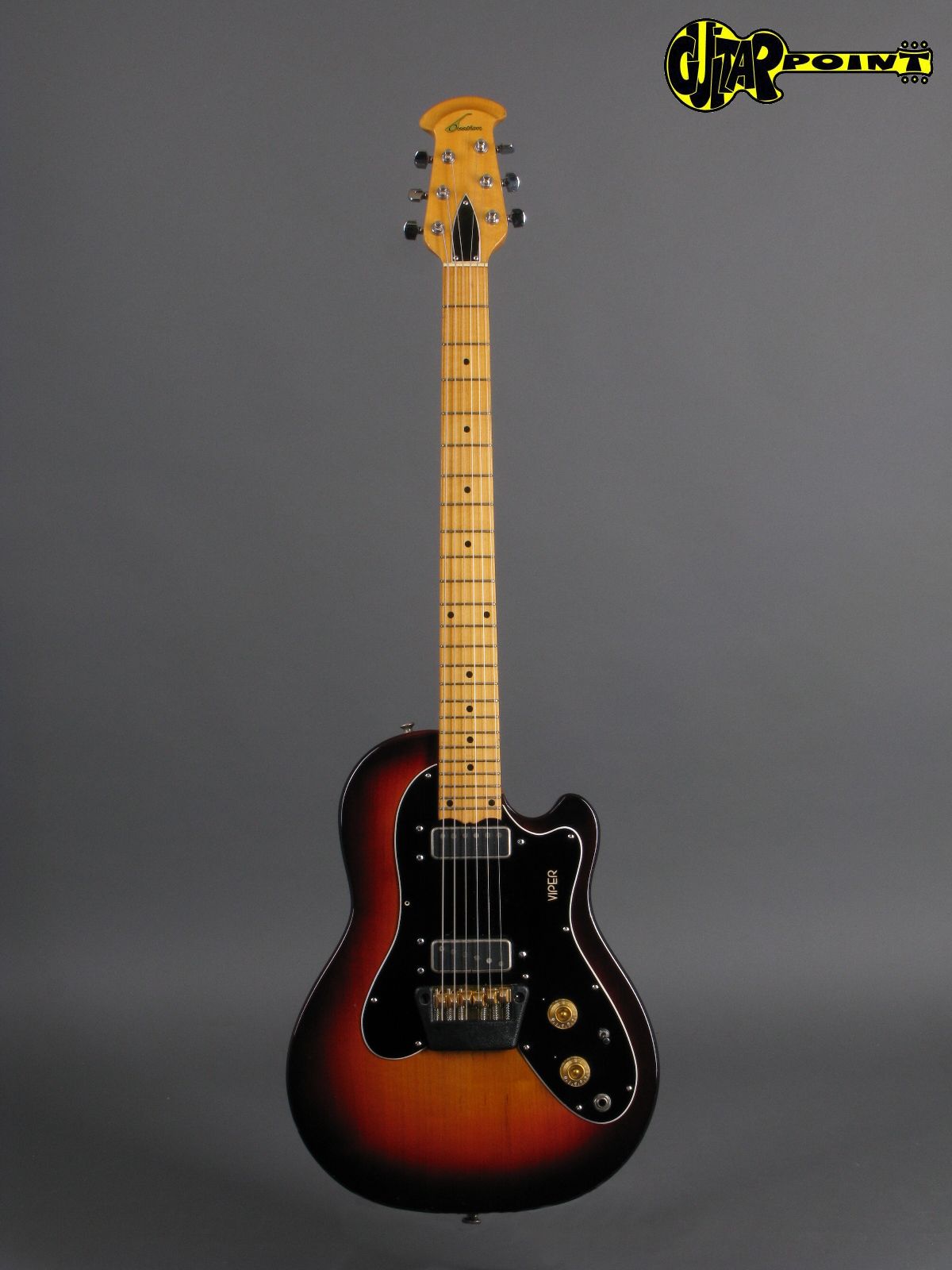
I had two Ovations. The first was a two pickup, solid body electric called The Viper. It was very Fender-ish with a body that vaguely resembled a Les Paul Jr. Overall it was a very well made guitar but it had a very narrow nut width that I never cared for. I should have kept it anyway.
The other was a deep bowl, single cutaway acoustic Legend. The Legend was the next step down from the Adamas. It was uncomfortable to play (standing or sitting) but I thought it sounded pretty good acoustically and amplified (I ran it through a stereo chorus and then into my stereo system). I liked it for blues leads. Don’t regret selling it at all.
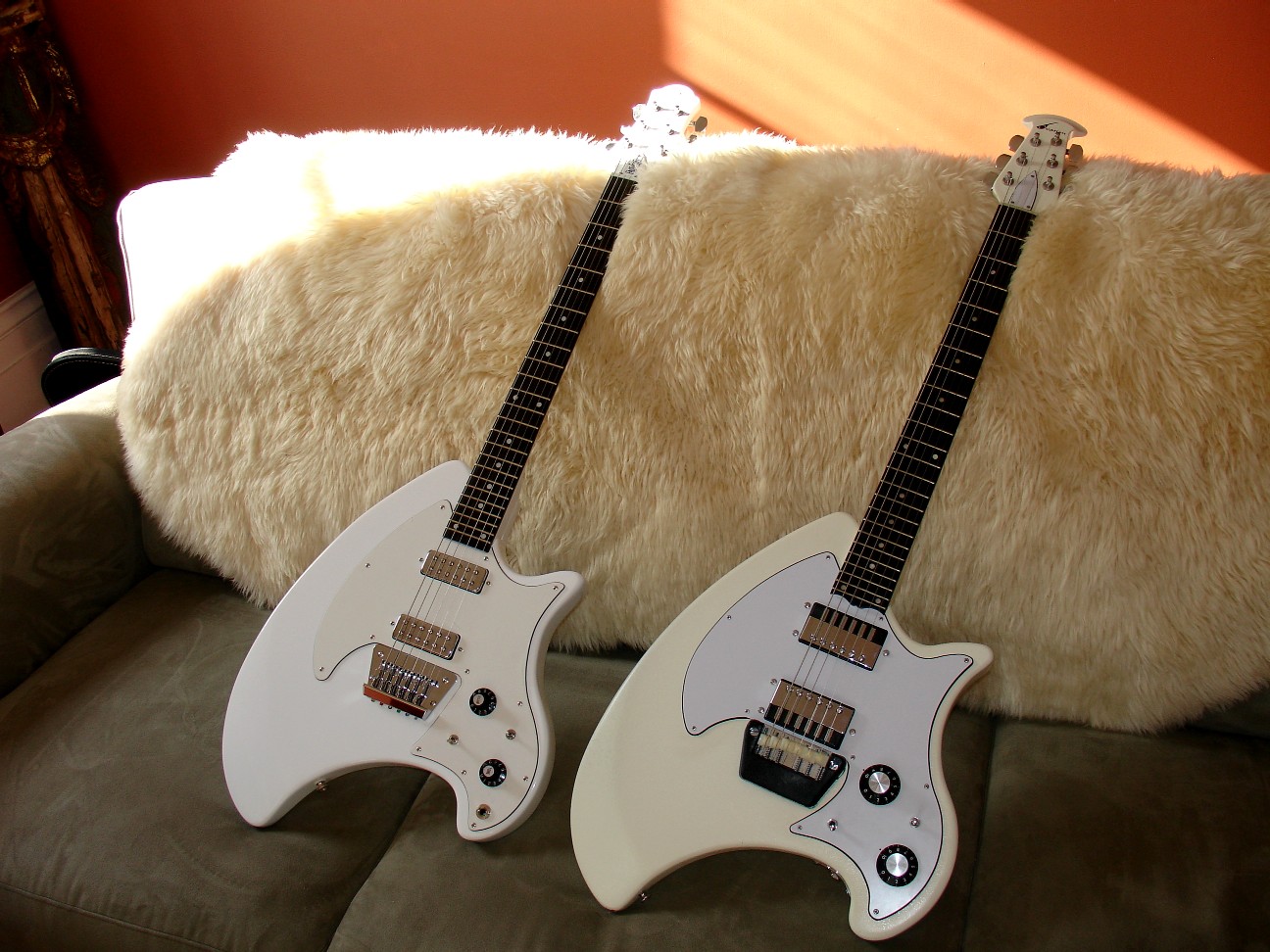
No Ovation thread is complete without mentioning The Breadwinner. The one on the right looks like the real thing, the one on the left looks like a clone or a home brew copy.
Interesting. My guitar teacher has a Taylor that sounds great to my ear; very clear and bright. And I really like the neck on it. I’m not sure what model he has, but it got my attention as possibly the next guitar I buy.
Remind me: you mostly play electrics? A classic part of the original Taylor designs was how well they suited electric players seeking a similar feel. Excellent, consistent necks on the slim side…
I have an electric, but I don’t like it, as it’s hell to try to keep tuned and the strings are too far off the neck. I’m learning on a Brazilian acoustic strung with nylon, but the neck is very wide; a capo just barely fits across all strings. For someone with some arthritis problems in the thumb joints, it makes a barre a real bitch. The teacher’s Taylor is acoustic/electric strung with steel, which he plays without an amp. Probably helps that he’s very proficient with it.
Interesting comments also on the Ovation. I used to jones for one of those way back in the late 60s, but it sounds like I didn’t miss much. Besides, my girlfriend back then would have ended up with it, just like she kept my 12-string. :mad:
It was an 80.
I have an Elite model. I love the shape, as well as having the cutaway. The typical full-size traditional guitars tend to dig into my arm and are just uncomfortable and boxy feeling. The round back on the Ovations just fits ergonomically better for me. It also has great action and is easy to play.
The sound is definitely a bit different, but I really enjoy that specific tone (think Roy Harper, Pink Floyd, Jimmy Page, etc).
For a long while, their built in mic, tuners, equalizers were great to have and of very high quality. However, they never seemed to keep pace with digital tech and lost out to extremely inexpensive digital pre-amps, tuners, etc. By the time they rolled out a model that could store mp3s or interface to USB, it was horribly underspecced for the price. They ended up being a niche between mid-range and high-end studio guitars that had the same offerings and capabilities at either end.