People who define things strictly (in everyday settings) - what's your motivation?

One group of people who are very big on the idea of precision in language are writers and literary critics. There’s a very well respected school of thought that says that good writing is in large part about selecting the right word or words - * le mot juste* - to accurately express your thoughts to the reader. Imprecision leads to misunderstanding, lack of clarity and to a greater or lesser extent, failure of communication.

See for example, Twain on Fennimore Cooper, giving both an explanation of the problem and some examples:

Cooper’s word-sense was singularly dull. When a person has a poor ear for music he will flat and sharp right along without knowing it. He keeps near the tune, but it is not the tune. When a person has a poor ear for words, the result is a literary flatting and sharping; you perceive what he is intending to say, but you also perceive that he doesn’t say it. This is Cooper. He was not a word-musician. His ear was satisfied with the approximate word. I will furnish some circumstantial evidence in support of this charge. My instances are gathered from half a dozen pages of the tale called Deerslayer.

He uses “verbal,” for “oral”; “precision,” for “facility”; “phenomena,” for “marvels”; “necessary,” for “predetermined”; “unsophisticated,” for “primitive”; “preparation,” for “expectancy”; “rebuked,” for “subdued”; “dependent on,” for “resulting from”; “fact,” for “condition”; “fact,” for “conjecture”; “precaution,” for “caution”; “explain,” for “determine”; “mortified,” for “disappointed”; “meretricious,” for “factitious”; “materially,” for “considerably”; “decreasing,” for “deepening”; “increasing,” for “disappearing”; “embedded,” for “enclosed”; “treacherous;” for “hostile”; “stood,” for “stooped”; “softened,” for “replaced”; “rejoined,” for “remarked”; “situation,” for “condition”; “different,” for “differing”; “insensible,” for “unsentient”; “brevity,” for “celerity”; “distrusted,” for “suspicious”; “mental imbecility,” for “imbecility”; “eyes,” for “sight”; “counteracting,” for “opposing”; “funeral obsequies,” for “obsequies.”

In the modern era, Dan Brown has also been sharply criticised for his word choice (alongside his sentence structure, use of metaphor, lack of detail, excess of detail and a dozen other literary sins, none of which have been an obstacle to his considerable success).*

I bring this up because the other great tradition of writing and literary criticism is being a complete dick to other writers, as can well be seen from the Twain essay. And I am prepared to bet quite a lot of money that on Reddit forums for aspiring writers there is much unpleasantry produced about aspiring new author’s word choice for all the reasons given above - except that without excusing the nastiness, underneath it is what might genuinely be valid criticism, in that unlike bakery what words people are using really is the point.

(*Entry No. 1 on this list is wrong, but that is well outside the bounds of this thread.)
Teaching math to middle school kids made this point vivid to me - many kids find it excruciating to have to discriminate context in order to interpret language. I worked hard to loosen the bolts on their brains a little bit so this wasn’t quite so painful, but as this whole topic makes clear, it’s a never-ending effort for all of us.

I found it helped to walk through an example that was relevant to their studies that I called “it’s all addition.” Subtraction is just adding a negative value. Multiplication is just repeated addition, and division is just repeated subtraction. Exponents are just repeated multiplication. It’s all addition, but we find it quite useful to manipulate concepts using the other terms, and silly to try to describe every operation using only addition.

I also found it illuminating to very occasionally use unconventional pronunciations for common words, making them stick out like sore thumbs enough to derail communication. “Please go the to front of the room and write your name on the chalk board” but instead of pronouncing it “chock” I would say “chalk” as written. Even the most demure student would feel the strong need to correct me before they could proceed with the request.

Communication is a collaboration, clarity and agreement are desired but unevenly accomplished.

On the other hand, I have encountered people who say ‘I don’t like bugs’ that turned out to include unexpected animals such as mice and lizards in the category. I feel it’s somewhat reasonable to point out that mice (and bats, Calvin) are not bugs and if they would like to avoid seeing mice they should be more specific, even if it would be a bit ridiculous to point out that the insect they’re screaming at is not actually in the order hemiptera and thus they shouldn’t be scared.

Last year, I went to a posh event in Manchester where the vegetarian option was listed as ‘vegetarian Lancashire hotpot’. I was a bit intrigued, as this dish is something I had often as a kid before going vegetarian, and it’s normally a chunky mutton or lamb slow baked casserole, often with some carrot or other vegetables and herbs and always with a thick layer of potato slices on top. It seemed an odd thing to make as a meat-free option.

What I was served was a spiced tomato-based bean dish involving no potato at all. It bore absolutely no relationship at all to the traditional food. I did question if I’d been served the correct menu option, but didn’t object, because, well, posh event, I’m sure it wasn’t the waiter’s decision, it tasted OK and besides, I wasn’t paying. As the only local at the table, I wound up trying to explain to the other guests that no, this is not a local dish; literally every part of the original recipe has been replaced with something else to the point the only thing it shares in common with the local dish is the name. I’m sure some of them thought I was being a crazy over-strict definer…

I still remember the mild shock of learning that some people use “worms” generically to mean “disease” (as in “a bad case of worms”).

Are you sure they weren’t referring to a disease caused by worms like tapeworms or hookworms or pinworms?

Yes, I still remember the conversation vividly from summer camp:

HIM: Ben [fellow camper, not his real name] doesn’t wash his hands after he uses the bathroom! He’s gonna give us all a bad case of worms!

ME: “Worms?” You mean like pinworms?

HIM: What - no! Worms! It means “disease”!

I wonder if this might be a symptom of them not spending a great deal of time studying the diversity within the category of things that they don’t like to be near to, or to look at or in fact expending effort avoiding that study - it’s perhaps understandable in that context (if that is the context) - also and interestingly I think, if they’d said ‘creepy crawlies’, it would make more sense to those of us who do appreciate the distinction, even though ‘bugs’ and ‘creepy crawlies’ are pretty nearly synonmous.

Ringworm might be an example of this phenomenon - it’s a skin disease caused by a fungus

That kind of sounds like you are talking about a one time incident.

It depends on the context. If you are having a “Bake Off” where the best adjudged pie wins, then you need a precise definition. If you are having a philosophical discussion like we often do here, then an agreed upon Operational Definition of the subject of discussion is necessary in order to avoid inaccuracies and misunderstandings. Other those types of things, I consider it anal retentive. LOL

The example I think of is when someone says, “Organic food? Isn’t all food carbon-based? Hur Hur Hur.”

Some folks deliberately misconstrue what someone else means, based on a single definition of a word with multiple meanings, in order to suggest that the speaker is dumb. That’s maddening.

Yeah, if Paul Hollywood has told me how he’s expecting a specific type of pie to be configured, that he is going to judge, I’ll absolutely work to that definition. In most other contexts it’s already a very loose collection of things.

The weird thing is that I think sometimes people believe they are defending some sort of ancient or eternal tradition against modern attack. Often they’re just wrong - and in the specific case of pies, they didn’t always have a crust that was supposed to be eaten (the pastry ‘pie coffin’ was made of salt dough and was for preservation before refrigeration was a thing), and there are also examples of antique pie dishes where the whole thing is ceramic including the lid and is decorated and glazed to resemble pastry, and others where the pie dish had ridges around the rim to aid in sealing a top crust straight onto it.

Agreed, and it makes no sense because language, words, and their meanings change over time. There was a time when “bad” didn’t mean good, “sick” didn’t mean really neat, and “curved” didn’t mean weird. LOL

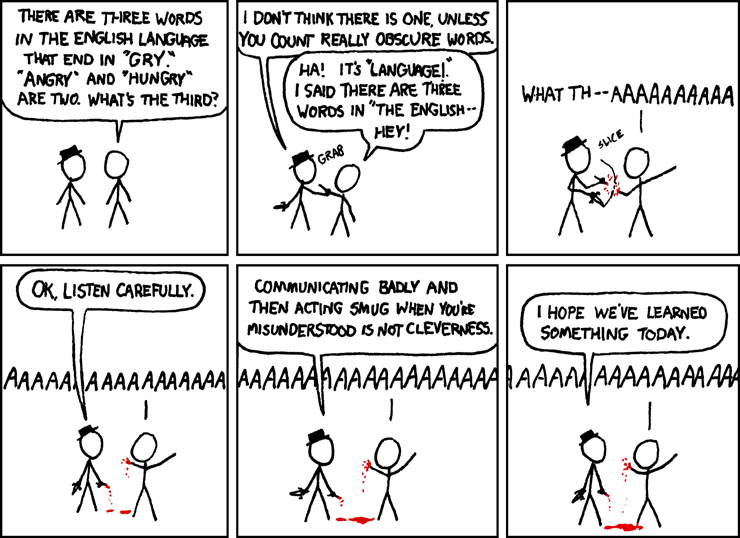
Kinda like this?

from xkcd: Words that End in GRY.


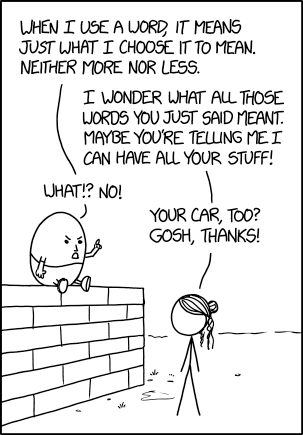
Although this one is also pretty on-point for this thread:

from xkcd: Communicating.

As written of course, Humpty was exactly the kind of intellectual battle royale prick we’re talking about.

In that case we start fresh,’ said Humpty Dumpty, ‘and it’s my turn to choose a subject—’ (‘He talks about it just as if it was a game!’ thought Alice.) ‘So here’s a question for you. How old did you say you were?’
Alice made a short calculation, and said ‘Seven years and six months.’
‘Wrong!’ Humpty Dumpty exclaimed triumphantly. ‘You never said a word like it!’
‘I though you meant “How old are you?”’ Alice explained.
‘If I’d meant that, I’d have said it,’ said Humpty Dumpty.

More from the passage quoted by Randall:

‘…There’s glory for you!’

I don’t know what you mean by “glory,”’ Alice said.

Humpty Dumpty smiled contemptuously. ‘Of course you don’t—till I tell you. I meant “there’s a nice knock-down argument for you!”’

‘But “glory” doesn’t mean “a nice knock-down argument,”’ Alice objected.

‘When I use a word,’ Humpty Dumpty said in rather a scornful tone, ‘it means just what I choose it to mean—neither more nor less.’

The funny part is that, if you squint just right, “glory” and “a nice knock-down argument” are at least somewhat in the same ballpark semantically: a “knock-down argument” is an undefeatable one, and “glory” can mean”success” or “victory” (as in “no guts, no glory”). It’s not as if Humpty said “there’s zinc for you!” or “there’s procrastination for you!”.

Sorry to have launched an xkcd side-track, fascinating though it is.


Back towards the OP, I wonder where the strict definer crowd fall on the “lumpers & splitters” spectrum. Lumpers favor combining distinguishable groups of items based on shared similarities. Conversely, splitters favor dividing common groups of items based on identifiable differences.

My own suspicion is “precision” mavens are actually extreme splitters. And in order to take a tool as blunt as English and use it as a micro-scalpel trying to separate the fly shit from pepper, they have to assume in far more sharp boundaries in meaning than words actually contain.


Many years ago I came up with an idea I called “LSLGuy’s Language Uncertainty Principle”, by analogy to Heisenberg’s famous principle of quantum mechanics. I’ve mentioned it here before, but not for years.

It states that language cannot be put under arbitrary magnification. There’s always a gray “diffraction fringe” around any attempt to nail down meaning to fully black or white. Zooming in past the point the fringe appears is folly; there’s not a more detailed there there to be found.

In short: language is fuzzy; get over it.

When I was younger, I had one of those faces that attracted rants; and I remember a very nerdy rant I got from some older dude on the streets of Olympia. For some reason he went off about Wittgenstein, and told me that Wittgenstein was famous for something very similar to what you’re describing. Using the word “chair” as an example, he claimed that Wittgenstein said there was no satisfactory definition of “chair” that included everything we’d call a chair and nothing we wouldn’t call a chair.

I’ve tried to look this up a few times, without success; but I find it a useful idea, especially to keep myself humble about definitions in particular and communication in general.

Good cite. Beyond the title I claim no originality for my thoughts there.

But it’s sometimes a useful tool to trot out when we see two posters starting to tit for tat about their mutual incomprehension of the meanings of each other’s words.

I’d like to probe this a little if you are willing. Where is your standard of purity coming from?