Mark Harmon was a star college football player before he starred in a few movies and now pulls down a little over half a million dollars per episode on television.
Donald Cook graduated from the University of Oregon before he was Jimmy Cagney’s straight-arrow brother in THE PUBLIC ENEMY. (“Yer hands ain’t so clean. Ya killed, and liked it. Ya didn’t get them medals fer holdin’ hands wit’ them Germans.”)
Sure, that was a supporting role, but it was a big one; he got noticed, and followed it up by getting second-billed to his leading lady in SAFE IN HELL and second-billed again in THE TRIAL OF VIVIENNE WARE, and again in THE CIRCUS QUEEN MURDER, and yet again in JENNIE GERHARDT – and then he started getting top billing in various mystery movies, in THE NINTH GUEST and MOTIVE FOR REVENGE and CONFIDENTIAL and so on; heck, he was top-billed as Ellery Queen in THE SPANISH CAPE MYSTERY.
Plenty of other top-billed roles, too – FURY IN THE JUNGLE and BEWARE OF LADIES and BLONDE RANSOM – and all before 1949.
Wiki says that Steve Cochran “graduated from the University of Wyoming in 1939” before he got work on Broadway and started fielding brink-of-stardom roles in the 1940s: he was third-billed to Robert Cummings and Michele Morgan, in THE CHASE; and he was third-billed to Chester Morris and Nina Foch in a BOSTON BLACKIE flick; and he was third-billed to Groucho Marx and Carmen Miranda in COPACABANA; and picking up that status in the 1940s is presumably why he got his first top-billed role when 1950 rolled around.
But what Wiki giveth, IMDB taketh away – or, at least, calls into question – by stating that, no, he actually dropped out of college “to give Hollywood a go.”
So I’ll instead mention that Cochrane was in THE BEST YEARS OF OUR LIVES, as was Hoagy Carmichael, who more conclusively stuck around long enough to earn himself a degree from Indiana University before – well, yes, passing the bar exam, but that’s not what made him famous; Heart And Soul and The Nearness Of You and Stardust and Georgia On My Mind, that got his name out there before he picked up his first Oscar nomination before the '40s were out.
(Same way he hosted THE HOAGY CARMICHAEL SHOW, broadcast as it was by CBS from '46 to '48. And like I’d said, he did a little acting, too: fifth-billed in Bogie and Bacall’s TO HAVE AND HAVE NOT; and fourth-billed, after Dana Andrews and Merle Oberon, in NIGHT SONG; heck, he even managed to get third-billed before the '40s were out; but, again, that wasn’t really his claim to fame, y’know?)
In the '50s, Robert Rockwell headlined his own TV show after Eve Arden won an Emmy for pursuing him in season after season of OUR MISS BROOKS; but before that, in the '40s, he was just a guy who’d picked up a master’s degree and top billing in a couple of films (THE RED MENACE and ALIAS THE CHAMP), explaining why he got top billing in a couple more (UNMASKED and TRIAL BY JURY) in 1950 before he moved on to all of that TV work I was just talking about. (And, of course, OUR MISS BROOKS was so huge on television that the movie version hit theaters in '56 – with Rockwell’s character finally proposing to Arden’s up there on the big screen.)
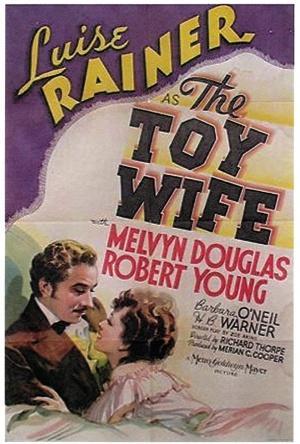
Barbara O’Neil graduated from Sarah Lawrence and then got all sorts of work in the '30s: after making her screen debut with STELLA DALLAS, she was billed third after Douglas Fairbanks Jr and Basil Rathbone in THE SUN NEVER SETS; and third again, after Rathbone and Boris Karloff, in TOWER OF LONDON; and third yet again, after Irene Dunne and Charles Boyer, in WHEN TOMORROW COMES; and even picking up second billing, as Edward G Robinson’s leading lady in I AM THE LAW.
Anyhow, after playing Scarlett O’Hara’s mom in GONE WITH THE WIND she earned an Oscar nomination for her role in 1940’s ALL THIS, AND HEAVEN TOO; and after that, O’Neil – well, yes, was still picking up name-on-the-poster work in Hollywood, sure, just like she did back when; but she was also busy on Broadway, acting with young Gregory Peck and younger Montgomery Clift and so on before 1950.
And, speaking of Oscar nominees who acted both on Broadway and with Vivien Leigh, University of Western Ontario grad Alexander Knox acted in a Broadway production with Leigh – she was Juliet, Olivier was Romeo; Knox, Friar Laurence – before he got top billing and an Oscar nomination playing Woodrow Wilson in WILSON, which in turn got an Oscar nomination for Best Picture.
Anyhow, WILSON came out in '44, and he followed that up by getting billed second to leading lady Irene Dunne in OVER 21 in '45, and then got billed second to leading lady Rosalind Russell in SISTER KENNY in '46 – and after returning to top-billed work in '47 with THE JUDGE STEPS OUT, in '48 he promptly got billed second to Susan Peters in THE SIGN OF THE RAM before getting billed second to Bogie in TOKYO JOE in '49.
Oh, and he was second-billed in NONE SHALL ESCAPE: one of those movies about a Nazi on trial for war crimes, sure – but one that came out during WWII, which made it a little more noteworthy. (He didn’t get an Oscar nomination for that one, but the screenplay did, because it was a downright interesting film.)
Students in my department are assessed by two written assignments for their autumn modules, and a written assessment + exam in their spring modules – the ‘single exam at the end of university model’ is long out of date. I’m not sure when my university dropped it, but it was at least a generation ago if not more.
Students do indeed get marks on their individual assignments and marks for their modules, ranging from first (equiv of an A) to fail.
Anyway, apologies for continuing the diversion; carry on.
It appears that some British universities still use a single test at the end of the last year to give students their overall assessment for their time at university. Look at this Wikipedia article. It says that at Oxford and Cambridge each student is given an assessment at the end of their time at university that tells anyone who asks how well they did, by saying that they got a 1, a 2.1, a 2.2, or a 3 degree (for Oxford) and a I, a II.I, a II.II, or a III degree (for Cambridge. Note that the article says that the class of the degree is determined strictly by the final exam at the end of university, even though there may be some earlier tests:
What university do you teach at?
In October last year, I had a long conversation with an Oxford graduate about the differences between American universities and British universities (and this conversation was while we were walking through the Oxford campus). She was astonished at some of the differences that I mentioned. She said that a professor doesn’t evaluate his own students. It’s done by someone else (or several other people) in the department. In American universities professors give grades for a single course strictly based on their own tests, etc. in their own courses. She was astonished by the notion that, if a student was having psychological problems, a decision that he should leave the university, at least for a while, wasn’t done by the student’s department or by his tutor. At an American university, there is almost always a counseling office with psychologists who will speak in confidence with students. Any decision that the student has problems which would cause them to leave the university temporarily or permanently would derive strictly from the counselor’s decision and can’t be discussed with anyone other than the student, including any professors the students has studied under.
Now it’s possible that this woman didn’t know much about how Oxford or British universities now work. She graduated quite a while ago. If what I just said is wrong, please inform me as to how British universities now work.
I hadn’t yet mentioned that, because – well, yes, you could argue that Rudy Bond qualified for this thread after he got just such a BA from Central High, as folks could then see him on Broadway in '47 and '48 and '49 with Marlon Brando and Karl Malden in that award-winning production of A STREETCAR NAMED DESIRE, which is why they all fielded their respective roles in the movie version in '51.
But I’m not sure that’s famous enough.
Anyhow, somebody else who acted in a production with Karl Malden in the '40s was Coleen Gray, who got a prominent “and introducing” credit right there on the poster for KISS OF DEATH; she was third-billed in that one, and after she was third-billed in a Tyrone Power movie promptly went on to get billed second as Victor Mature’s leading lady in FURY AT FURNACE CREEK in '48 before she was billed second to Mark Stevens in SAND in '49; she was then second-billed to William Holden in one 1950 picture, and second-billed to Bing Crosby in another, but that’s irrelevant.
What is relevant, though, is that before all of that she earned a BA from Hamline.
Tex McCrary was a Yale grad who, in the 1940s, hosted a radio show with his wife, actress Jinx Falkenburg, which soon got them hosting Bristol-Myers Tele-Varieties, also known as Jinx And Tex At Home, on Sundays on NBC in '47. (Aside from that TV work, they were of course also still on the radio in '47, doing Meet Tex And Jinx as a summer replacement for the crazy popular Duffy’s Tavern – which they did again in '48, before they started hosting the TV show Preview in '49.)
[del]Benjamin Franklin[/del] Howard Da Silva famously originated the role of Jud Fry in the '40s on Broadway in Oklahoma! after (a) fielding a dozen other roles on Broadway, and (b) picking up a college degree.
Da Silva also got plenty of prominent-placement-on-the-poster work in movies during the '40s; he was third-billed in Bullet Scars, and third-billed in Border Incident, and third after Cathy O’Donnell and Farley Granger in They Live By Night, and third after Gary Cooper and Paulette Goddard in Unconquered, and so on.
Da Silva wasn’t really leading-man material – though he did manage to get second billing, in the WWII flick Five Were Chosen – but the point is, he was all over the place; The Lost Weekend was of course Ray Milland’s vehicle all the way, but that was Da Silva’s name on yet another poster all the same; and that was his name again, as big as Alan Ladd’s, on the poster for The Great Gatsby; and his name, as big as William Holden’s or Sterling Hayden’s, on the poster for Blaze of Noon; you couldn’t really miss him, what with one high-profile role after another.
My dad told me that when he went from high school to college (in the 1950s), his grades dropped from straight A’s to straight C’s. College, back in the day, was hard. My GPA hardly flinched when I went from high school to college in 1983. By then, College had become a lot easier.
Kids these days, they don’t know how good they have it! <shakes fist>
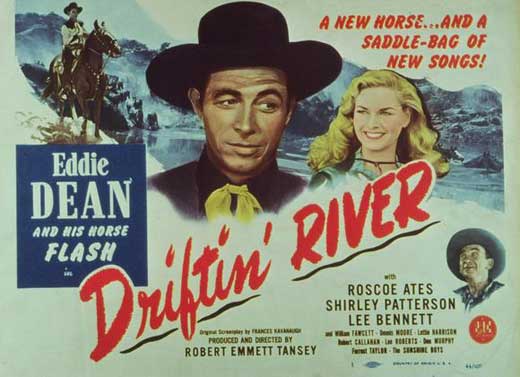
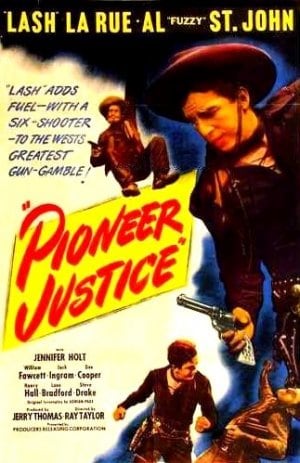
Switching gears entirely, consider William Fawcett – a WWI veteran who earned a PhD before becoming a professor of theater arts at Michigan State before deciding he’d try his luck in Hollywood. “He sought a part as a college professor but was turned down on the grounds that he did not fit the part.” Vowing not to let a little thing like ‘irony as she is cast’ stop him, he soon got name-on-the-poster billing in a western, followed by getting it again in this poster for another western, and then again in a poster for yet another western and then in the poster for another western before it was 1949 and suddenly there Fawcett’s name was on this here poster for the other type of riding-around-on-horseback movie: THE ADVENTURES OF SIR GALAHAD, where he scored third billing as Merlin – after second-billed Nelson Leigh as King Arthur and top-billed George Reeves as the title character, sure; but Fawcett’s name is just as big there as those of the others for a reason, y’know?
(At that, while the story of George Reeves is the story of Pasadena Junior College, Nelson Leigh was a USC grad who got top-billed as Paul of Tarsus in one movie and Jesus Christ in another, both before 1950, which seemed worth mentioning.)
After graduating Phi Beta Kappa from Indiana University, Catherine Craig had a pretty good run as a leading lady in Hollywood – she was second-billed to Richard Travis in SPY TRAIN, and she was second-billed to Richard Denning in SEVEN WERE SAVED, and she was second-billed to Albert Dekker in THE PRETENDER, and she was second-billed to John Calvert in APPOINTMENT WITH MURDER – and she otherwise spent the 1940s getting name-on-the-poster billing in a western with Randolph Scott and a musical with Bing Crosby and thus and such. (Plus, figure that Craig had an extra measure of fame due to, y’know, being married to Robert Preston.)
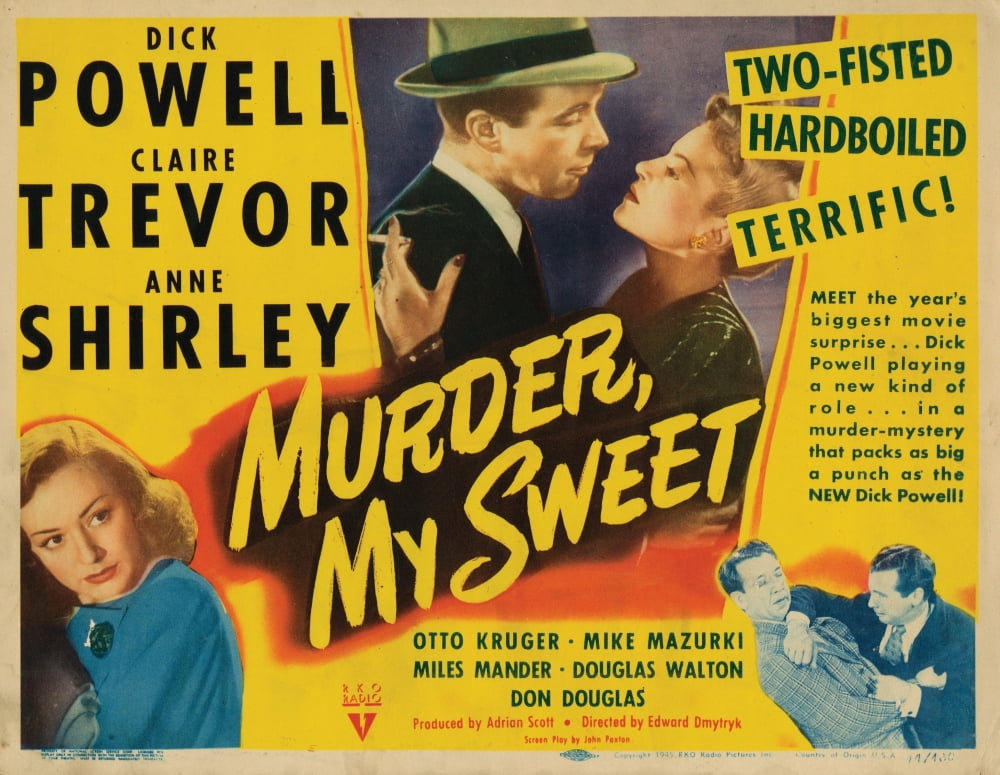
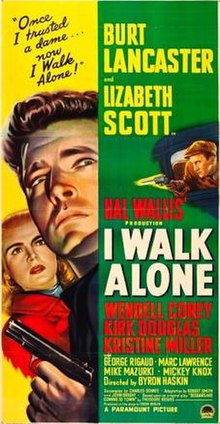
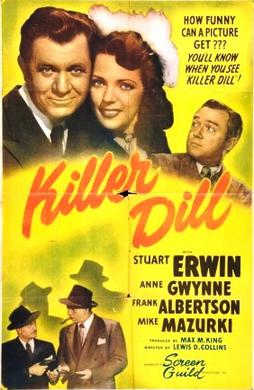
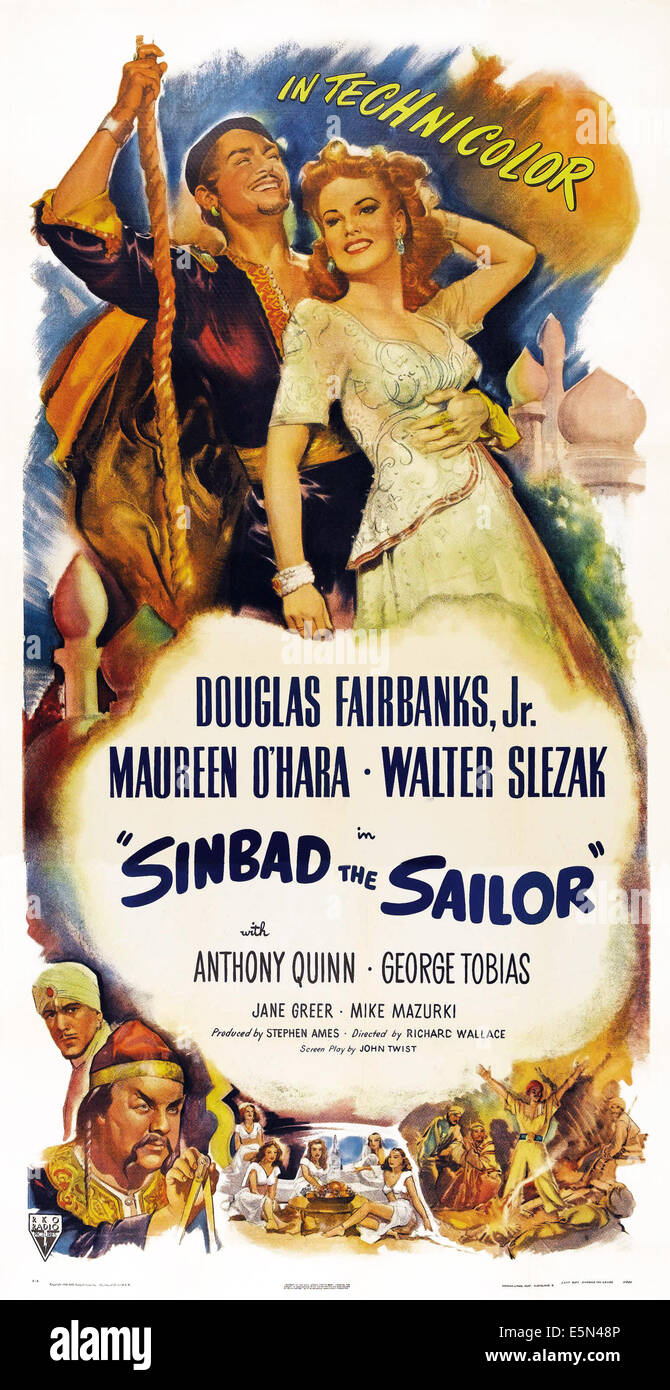
Someone else who got second-billed to Albert Dekker: Mike Mazurki, who got a BA from Manhattan College before getting prominent billing in THE FRENCH KEY. (In between, Mazurki was third-billed on the poster for DICK TRACY – which was pretty respectable, since the #1 and #2 spots were clearly set aside for the folks playing Dick Tracy and Tess Trueheart – and he got third billing in THE DEVIL’S HENCHMEN, too, along with tons of other name-on-the-poster work in the '40s: that was him in MURDER, MY SWEET with Dick Powell and I WALK ALONE with Burt Lancaster and KILLER DILL with Stu Erwin and SINBAD THE SAILOR with Douglas Fairbanks Jr and RELENTLESS with Robert Young and ABBOTT AND COSTELLO GO TO HOLLYWOOD.)
Incidentally, that DICK TRACY movie I just mentioned had Morgan Conway earning top billing in that title role before he got it again in DICK TRACY VS CUEBALL a year later; and, in between, he was second-billed as a crusading attorney opposite leading lady Bonita Granville in THE TRUTH ABOUT MURDER; and, per IMDB, “Columbia University graduate Conway, incidentally a founding member of the Screen Actors Guild,” picked up yet other name-on-the-movie-poster work in the 1940s.
Patricia Neal, of course, went on to spend the '40s winning a Tony on Broadway and getting second-billed to Ronald Reagan in one film and Gary Cooper in another; but that’s another story for another time; I just want to note that Martha Hyer spent the '40s getting prominent placement on the poster for this Tim Holt western and that Tim Holt western and another Tim Holt western – getting second-billed in that one instead of third – before it was the '50s and she picked up an Oscar nomination.
Shemp has to get married in 48 hours in order to inherit his uncle’s fortune? Okay, have McIntyre smack him around after kissing him in a mistaken-identity plot before a phone call straightens everything out – and put her name on the poster. You need an old woman who gets a Fountain-of-Youth treatment to win back her husband, who then overdoses on the stuff and becomes a baby? Yeah, that’ll be McIntyre – and bill her right after the Stooges. And bill her right after the Stooges as the lady who alibis 'em for a crime they didn’t commit, puts 'em to work at her café, and has 'em check out the spooky old mansion. And bill her right after the Stooges as the princess who loves a common blacksmith. And bill her right after the Stooges as the murderess (or IS she?) investigated by a trio of inept private eyes; bill her right after the Stooges if they’re sailors on the high seas, or plumbers foiling an art heist, or janitors who realize dat goil is a potential singing star, forever and ever, amen.
That’s not all she did in the '40s, of course; she was third-billed on the posters for three different Johnny ‘Mack’ Brown westerns, and second-billed on the posters for various Hugh Herbert comedies, and so on; heck, she was even getting third-billed for some name-on-the-poster acting and singing back in the '30s. But, man, did they ever love plastering her face and figure up there on posters where the alternative was just having people look at three guys who weren’t exactly matinee-idol handsome.
And after fielding Broadway roles in the '30s, she headed to Hollywood and started getting name-on-the-poster roles in the movies – in, well, JUST OFF BROADWAY, of course; and in CADET GIRL in 1941, and in SECRET AGENT OF JAPAN in 1942, and in SWING OUT THE BLUES in 1943, and so on – and then, in 1944, Carter started picking up second-billed-to-the-leading-man roles: in THE GHOST THAT WALKS ALONE, and again in GIRL IN THE CASE, and again in THE MARK OF THE WHISTLER; and, after more second-billed work in ONE MYSTERIOUS NIGHT, and THE MISSING JUROR, she was back for second-billed sequel work in, well, THE POWER OF THE WHISTLER.
Carter then went on to pick up second billing under leading man du jour Gerald Mohr, in THE NOTORIOUS LONE WOLF; and then she picked up second billing under leading man William Gargan in NIGHT EDITOR; and then she picked up second billing under leading man Glenn Ford, in FRAMED; and et cetera, throughout the '40s.
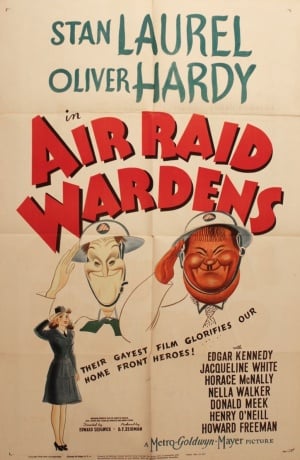
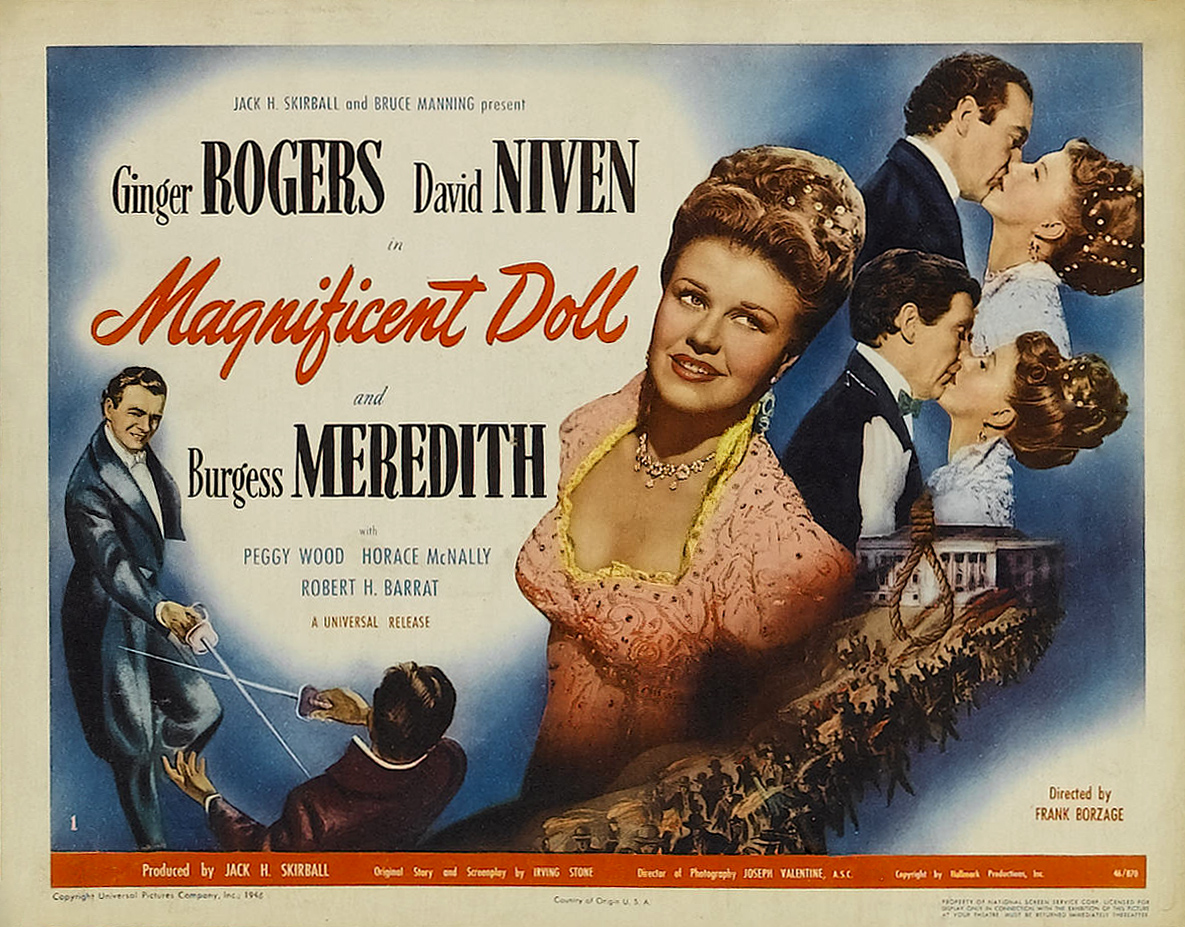
Possibly you’ve heard of him? I mean, he got name-on-the-poster work in assorted movies – like this one about a blind detective; or this one, with Laurel and Hardy; and this one, in glorious Technicolor; or this one, THIRTY SECONDS OVER TOKYO, starring Spencer Tracy; or this one, MAGNIFICENT DOLL, with an odd love triangle involving Ginger Rogers and David Niven and Burgess Meredith?
No?
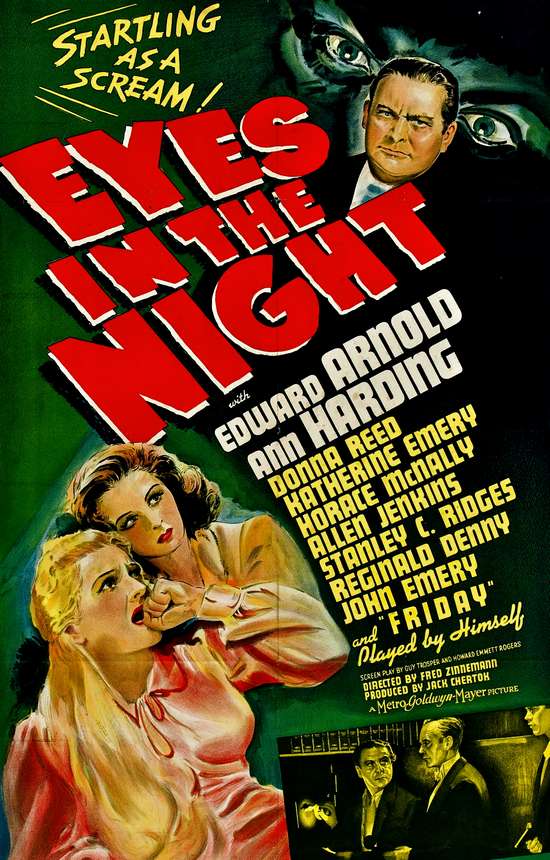
Well, who the hell ever heard of a movie star named Horace? So he swapped it for Stephen McNally on the poster when JOHNNY BELINDA got (a) the movie treatment, and (b) a dozen Oscar nominations. And so it’s Stephen McNally on the poster for ROGUES’ REGIMENT; and on the poster for CRISS CROSS, with Burt Lancaster; and on the poster for THE LADY GAMBLES, with Barbara Stanwyck; and on the poster for SWORD IN THE DESERT, with Dana Andrews; and what with those prominent third-billed roles I was just yammering on about, he even managed to score top billing in CITY ACROSS THE RIVER in 1949, as per this poster right here.
(See how that poster also mentions young Tony Curtis? Yeah, back then he was still getting billed as “Anthony Curtis”. I mean, yes, sure, he’d of course moved on from “Bernard Schwartz” – but he still wasn’t quite getting it right.)