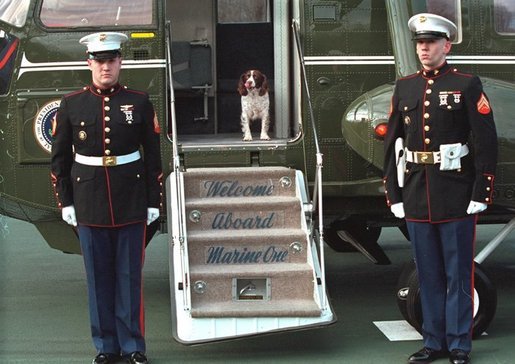
Shortly after Trump’s inauguration last week, the Obamas walked out the other side of the Capitol building and boarded the Marine One helicopter.
I know it wasn’t technically Marine One since Obama wasn’t president any more, but you know exactly which helicopter I’m talking about - and besides, the boarding stairs are very clearly labeled “Welcome Aboard Marine One”.
In the minutes before they boarded, the whine of a gas turbine engine could clearly be heard in the background, although the main rotor wasn’t spinning. I thought maybe this was an APU or something to keep the lights and heat on in the helicopter until the Obamas boarded. But then something subtle and interesting happened: with no change in sound, the main rotor suddenly began accelerating. The “suddenly” is significant here: it was analogous to a plane spooling its engines up to full power and then releasing the brakes (as opposed to “brakes off first and then firewall the throttle”, which results in a gradual buildup of acceleration). If Marine One’s engine was just starting up, I would have expected the main rotor to begin gently accelerating at first.
So is there some kind of main-rotor brake on that helicopter? Or some kind of duct that can be opened to let engine exhaust bypass the power extraction turbine? Is this feature unique to VIP transport helicopters (so that you can keep the interior warm and spin the main rotor up quickly without blowing everyone around as they approach to board)?
Helicopter turbine engines have two coaxial shafts. The compressor section spins on one, and the turbines and output shaft spin on an other. The starter spins the compressor, pumping air through the combustion chamber and out through the turbine blades. The starter by itself doesn’t move enough air to spin the turbine. The compressor has to come up to speed before the engine is “lit off”. Once you hit about 13%np (more or less) fuel is injected and the igniters are lit. As the fuel burns the expanding gasses start driving the turbine and the output shaft. It takes a bit to come up to speed. As the turbine spins up, the rotors follow.
Starting a helicopter turbine sounds like an ascending whine for a few seconds, than a foop of ignition then a build up to typical exhaust roar and then rotor sound.
The rotor brake holds the rotors and transmission all the way back to the turbine section, but I doubt it can hold back against engine power. Maybe some can. It’s really used to stop the rotors quickly at shutdown.
So how to explain what I saw and heard? Here’s the video; the main/tail rotors begin briskly accelerating at 6:38, like flipping the switch on a ceiling fan, with no perceptible change in sound.
I heard a sound change about a minute later around 7:40. What came to mind was during the shuttle launches when CapCom would say, “Go with throttle up.”
I think what you are hearing the whole time is the APU. It is also a turbine, but a small one. It powers the electronics and the starter. They are pretty loud and annoying sounding. Once everyone is on board, the main engines are started. The spool up of the rotors seems about right to me.
At 7:24 the sound changes as the pilot does something - this could be shutting down the APU.
I think that’s just an artifact of the video. It sped up. You can really hear the tail rotor’s burr sound as the speed comes up.
You can hear the engines go from idle to fly at 7:40. Note that idle is like 60% nominal engine speed - it is still pretty fast.
Fun fact about turbines - even at 100%, on the ground, they aren’t producing a lot of HP. With no load, the engine is just spinning the rotors. Once you pull power on the collective, then things start happening.
Just a few more details on that specific type of helicopter, VH-3D. There is an APU, small gas turbine powered generator, in the teardrop fairing above the starboard side landing gear sponson. However the sound on TV was probably the main engines. They are started by electric motors inside the bulbous fairings you see in the center of the engine air intake inlets. Those spin up the ‘gas generator’ portion of the engine, consisting of the compressor and turbine stages which turn the compressor, mechanically separate from the power turbine stages which turn the rotor, as already mentioned.
On the S-3 though the No. 1 (port or left side) engine can be run in ‘accessory drive position’ where its power turbine is also disconnected from gear box, as would be typical when starting it. Once it is started, the APU is turned off and the generator of that engine used to start the No.2 engine. There is a rotor brake, as there usually is for helicopters designed for shipboard operation, but it can only hold the power turbines still at ground idle power. The rotor is engaged by accelerating the No.2 engine past ground idle while releasing the rotor brake. The No.1 engine is shifted to ‘flight position’, connected to the gearbox, when the No.2’s power turbine, and the rotor, reach full speed. An overrunning clutch prevents the rotor driving back through the power turbines, and the No.1 is smoothly brought up to speed.
IOW it’s just one of the engines (No.2) doing the initial accelerating of the rotor, but it’s still pretty fast, as seen on TV. As to the sounds, I assume the perceived changes are mainly from the gas generator speed, which doesn’t increase that much from rotor still to rotor full speed but at zero pitch. The power turbine is going from zero to full, but that’s probably not much of the sound you perceive. The No.2 engine is operating between 40-60% of rated torque as it accelerates the rotor.
Details of start procedure can be seen in chapter 7 of this flight manual for the similar UH-3H
Yes, there is a rotor brake on both the VH-3D and the VH-60N, and there is a rotor brake on the VH-92 that will eventually replace both of them. Not unique to VIP at all; all Navy & Marine Corps helicopters (to include the MV-22 Osprey) have them. Plenty of civilian helicopters have rotor brakes as well. Here’s what the rotor brake looks like on a Sikorsky (Erickson) S-64 Skycrane; it’s the disc in the lower left corner of the pic.
The VH-3D does have an APU - it’s the pod on top of the right sponson with the upturned exhaust duct. The H-3 series helicopters (civilian S-61) that the VH-3D is based on didn’t have an APU, so they had to graft one on. I think the VH-3D APU only supplies hydraulic and electrical power, but I’m not 100% sure on that. I do know HMX-1, the squadron that owns the VH-xx helicopters and is responsible for the Marine One mission, among other things, has several portable combustion heaters (basically thesewith a paint scheme similar to the helicopters, on a 4-wheeled cart that can be pulled like a kid’s wagon), but I don’t know if those are used during the onload of a VIP lift, or just for preheating the aircraft before the VIP arrives.
EDIT: Wow, 3hrs of Facetime with the family put me way behind on this; when I opened this post, there were zero responses.
I’ll watch the video as soon as it finishes loading, and see what’s going on.
OK, I watched the video several times, and took notes:
[ul]
[li]The APU was definitely running from the start of the video.[/li][li]The rotor brake was released at 6:36, and watching the acceleration rate, there was definitely an engine at idle prior to that (we call that a “locked start”, where the rotor brake is on, and at least one engine is at idle).[/li][li]The engine at idle was #2 (right side). There’s no way DJT, BHO, and the others would have been able to have a normal-looking (i.e. not shouting at each other) conversation if #1 was at idle - the engine inlet is right above their heads, and the exhaust duct points straight out, not up or back. There was also no heat plume visible (at least, not at 360p resolution; my bandwidth won’t support higher than 480p in my location) from #1.[/li][li]Acceleration to 100% Nr was from ~7:00 to 7:10. The Carson main rotor blades are extremely quiet; the rotor sound you’re mostly hearing is the standard H-3/S-61 tail rotor sound, which easily overpowers the Carson main rotor sound.[/li][li]At ~7:24, both pilots (and, briefly, the crewchief) have hands in the cockpit overhead, at the top of the windscreens. This is where the engine speed control levers (and the engine start buttons) are located.[/li][li]At ~7:37, there was definitely a change in the turbine noise. It’s been 15 years since I was near a running S-61, but I do believe, based on seeing the hands near the SCLs at 7:28 and the transient change in rotor speed, what we’re seeing and hearing is the #1 engine being brought up to speed to share the load with #2.[/li][li]At 8:14 the pilot began pulling collective to lift, and from 8:16 to liftoff at 8:22, you can really hear the #2 gas generator spooling up to keep the power turbine at a steady speed as the rotor loads up. #1 is doing the same thing, but since #2 is pointing nearly right at the camera, #2 is mostly what you’re hearing. That C-SPAN microphone really picked up the high frequencies well.[/li][/ul]
Yes… I’m a professional helicopter geek.
I figured that from the pitch I was hearing, about 110 Hz. For a five-bladed rotor, that works out to 1320 RPM - way too fast for a main rotor, but in the right range for a tail rotor.
Great, glad to have you here. In my OP I was mostly curious about the existence of a rotor brake, something I had never considered before - but I appreciate all the extra detail you’ve provided in your posts.