Not wanting to wander even further off topic, there’s much anxiety over what will be entailed in the planned repairs/overhaul to the Houses of Parliament in London. Any project of that size is bound to take twice as long and cost who knows how much more than estimated.
A recent update on where they’ve got to:
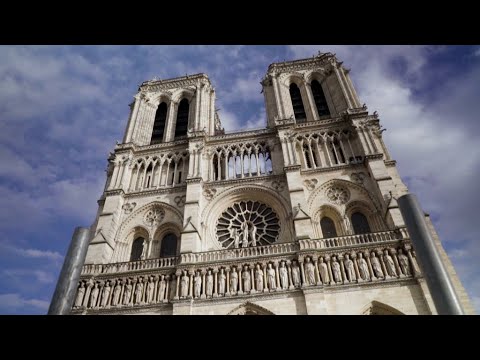
As it happens I was walking past there about half an hour ago. There’s a photographic display on hoardings around the Cathedral, outlining all the work to be done - now a bit overtaken by events, but it makes clear the meticulous nature of examining and understanding the debris for what it tells the experts about the needed restoration (plus the archaeological work now made possible).
I recall a visit, I think it was Salisbury cathedral - the stonework shop around back had a giant saw to handle large blocks of limestone. They did use hand carving for certain details, but were not averse to using power tools. The goal was to repair the crumbling pieces - where absolutely necessary - with the same materials, not to replicate the building process. (Presumably they used modern cranes too, not a giant hamster wheel, when necessary.) If the hidden/buried part of the stone had circular saw marks, who cared? But if it was limestone, it stayed limestone; if it was solid oak, it was replaced with solid oak. If it was a hand-carved gargoyle, it was replaced with a power tool and hand-carved gargoyle.
I presume with heritage buildings, this extends to not using say, modern glues or modern nails and screws, if the goal is to preserve the original character.
If they want me to donate, they could easily find out and respond to my question. I’m sure I’m not the only American wondering.
It is none of my business. I wish the project nothing but success.
That said, it seems we have wasted a wonderful opportunity to add our generation’s touch to this cathedral. Modern steel beams instead of recreating the “forest” in the ceiling. Why not allow tourists to go up the spire?
The building we all grew up with and learned to love has always been modified over the centuries. It seems wrong to blow the whistle at this point in history and freeze the design.
There is a balance to be struck.
The Cutty Sark is a good example. The ship had been resting on its keel in a dry dock since the 50s, which was distorting the whole frame. After a fairly disastrous fire, it has been completely restored.
Steel supports have been added and some alterations previously made, restored.
The steelwork enables this famous ship to be preserved and, importantly, to be viewed internally and externally from below the hull.
The inclined steel struts support the ship, and the timber and refurbished iron members and internal steels maintain the hull’s original shape. The steelwork has been very carefully and sensitively detailed by the use of extensive 3D [modelling]
Ingenious steelwork is key to this remarkable visitor attraction.
Eventually there is no right answer. Entropy requires no maintenance. It gets you in the end.
A building becomes a Ship of Theseus.
Speaking of which, a truly fabulous YouTube series that has been running for a few years now is the rebuilding of a century old sailing boat the Tally Ho. Highly recommend for many reasons although it is well into 100 videos now. The philosophical problem there is faced front and centre.
Yes, and it’s quite something to sit in the café in the space vacated by lifting the Cutty Sark - with 1000 tons of ship over your head.
But Notre Dame is a very different case, in terms of its significance in church and national life. I can understand why it was decided to revert to as close as possible to what it was, but spruced up and made safe.
A closer comparator would be the repairs to the Houses of Parliament at Westminster, still hugely argued over while it gently leaks and crumbles.
There’s an interesting CGI-driven exhibit about the construction, evolution and current repair of Notre-Dame, now open at the National Building Museum in Washington.
To me it’s simple. A building is the meeting point of two separate and sometimes opposing disciplines: architecture and engineering.
Architecture is art, and important art should be preserved for future generations, unchanged. Engineering, though, is science, and there’s no room for sentiment in science. If a better method is discovered, you use it.
So if you want to restore a building, you should do the utmost to restore its original form and appearance. Its internal mechanisms, though - the parts you don’t see - should be updated, because it’s the logical thing to do.
It sort of works itself out, in that if they built the structure to last 5000 years in the first place, it will not require that much extensive “updating” and re-engineering, at least not quickly. And if they built something that is falling apart after 50 years, there will not be much choice.
A building has no “original form.” It has been changed since before it was built. You could restore it to some past date, or perhaps to one day before or after that date. But none of those would be the original plan.
We have buildings to meet our needs. We need not be enslaved by the decisions made by our grandfathers. After all, they themselves were not shackled to the plans of their grandfathers.
I, for one, am definitely in favor of making doorways taller. I don’t care if the designers were Ewoks.
French cathedrals are a great example of how the idea of an ‘original’ concept is nonsensical. There are plenty of them that required decades (or centuries in some notable cases) to ‘complete’, by which we mean somebody said “ok, we’ll just say we’re done now”.
The ‘original’ version for many of them feature vastly different architectural styles. Even the restoration of Notre-Dame is not to its ‘original’ form (whatever that would mean) but to something very close to how it was restored in the 19th century.
The 2018 church is a known quantity as a national monument, national symbol and tourist attraction. And, I guess, as a cathedral in the religious sense. I think rebuilding it as it was in 2018, with the same materials (maybe skip the lead roof) is the easiest, least controversial solution.
If they rebuilt using steel trusses instead of multi-century oak beams, it would work but the story would be less cool, and the continuity from the 13th century would be somewhat broken.
If they called up Foster & Partners to design a modern glass-and-steel building somehow integrating the old cathedral, it would attract much more controversy. The building would become a different entity altogether, more of a museum than a church, and run the risk of being less popular than the cathedral, especially as the concept ages and starts looking like an old shopping mall by 2072.
I dunno, the Eiffel tower did okay.
I think they should have kept the stone exterior, but replaced the “forest” with some good steel beams. But hey, it’s not up to me.
An example of a more recent building reworked (although not after a fire) is the Musée d’Orsey. Once a train station from the era of grand central stations it is now an art museum. Personally I find it a trifle bland and soulless. Very much a renovation of its time. It is a good example of how some architects think about clean sheet reworking of a building into a modern world.
Use of wood rather than steel in the Notre-Dame is perhaps a question of form versus history. There are a whole raft of intangible reasons to swap the building form one of utility, being a place of worship, to a historical entity. One might argue that we have simply seen the transition occur.
Lots of things seem to make this transition. Objects have utility, and are maintained for this utility. Often times they wear out and are replaced. Those that survive are eventually recognised for their intrinsic historical value. Then maintenance takes on a different form.
In the extreme the Parthenon could be easily rebuilt with reinforced concrete. Nobody suggests this.
Nitpick: it’s the Musée d’Orsay. And some really like it: https://theculturetrip.com/europe/france/paris/articles/the-musee-dorsay-is-officially-the-best-museum-in-the-world/
The Musée d’Orsay makes for a less-than-straightforward comparison.
No one thought that the building could continue being used for its original function. The replacement station had already been built. Given that, there were only two options – demolition or radical conversion. And the demolition option had been a real possibility. Those who wanted to save the building knew that it would have to be converted to a completely different purpose. Turning it into an art museum was actually the most conservative solution.
Moreover, the general response of architectural critics to Gae Aulenti’s design was and remains merely lukewarm. The standard criticism from the cognoscenti has been that her scheme was not daring enough. Plenty of other high-profile museum projects have sharply divided opinion. That is often the intention. The Musée d’Orsay is the odd contrasting case, as it has instead tended not to attract strong opinions either way. For some, that is a good thing, for others, a failure. Shouldn’t such a major museum have been a major piece of architecture? Of course, everyone thinks that the collections are amazing.
Which they are. But the building now? Meh. It neither celebrates the architectural heritage of the original nor creates its own. It could have been so much more.
Perhaps this is the danger. Not every major makeover is going to be a masterpiece. If you don’t have to, don’t mess with success.