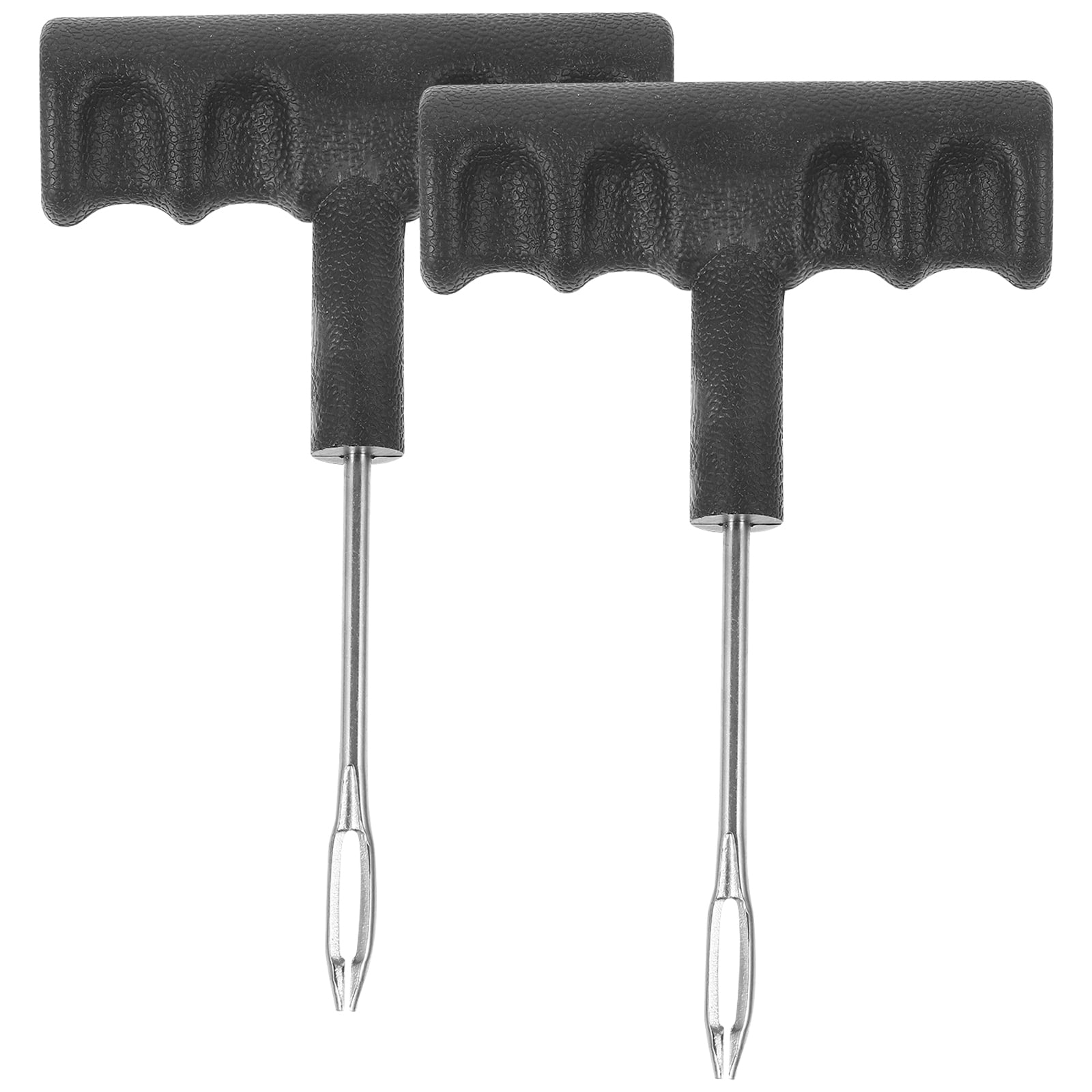
I picked up a nail and want to plug this. The tire is new, with 1,000 miles. What plug kit / repair kit can you recommend?
Links appreciated.
Thanks!


I picked up a nail and want to plug this. The tire is new, with 1,000 miles. What plug kit / repair kit can you recommend?
Links appreciated.
Thanks!
Remove tire, patch from the inside. I don’t think I’d trust a plug on a motorcycle. The Jeep, sure. But not a bike.
I think it’s worth trying, if even just for a quick temporary fix just to get back on the road quickly. Then, soon after, I can replace the tire. But also, a plug might hold for a long time. Possibly.
Yeah.
I worked in a garage for a little while after the army. We used plugs, and if they didn’t leaks, charged people $10, and sent them on their way. I still plug my tires. If they leak, then you need to patch.
That nail is pretty centered, and in the high part of the tread, which looks thick. Those are all good signs for plugging. If you want to plug it and just see what happens, try it, but I say this not knowing that much about motorcycles.
There is no particular brand of plug that works better, but there are two types that you will see: black, and reddish-brown. The reddish-brown ones are WAY superior. Buy that kind. Also, buy the installation T-tool, first of all, that IS a T, not one that looks like a screwdriver handle, and that has a slit right through the head, not to the side, for releasing the plug.
Make sure you have needle-nosed pliers to get an embedded nail out, and side-cuts to snip off the bit of plug outside the tire, if there is any. Also, get a jar of rubber cement (any brand) to use as lubricant. Really do.
Carrying this as an emergency kit for a nail you pick up on the road is a good idea, I think, even if you drive it straight to a shop to get it patched. It keeps you from having to call for assistance, and takes about 5 minutes to install.
I’ve installed plenty of plugs in car tires (though perhaps not as many as @RivkahChaya  ).
).
Here are some instructions. And there’s undoubtedly countless YT videos on it.
I’ve never liked the reamer tool, though. I always use a drill & drill bit, where the latter has the same diameter as the reamer tool.
I’ve also never plugged a motorcycle tire. Other than the obvious size difference, I’m not sure what (if any) differences there are between a motorcycle tire and car tire, or even if it’s advisable to plug a motorcycle tire.
It is recommended by motorcycle riders who want to be able to plug a tubeless tyre on the side of the road in a few minutes, without having to take it off. At least you will get home.
If you plan on plugging it and monitoring it for leaks, this could be a good excuse for buying one of these:
It’s been a number of years since I rode motorcycles or wrenched on cars. But the failure modes for plugs haven’t much changed since Ye Olden Tymes.
One possible failure is the plug doesn’t quite seal and you still have a slow (like hours to flat) leak, but probably slower than the leak from the screw or whatever you removed. Car or motorcycle, that’s not going to be a disaster unless you’re riding real hard and paying no attention to the slowly deteriorating handling. IME a bike with a low tire feels very obviously squirrely when riding. So pay attention to handling, ride conservatively, and get home as you can. If it isn’t slow leaking after a day or two of sitting, it probably never will.
The other failure mode is the plug blowing out entire, leaving the reamed hole behind. That leads to a deflation over a minute or few. It’s real hard to ignore that. Again careful aware riding well back from the performance limits of your tire will get you safely to the roadside again if that happens. And by and large if that doesn’t happen in the first hour, it won’t ever.
IMO, and based on scant actual plug failure experience, cutting off the plug tails as short as reasonable is better than skipping that step and leaving the long tails hanging out. If you happen to need hard or panic braking while the long tails are out and not yet worn away, they might be the thing that drags the plug the rest of the way out. A tiny risk statistically speaking, but if you do have side cutters, it’s a risk that’s just one or two snips to mitigate. Just don’t be pulling the plug out yourself while getting a grip on those tails.
My personal bottom line is that a plug failure on a bike is a bigger deal than on a car. But it’s not like a plug failure on a bike guarantees a crash. It just guarantees yet another unscheduled stop.
Good info here, thank you for the tips, especially @RivkahChaya. I carry a multi tool and also a knife on me so I’ll have them to pull out the nail and to cut the plug end. I’m looking for a temporary fix that would get me going and back on the road, not for a long term permanent fix. But a plug might last a pretty long time. It’s worth a shot. As @DPRK said, at least I’ll get home. And that TPMS system is worth a look too, @Son_of_a_Rich.
A couple of comments on this:
The first is that you can find even a pretty slow leak with a spray bottle of soapy water or something like Windex (or the cheaper generic thereof), albeit, I don’t know the logistics of carrying even a small one on a motorcycle. But anyway, you spray around the plug and wait for bubbles.
Second, if you were to spray around an embedded nail like the one in the picture, and not get bubbles, because it was in that tightly, I still wouldn’t drive on it, because it’s rigid, and the movement of the tire could dislodge it enough to start a slow, or even fast leak. That won’t happen with a flexible plug.
Third, I have run on plugged tires for more than a year. Probably could more than that, but if a tire still under warranty picks up a nail, I take it in for replacement. A tire out of warranty rarely has more than a year left on it, and frankly, in my opinion, isn’t worth taking in to have patched, because if you are paying for dismount and mount, plus balance, you might as well get a new tire. You are just going to be paying that again in a year for the new one you need anyway.
Fourth, for people taking this advice for cars, keep an inflator in your car that hooks up to the 12V power outlet (formerly known as “cigarette lighter”). These cost about $25, maybe (I paid $15 for mine at Walmart about 20 years ago, but now they have a few extras, like being able to set the stop point). I have limped many a slow leak to my next paycheck with them. If it’s a leak that needs to be filled something like once a week, they are great.
They are also great for when you pick up a nail on your way to work, and come out at the end of the day to a flat tire. If you also have the plug kit and spray bottle, you have a few choices, besides changing the tire.
You can pump it up, and spray around the nail to see how fast it is leaking, while Googling the nearest tire place, and calculate your chances of getting there before it is flat again.
You can pump it up, plug it, and possibly forget about it.
You can pump it up, plug it, and when you have time, drive it to a tire place.
I don’t personally hate changing tires, though, if it isn’t raining, and it’s a good thing to know how to do, because a tire that genuinely cannot be fixed doesn’t put you off the road: you take it off & put on the spare; the next morning, you leave a little early, drop just the tire and wheel of at a mechanics’, drive to work, and pick it up after work. If you call to say you are coming, they will probably be ready to put the tire right on for you using a floor jack, so you don’t have to wait for an open bay.
Just remember-- every time you air up your tires-- that you have 5, not 4.
What is this “spare” of which you speak, oh master maven of motorized mobile machine maintenance?
It’s been about 15 years since I owned a car that had a spare tire. Or the provisions for storing one. They’re getting to be kinda rare on many types of vehicles. Not all of course, but many.
Other than that, 100% agreement with all you’ve said. I’ve sure done the “top up once a week” trick for a month waiting to get to the date I can do without the car for a full day.
@RivkahChaya good advice and guidance.
FYI I like to go overlanding in my SUV. It has a full size AT tire on a back rack. But when I go to very remote destinations I actually take a second full size spare with me. That goes on the roof. Because when you’re out in the boonies, 100 miles from services, if you have to mount your only spare you’re continuing on with a thin margin.
On the motorcycle I’m preparing to do some Iron Butt rides (➜ https://ironbutt.org/rides■) and if I get a flat I plan to plug it and continue on — as long as it’s ‘plugable’, e.g. not sidewall, etc). I’ve done some of those rides in the past but I never submitted the documentation for them. I just wanted to see if I could do it. But now that I’m 64, 65 in 3 months, my riding years are winding down. I’d like to have the certificate to hang on my garage wall.
Out in the boonies for sure 2 spares is the minimum sane number
Lotta ordinary cars in ordinary cities simply don’t have spares. They’re a largely obsolete idea. Whether the car buyers agree or not, the manufacturers have decided.
Can you elaborate on that just a bit? Like, what’s the “modern” alternative? Run-flat tires have their own issues.
One alternative for me has been to always carry around a 12V powered air compressor, which is great for relatively slow leaks which are the most common kind, but useless for disastrous leaks. Which are admittedly very rare but I did have one a few years ago. And 5 or 7 years before that, I had a full-fledged blowout on an expressway – on a front tire – which was quite the adventure! Lots of fun when you’re doing around 70 and the car suddenly violently pulls to the right. Even more fun when you’re in the middle of a fucking construction zone and there are no shoulders to pull off on!
I honestly don’t even know if the current car has a spare. If it does, the spare and the jack will be underneath the nicely carpeted trunk. I must have a look or consult my old Mexican friend, Manuel!
Many modern cars include a small compressor & a one-time use cartridge of slime to seal any puncture from the inside.
No jack, no spare, no lug wrench. Just a baby compressor & slime cart. Saves space, weight, mpg, & money. Manufacturers love all that.
Most drivers go decades between flats. It works fine for them.
And sometimes it even works!
Before my current car, my last 3 had the doughnut spares. Current car is a Leaf, which came with the Fix-a-Flat, but that stuff stinks as much as it literally stinks.
For most of my previous cars with the doughnuts, I bought full-sized spares by getting a junkyard wheel, and putting a used tire with about 5-10,000 miles left on it. For my Chevy Spark, it was a new model, and not enough in junkyards, but it was a 13" wheel, and a new one was about $125.
On more than one occasion, I have had a flat on a trip, and put on the spare before getting on the highway and going home, if there was not time to replace it before getting to my next destination.
I still had to doughnut too, just in case. When I was at home driving around town, I might not carry the full-sized spare in favor of the doughnut-- except since I moved to Indy, where there are many occasions in a day to drive (legally) over 50mph (doughnuts usually say “under 50 miles; under 50mph.”)
I’ve had actual blow-outs. They happen.
None pissed me off quite as much as the one on my Leaf, though. Fix-a-flat won’t limp a blow-out to the nearest garage, and the tire was under warranty, so I needed a Nissan dealership, not any garage.
The reason I had not procured a full-sized spare was not lack of trying. The model is too new, but I was looking, and had had the car all of three months when I drove over a new overpass/former construction site.
New wheels for this car were $425.
The replacement tire was free, but I lost a day’s pay (chose over using personal time, for reasons).
A few months later, I slid on debris from a previous accident, and whammed into the curb. Damaged tire and wheel. The wheel was insurance-replaced, but was good enough for a spare-- getting the insurance company to sell it back to me was a ton of paperwork, and at first they wanted to charge me more than the payout for it. I had to get a letter from the dealer stating that my interest in it as a spare did not indicate resale value on the open market. Included pictures.
Haven’t used it as a spare yet, but it was able to be balanced, and does not leak at the bead, so it has to be better than Fix-a-Flat.
I’ve been in quasi-similar situations and when there, I’ll flat-out lie and say something like, Oh, I’m not going to mount it on my car, I’m going to incorporate it in my artwork and turn it into a coffee table. Or some such story.
Specific cases when I lie is sometimes, not often, is when I rent a trailer from UHaul (which I often do). I’ve only done this maybe 2-3x in 30 years and I’ve rented their trailers maybe 40-50x over the years — sometimes I need a larger trailer to haul something that’s large but not heavy. I tend to own smaller cars, not full size pickups or SUVs, and they’re not rated to tow the larger trailers. But I need the size capacity not the weight capacity. I have a good understanding of physics and momentum and dynamics and Newtonian mechanics, yadda yadda yadda, and I understand how one can quickly get into trouble if hauling something too heavy for the tow vehicle, and not because I’ve gotten into trouble. For example I used to own a 2001 Honda CR-V, for instance, and I’d tell UHaul that it is a Honda Passport, a larger SUV.
Once when the UHaul guy was connecting the larger trailer he said, Hey, this isn’t a Passport, this is a CR-V. I explained what I needed and he still hesitated. So I then said, Hey, the customer is telling you that he drives a Passport, and not every UHaul employee knows which car is which, so that takes you off the hook, right? You’re not expected to know what every vehicle is, right? He connected the trailer and I was on my way. In that instance I needed to haul a large entertainment system cabinet (empty), so it was big but not heavy. And I did just fine.
But the UHaul trailers are built like tanks, and even when empty they are heavy, so you have to be careful. You can almost always control how quickly you need to accelerate, but you have less control over how quickly you might need to brake. So you allow for that and keep a big cushion of space around you as you go.
We live in a world where people do something stupid and make mistakes, then get into an accident, and then they lawyer up and find somebody else to blame and sue for their own stupidity. I make it clear, verbally, that I take full responsibility for my actions, and that helps when having those discussions. But it’s no guarantee and it’s still a risk for the UHaul guys. But I try my best to give them plausible deniability.
Anyway, I digress!
Good advice, and I’d like to add: If you drive a really large vehicle, test run your inflator by simulating it’s use at each tire. Don’t be like me, who discovered the cord wouldn’t reach from the outlet to my rear tires.
Referring to spares:
I wonder if part of the reason is increased urbanization. I get a flat every year or so, but usually somewhere it’s safe to change. A flat on the busy freeways in the DFW area would be too dangerous to repair myself. I’d have to call a tow truck even though I carry full-sized spares.
Tires are much better these days; much stronger.
This sounds like a very high frequency! I drive 20,000 - 25,000 miles a year and haven’t had a flat tire in over 13 years. And I do a fair amount of serious offloading, including onto sharp desert rocks, and some bad cactus thorns.