That’s what she said! :p:D
The risk is already pretty low, and decreasing. (Tamper-resistant outlets reduce the likelihood by 50%, GFCI outlets effectively to 0% – they cut out before injury.)
About 7 people per day are injured (mostly minor burns on the fingers), and only about once per 11-12 days does someone die. 90% of those injured are toddlers (under age 4); the rest are mainly construction workers. And they are more likely to be the fatalities than the children.
To put this into context, about 800 children per day are injured from abuse by their own parents; about 5 per day die.
And those switches are mounted higher up on walls, generally out of the reach of toddler children. The British switches are right next to the receptacle. I don’t think it would take too long for a toddler to learn that ‘Mommy always turns this switch on before using the Hoover’, and so to imitate and turn that switch on while he is playing with sticking a fork into the outlet. So I’d think it would be nearly as risky in the UK.
Nope, UK wall outlets have been tamper-resistant for decades, AFAIK. Appliance plugs have a ground pin that’s much longer than the other two, which opens up the receptacle when inserted. Which means, of course, that the wall switches don’t solve a play-with-outlet problem, but they may solve some other problems with simple, somewhat dangerous-to-toddlers appliances such as lamps and toasters being on 240 V AC.
Turning off the ignition with a key and then physically removing it is a more unique and memorable movement than pushing a button. We push many buttons in cars for various purposes. We only insert and remove a key to access electric power and to start and stop the engine. That’s what I mean by mechanical certainty. There is a tactile and visual component to the action.
Airplane controls are designed with this sort of ergonomics in mind. Landing gear controls usually have one job and they are shaped like a wheel. Flap controls are shaped like an airfoil. There is unique tactile feedback associated with using these controls for a specific purpose. I don’t think pushing one of many buttons does, which may have something to do with the fairly common error of leaving the car running.
Also remember, this is a fairly new innovation. It goes against what drivers have been doing for years. Maybe new drivers will be less prone to problems with button starters because they won’t experience interference from past habits.
I do find our car’s keylessness convenient (not yet having been burned by the feature’s possible problems), but the only modernish feature I strongly appreciate is the rear-view camera. (It seems like a stupid bug that that camera is active if and only if the car is in reverse.)
My Honda CRV has a touchscreen but all the things you mention also have buttons. (There are few knobs though; repeated button clicks are needed to change some settings.)
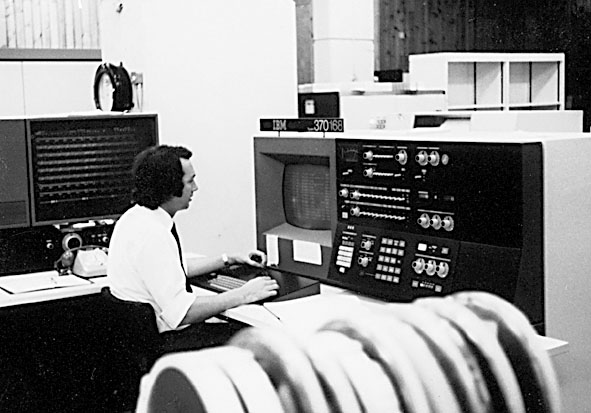
In the mid-1970’s I was involved in troubleshooting IBM mainframes with consoles like this one or, my favorite, this one. I became adept at twirling the knobs and switches. I often dialed a microinstruction into 8 rotaries and pressed ‘Execute from switches’ to get a scope loop. Great fun! When giving the machine back to the customer, you run your hand along the row of toggle switches to get them all in the upright (non-Test) position. By the late-1970’s IBM had replaced all these consoles with a drab CRT and light-pen. Most FE’s seemed to prefer the new consoles, but I was saddened by the demise of those (expensive but) beautiful consoles!

My example of a ‘computer solution’ I detest is making fingers “more efficient” by mapping every isolated keystroke or mouse event to some action. I’m clumsy enough that I often press the wrong key or jitter the mouse. Very often I find windows popping up or editor’s-text damage and, without even knowing what “I did,” I need to undo it. Twice recently due to mouse jitter I’ve accidentally shut down Windoze 10 when I intended just to Sleep it. Isn’t Shut-down drastic enough that it should produce an “Are you sure?” ?
A whole of things that are Bluetooth connected.
E.g., I came across a kitchen scale that’s Bluetooth connected with no display. You have to use a phone/tablet with it.
What?
One supposed benefit is saving on bowls and such. You add ingredient 1 to a certain amount. Then ingredient 2. Etc. But: A, you can do that with an ordinary scale. And B, what if you go a bit over and have to take back some stuff without also pulling out other ingredients?
Of course Bluetooth can be a big battery waster, both for the scale and the phone.
And there’s an app with “free recipes”. I guess it’s impossible to find free recipes on the Internet.
Definitely worth paying 3x more than a regular scale, right?
As a certified turd in the progress punchbowl, I would say that the ratio of solutions to problems is now running about twenty thousand to one, and increases hourly. There are probably a thousand just on my smartphone.
I hate that too. Fortunately, my Beemer has a button that turns that option off. It’s right below the ignition.
Yes, all of them.
Electric ovens in the UK are also on 240v, 32A or 45A circuits, and yet we somehow manage to put switches on them. You get one of these type things mounted on the wall above your cooker. Note that the socket outlet there is attached to the cooker main, not the ring main all the other sockets in the house will be attached to.
Of course, in practice, none of these switches ever get used. I’m sure there are people who go around turning off the switches on their outlets when they are finished with things, but I’m not one of them.
With regard to the car engine stopping when the car stops thing, I first came across this system about 8 years ago in a Vauxhall Astra hire car, and it was bloody awful - the car would start when you put your foot on the clutch but it took just a half second longer to spark up than you’d want and I very quickly turned it off. My current car is a VW Passat that has it, and that sparks the engine up before your clutch foot hits the floor, so it’s very natural and pretty much ignorable - it doesn’t slow me down at the lights at all.

Social media. Bar room full of belligerent drunks. I left.
NO NO NO! That is why Neutral is between Forward and Reverse. If you put Park between them you would rip your transmission to pieces. Shifting into the gear opposite to your motion just makes the transmission work a little harder to change vectors.
Park has a detent pin that slots into the drive train to prevent motion with the engine uncoupled from the drive train. If you remove that pin, then what you have is Neutral. :smack:
One thing that drives me nuts on my smart phone is the apps that are running when I haven’t asked them to do anything. Sometimes I’ll go to a restaurant, and then I’ll see a notification from my navigation app like “Would you like to rate your visit to Pizza Yurt?” I know my way to Pizza Yurt by heart. I didn’t use the navigation app to get there. Why is it bothering me about rating my visit? Why is it even running to monitor my comings and goings? It is an app. I will turn it on when I need the information it provides, and turn it off when I don’t. Processing power is not infinite. Memory is not infinite. When I’m not using it, I don’t want it taking any resources.
The off switch seems to be a relic of the past. I can’t think of any apps on my phone that even offer a way to turn them off. Programs on my desktop and laptop at least offer a way to shut themselves down. The only way on my phone to turn something off is to hit the Recent Apps button and to kill it there. That seems rather like using the Windows Task Manager every time you wanted to close a program. And on the phone, even killing something doesn’t mean it’s actually dead.
The fashion/cosmetics industry is full of this.
Invent a problem (‘Oooh, look! You have dry elbows!’). Invent a solution to made-up problem. (‘Magic Pixie Lotion!’).
Starting this summer we’re getting “more secure” timesheets that are going to require we get a single-use code by text to enter before we’ll be allowed to submit our hours. Great…that will protect us from the danger of, um…people entering our hours for us?
We are all super grateful that they’re solved this non-issue for us.
Advanced Task Killer puports to do that rather easily on my Android smart phone.
… though it’s unfortunate that Android is more or less designed to fail when you do crazy things like shut down apps that you don’t want to use. (Or crazy things like find out exactly which apps are running, and which app is doing what.)
Pedestal sinks. In the 70’s, houses reached peak utility IMO. Bathrooms had long spacious countertops with a sink (or two) in the middle. Who on Og’s green earth thought it was a good idea to backtrack to the 1940’s and provide a primitive sink with no place to set razor, cream, deodorant can, etc. This is a classic case of fashion overruling usability.
Don’t get me started on the IOT. I went to a convention of Internet of Things a few years ago, and it was a giant hall full of solutions in search of a problem.
Listerine was invented like that.
This is to reduce fuel consumption and (if the catalytic converter remains hot enough) air pollution. I care enough about the second part that I hope it becomes mandatory on all cars and especially trucks, but of course that’ll never happen in the U.S.
Apart from the hybrids, we’ve had it on two Mercedes cars(*) so far and it restarts the engine when you lift your foot off the brake pedal, no delay at all at a traffic light. It doesn’t trigger if the car stops very briefly, such as a stop sign with no cross traffic.
(* What’s the plural of Mercedes? Mercedess? Mercedii?)
Rented a Volvo that had the stop/start feature. The first few times it happened I was WTF, something is wrong with this car. And I kept starting it up again. :smack:
Oh, right. Totally forgot that some cars do this now.
After a few miles, didn’t even notice it. Was quite strange at first.
My Wife once nearly walked away with a keyless car key fob of a rental. I suppose this isn’t uncommon, as you completely forget about the ‘key’. THAT could have been expensive.