Someone mentioned above you can run your finger down the line of breakers and feel the one that went off. If I don’t know which one is a problem I usually start switching them on and off one by one until I find it.
Also, leave a light or something else you can see or hear turn on when you reset the breaker.
Just want to repeat what others have said about a failed connection, as that is exactly what happened with my aluminum wiring. In my case the junction was in the box for a light switch. It could happen with copper, but probably not as easily.
For aluminum reasons, the bond would arc, and eventually stop making any connection. High amp draws, like a shop vac, compressor, or electric lawn mower made it worse.
So no breaker would trip, but I’d lose all power to the garage. That let me know it was time to go upstairs to the bathroom and fix the connection in the light switch. I did have it repaired by an electrician, but really there was only so much that could be done. That repair lasted 6 or 7 years.
So the answer could be anything anyone else has mentioned, but the bad connection is my experience.
This summer I ran a 20 amp 110 circuit to the garage to handle high amp loads.
Most of my house has copper wire, but for some reason there’s an aluminum wire from a subpanel to my kitchen oven. Some years ago I bought a new oven and unbeknownst to me, the so-called “professional installer” connected the oven to the incoming aluminum wire with ordinary wirenuts. A few years later the circuit breaker for the oven started randomly tripping when I’d use the oven. I thought the oven was bad and bought a new one, and this time installed it myself. When I pulled the old oven out, I was horrified to see this:
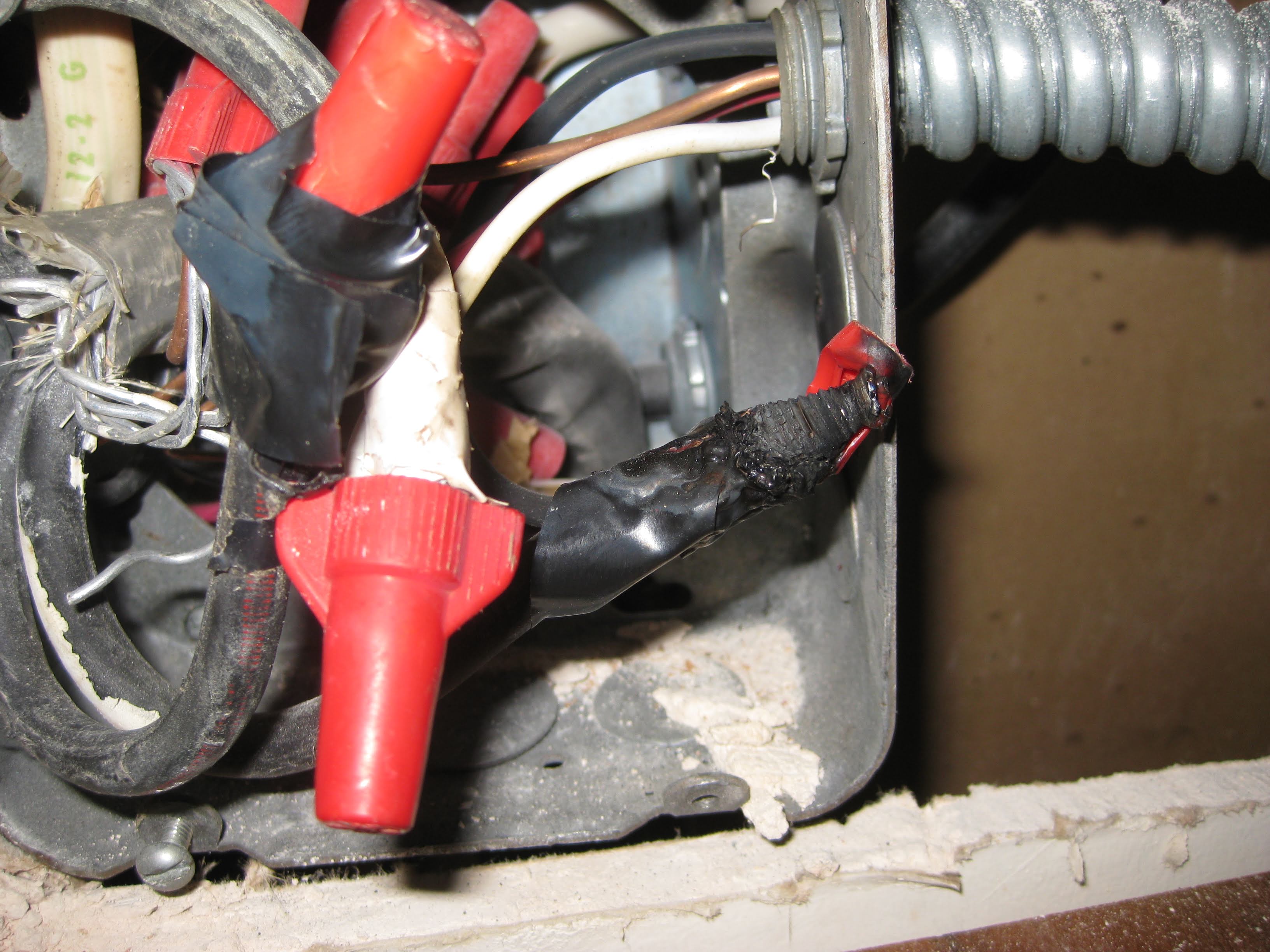
That black thing on the right below the incoming wires is a wirenut with the plastic shell completely melted off. The wirenut connection had evidently loosened due to the differing thermal characteristics of aluminum and copper, started arcing, and melted the wirenut.
Boom, nailed it in one. I even have a sticker on that switch not to turn off - the cleaning people switched it off. I forgot all about that. Should have dawned on me since I have one in the bedroom that is the same. Weird that the switch is only for the top outlet, but there ya go.
Glad I didn’t call an electrician - that would have been embarrassing!
That’s usually so a desk or floor lamp can be plugged into the switched outlet, if there is no ceiling fixture.
Maybe put a label on the outlet marking it as switched?
I first encountered that in a Las Vegas hotel many years ago. (The Venetian). I plugged my camera battery in at night to charge, it was charging. Went to bed, next morning we’re a ways down the strip and - oops! - the battery is dead.
Turns out the top outlet was switched to the same switch as the main light so you could turn out all the lights at once. Some previous occupant probably had gotten annoyed at that and moved the lamp to the bottom (always on) outlet, and so I used the switched outlet for the charger. so much for overnight charging…
Right. Building code may require a switch controlled light in a bedroom. If it’s not a built in wall or ceiling light it has to be an outlet to plug in a lamp. With only one outlet switched the other one can be used to plug in a clock or other device which should remain on.
At both my condo and house, the first time I needed an electrician for something, I had them rewire all of the switched outlets, so one receptacle was switched, and the other always on. One switched receptacle is convenient, two switched receptacles is inconvenient.
Actually, the location of the loose wire (open circuit) could be either the 1st dead outlet, or the previous (still live) outlet on the daisy-chain. On that one, the wire exiting to feed the 3 further outlets could be the one that came loose, leaving it still live, but all those after it dead.
If you open up the 1st dead outlet and all the wires look OK, but the incoming wires are dead, then the problem is before that, in a previous outlet. But in a 110-year-old house, the problem may be finding where the ‘previous’ outlet is. Generally, it will be found moving closer to the breaker box, but no guarantee.