Our brains were not designed by evolution to be happy. They were designed by evolution to survive in a dangerous world. Hence we are prone to misery.
Reprogramming people’s brains is going to be the actual solution. It’ll be voluntary but when people have the option of having an IQ leaps and bounds beyond the smartest person ever alive, and to feel positive emotions (or no emotions if they want, or entirely different emotions than the ones humans have) while still being productive, pro-social and helpful to others, many are going to take it. The same way most people choose to stop living as hunter gatherers when an alternative comes up.
In media its always presented as some horrible dystopia. But if you have to choose between a life of chronic emptiness and pain with an IQ of 105 vs a life of intense positive emotions, or a world of infinite emotions we can’t even fathom and an IQ of 15,000, most will pick the latter.
No; you just don’t have the action happen in the utopia. Both Star Trek and the Culture novels lean that direction. Or you have the utopian society fighting against those who would overthrow or invade it.
Dystopias are depressing and often foster an attitude of “people are all monsters, either give in to the evil or kill everything out of mercy because making anything better is impossible”.
That’s my point. Those societies might be described as “utopias” in universe, but from the audience perspective they obviously are nowhere close to being actual utopias. In fact they’re mostly worse than our present society (or at least our society as it was at our peak around 2015). Just because the people in universe call it a utopia doesn’t make it one. I maintain that other than the Federation from the Star Trek TNG era, we don’t have any examples of any societies that are anywhere close to being a utopia (again from our perspective, as opposed to the perspective of the in universe characters). At least none that I’m aware of.
ETA: Although @Wesley_Clark , to your point, I suspect that’s why the writers from JJ Abrams up through the present went the direction they did. They wrote the supernova of the Romulan star and the attack on Mars by synths to turn Star Trek into just another dystopian sci-fi show / movie. It’s easier to write for, but it destroyed what made Start Trek Star Trek.
Rates of physical and sexual abuse of children is down.
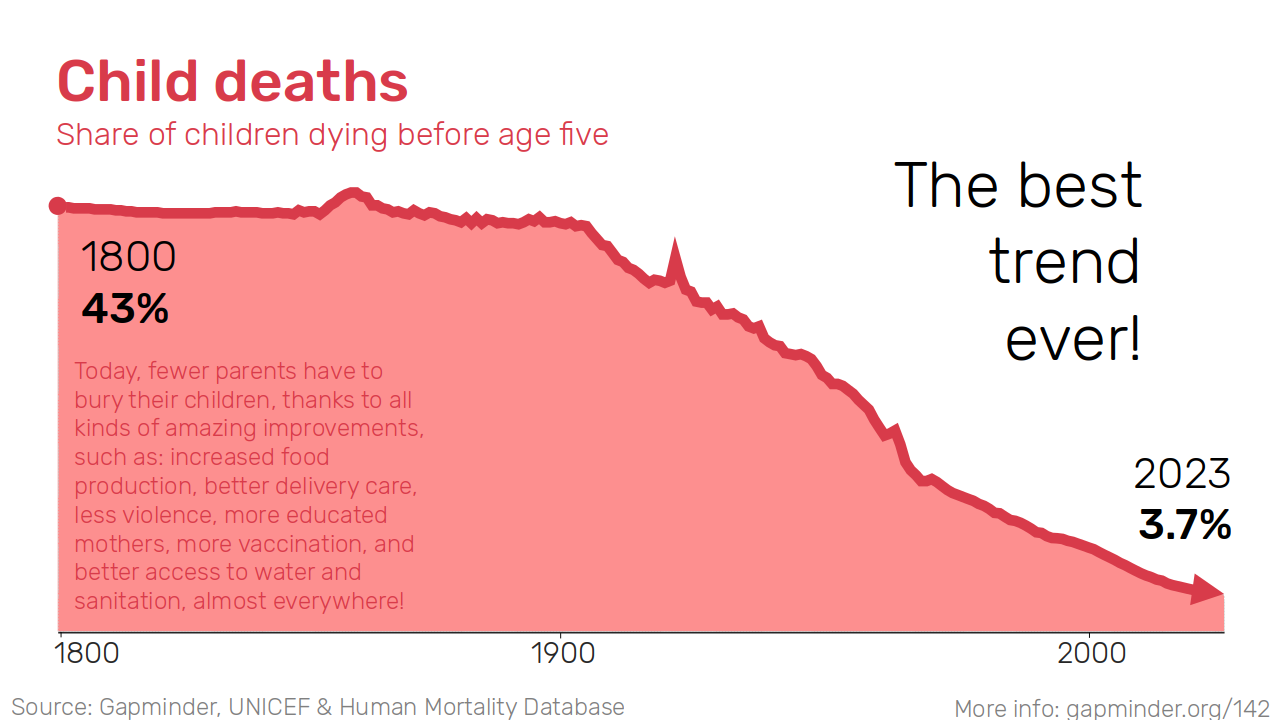
Childhood deaths are down.
But none of this is interesting or exciting. Making a movie about how child physical abuse and child sexual abuse has dropped by about 60% in the last few decades doesn’t make a good movie plot.
I enjoyed watching the TNG group of well adjusted adults (at least the organic people, but since Data was programmed to be low drama we might as well include him as well) who had safe, happy childhoods and who all got along with each other. It was a refreshing change to watch them faced with primarily external challenges and having little to no internal conflicts like almost all other sci–fi has.
ETA: Which isn’t to say that internal conflict on those other shows is due to those characters being abused as children. What I’m saying is that a show that focuses on external threats, with main characters who all get along and don’t have interpersonal conflicts, can be very entertaining. I’m sure it’s more difficult to write for such a show, but not impossible.
I’ll suggest it can be very entertaining to audience members who are not themselves damaged people steeped in useless interpersonal conflict and drama.
The kind of people who find “reality TV” with the continuous gratuitous infighting to be comfortable familiar entertainment reminiscent of their own lives probably found TNG to be unwatchably dull.
And those kinds of people are, if not a majority, at least a hefty plurality of humanity.
I don’t know that Star Trek and the Federation was ever a Utopia. It’s certainly a much more advanced society that has solved many of our modern problems. And maybe Earth and other core planets are utopias but they are also enclaves from less developed planets and colonies in and outside of the Federation. And even those utopian planets have varying different species and cultures.
And there are definitely external threats to the Federation and its member planets
So maybe not dystopia, but plenty of sources of potential conflicts.
Right. Let’s give one segment (or even all of society) infinite emotions and intelligence and nothing to do. That’s not going to create any conflicts.
You could make that same argument for anything. Cell phones in the 1980s were something only the rich in large western cities had. Within 30 years the poorest people in Africa had them.
Sub Saharan africa is one of the few truly poor parts of the world left. Much of the world has grown beyond the extreme poverty in Africa.
But 300 years ago, about 90% of people lived in extreme poverty. Also even the extremely poor in Africa have access to things like medicine, communication devices, etc that nobody had 300 years ago.
I’m not saying its ok. The world needs to work harder to invest in Africa to help lift people out of poverty. But someone in the 18th century would love to have the medical technology or communication technology of someone in the poor parts of Africa.
It isn’t like once water purification, antibiotics, cell phones, the internet, etc were invented that only a handful of rich people had them.
The world (ever since the scientific revolution of the 16th century) for the most part, goes in the right direction. For the most part. 3 steps forward, 1 step back kind of thing.
We won’t; we’ll be doing the opposite and trying to make the division between rich and poor worse, both individually and on the scale of nation states. We are moving backwards towards a more xenophobic, authoritarian and force-based society. We won’t try to lift Africa out of poverty; we’ll take what we want and bomb them if they resist.
I think some of these posts miss the point that much of the “soulless crushingness” of modern society is in the affluent parts of wealthy countries. Life is generally always hard if you live in a poor region. But it seems like much of the technology and infrastructure that was intended to improve people’s lives is just making people more miserable.
Yet people seem to feel like the solution is to double down on more tech.
True of myself, mostly. I think most of this technology is fine in moderation but humans, being instinctual animals, don’t do well with moderation. I have a very scarcity mentality brain that just wants to gorge itself on content.
Sometimes I think our society is kind of dystopian. Opportunities for self-reflection are rare. One of the reasons I left social media is because my head was so full of other people’s ideas I scarcely had time to generate my own. You can only take so much of other people screaming at each other.
For better or for worse, we are a heavily materialistic society. No matter how much I have, I still get in these phases where I want more. It makes no sense because I don’t really lack anything.
I was talking to my 87-year-old Grandpa yesterday about the trajectory of his career. He was raised on a farm but was a highly curious person, very mathematically and mechanically oriented, so eventually he worked himself up to a highly respected position at a major power company. As a child I always assumed he was highly educated because he just gives off that engineering vibe, and by the end of his career he was basically an engineer without the degree. He learned computers when nobody else wanted to. He learned how to do everyone’s job so he could improve the process. He was telling me about one of his earlier jobs where he ran payroll and I was thinking, “That’s all automated now.”
He loved his job and it’s all he really knows how to talk about. A very hard worker but someone who came up in a completely different era, but he definitely felt his work was respected and he was valued. His one regret is that he never got an engineering degree.
He said he’s not that smart (he is), just insatiably curious.
There’s a lot to be inspired by. But I’m wondering how much of what he did is automated now. And how that can eat away at the dignity and self-worth of an employee. He thrived with autonomy. If we take away someone’s ability to be curious and to contribute something unique, it’s going to affect people. It’s also going to make companies less resilient, I think. I think you miss out on a lot of progress when you stifle people’s autonomy.
That was a theme in the third(?) season of Westworld as I recall that took place outside of the park. One of the characters was stuck in a dead-end construction job and it was specifically stated that in an earlier time he probably could have attained a much higher position through his hard work and ingenuity. But the way their world was, most work was automated and for work that wasn’t, people were assigned roles based on algorithms.
That’s the sort of dystopian direction I think a lot of people are afraid we are headed in. One where your Grandpa would not have had a career because he either didn’t fit some profile or there wasn’t work for him to be curious about anyway because it all happened within some black box.
Or even worse, there’s no corporate “progress” to speak of because most corporate jobs become bullshit anyway. A sort of post-industrial technocratic feudal structure / make-work UBI program for overeducated elites to keep their brains busy.
When the product is simple, one person can master it end to end. When the product is complex, it has to be subdivided into components that may not be individually of much use. Or of much satisfaction.
Consider the difference between a craftsman making kid’s toys in 1840, carving and gluing and painting. Each one starts as a couple blocks of wood and ends up as a finished saleable product. That can be satisfying, and they can evolve the design at will as they are both the boss and the worker. Now consider somebody working in a 1960s toy factory: plugging e.g. Barbie heads onto Barbie bodies all day long. Lots less satisfaction. Now consider somebody in a 2025 toy factory sitting at a screen watching the computer run the assembly line making the toys.
The hands-on craftsmen of the world got to watch their livelihoods and satisfaction be destroyed in the 1800s to early 1900s.
Office & technical workers are witnessing the same thing happening to their jobs over the last ~50 years, say 1970 to now. It’s not different in kind. It’s just a difference in who’s freshly experiencing the dislocations.
One of the promises of the internet / WWW was that it would empower the little guy, the garage tinkerer who could go as big as their imagination could take them, with computers cheaply supplying the muscle that used to take an army of people and hence a boatload of capital.
Of course it really did that. Very briefly.
And then the same tendency to complexity took us from e.g. games for a phone that one person created in two months to games for a phone that take 100 people 2 years to create. And all but one or two of that 100 are mere cogs who rightly view their role as mere cog, largely devoid of satisfaction.
By a lot. I recall a comment I read a short while go, that instead of using AI to increase what people can do, the push is to use AI to make people into hands for the AI while the AI makes all the decisions. “Just do what the chatbot says and don’t argue” is not the path to job satisfaction.