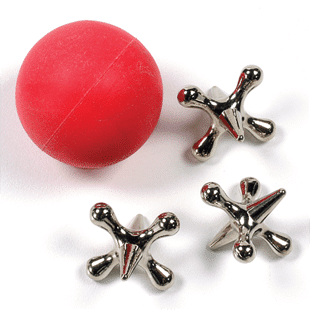
I read a quote the other day that mentioned that kids in ancient Egypt played “knucklebones” with sheep toe bones. The game of knucklebones led to dice games for boys, and jacks, usually played with a wooden ball, for girls.
The closest answer I could find is ‘we don’t know’.
It is unclear when the six pronged shape of Jacks came about
I do kind of wonder if they came about because, I’m guessing, it’s an easy shape to manufacture. With points instead of balls on two ends, it can be done with a two part mold.
Jacks were never a fixture in my own home–I think when I was a kid it was mostly girls who played with them–but it occurs to me that they surely must be excellent caltrops, in the era before LEGO blocks. Imagine stepping on one of those in the middle of the night!
Interestingly, the link I posted above made the exact same comparison
It is unclear when the six pronged shape of Jacks came about, but curators at Jamestown couldn’t help but notice the jacks similarity to caltrops. Like today’s Legos, when toys like this aren’t cleaned up at the end of the day, the effect on a tired parents foot in the darkness of night would be similar to the effect of a caltrop! Ouch!
There’s also a different tetrapod shape, like two Ts with the same stem, that’s used for that purpose. Either one would be painful to a barefoot giant.
One thing I remember about jacks, when we got them from the girls across the street, was that they made fine little tops to play with. Although spinning the jacks as tops isn’t part of the game, it almost seems like they were designed to be spun. The four heavier ends seem to facilitate that.
Was the game played with a wooden ball? I thought it was a small red rubber ball, because you were supposed to bounce the ball as part of the game.