We watched the Expedition Unknown episode. I want to watch the update.
Existing thread:
Question based on old “Fantasy Island” episodes that I’ve been watching on YouTube. “De plane!” is always a Grumman G-44 Widgeon, which makes sense, since they could use the same footage for the approach and landing from week to week. Nobody would notice and nobody did.
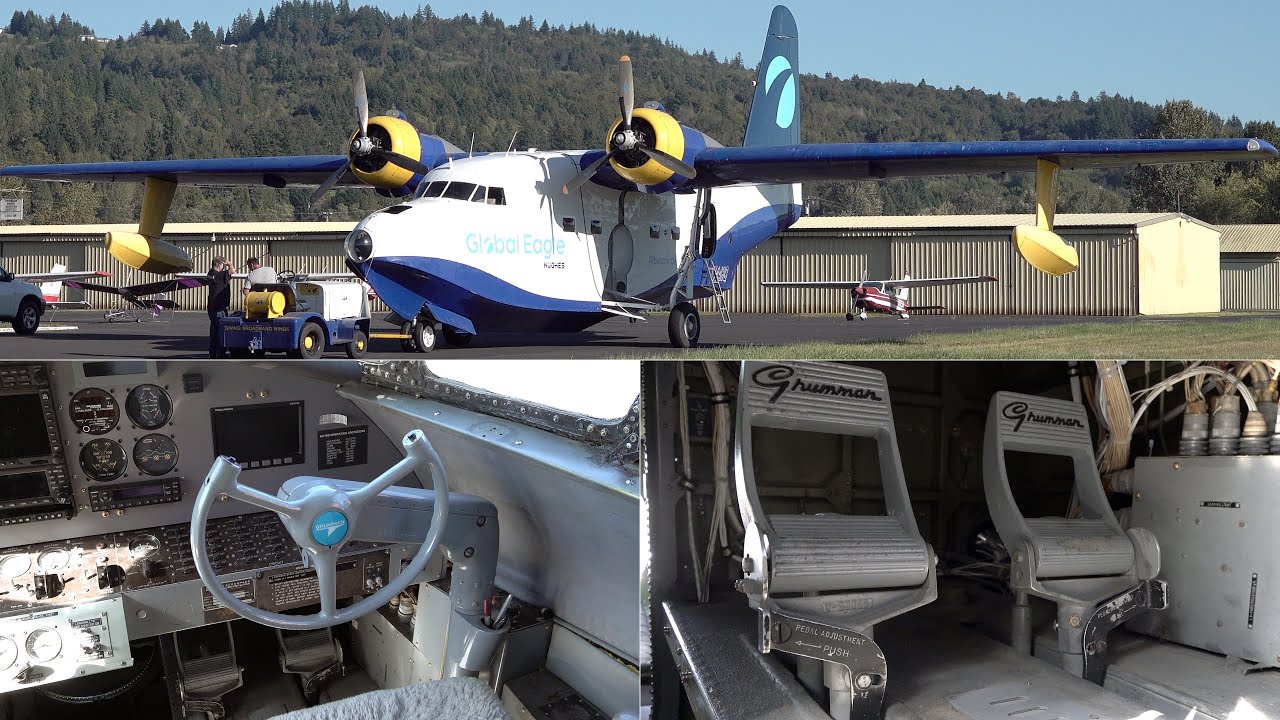
But it looked like the co-pilot could crawl under the instrument panel and the front cowling and flip a hatch so as to secure the aircraft via ropes to the dock. Was/is this the case? A co-pilot had to crawl over rudder pedals to flip a hatch to throw ropes to the ground to secure the aircraft?
Looking for answers from our more experienced aircrew. Not that it matters, because all passengers arrived safely on Fantasy Island, but I am curious.
I watched some youtube videos of Widgeons, and you can see the opening in the dashboard, and I see some folks standing in the hatch, but none of anyone crawling into the front compartment.
Brian
Airplanes are like weathervanes and badminton shuttlecocks, they have a tendency to point into the wind. That’s a very good thing when you’re flying. On the ground, the tires have enough traction to point you wherever you want. Even on the water, when you’re going fast enough, there’s usually a rudder that extends into the water and allows you to steer. When you slow down, the rudder loses effectiveness. That can limit how you maneuver, and which direction you approach a dock from.
(Google AI tells me that the Widgeon doesn’t have a water rudder, and water steering is done by differing the thrust to the engines. I suspect that has similar limitations.)
Consider a Cessna 206. It has three rows of seats, and three doors (left-right-left). One modification you can do when adding floats is to install a small door on the right for the front seats. A pilot flying alone may need to head toward the dock, cut power and shut down the engine, then climb down onto the right float to step onto the dock before the momentum runs out.
So I’m not surprised that the Widgeon (and lots of other seaplanes, too) has a means of docking on the front or right side, but they wouldn’t need it every time.
I’m not sure how to post photos, but if you do a search for Widgeon cockpits, you can see that the instrument panel has a big cutout on the copilot’s side to make access to the nose easy. It also looks like the copilot only gets a rudder bar and not rudder pedals, also to make the crawl easier.
To post a photo that appears inline, just ensure the url is of the photo itself ending in “.gif”, “.jpg”, “.png”, or “.webp”. And ensure there is nothing else on that line of your input except the url. No leading or trailing spaces, no punctuation, no words, no nothing. Here’s an example:

You can also post links to search results in the middle of a sentence like this Aviation Photo Search | Airliners.net but you won’t get a preview.
For comparison, here’s a Grumman Goose cockpit. Note I could not isolate the url of the photo itself; I suspect they’re making that difficult for copyright reasons. So you get a link to a page containing the photo and the preview is of the page content, not the photo itself.
The Mallard seems to have the passage in front of the cockpit like the Widgeon.
Finally, the Albatross seems to have no forward hatch at all:
The Albatross doss have a front hatch, not sure how to get to it:

Brian
The access is between the seats:
Brian
I’d seen the Leno clip but didn’t know what Grumman it was taken from. A fun bit of footage.
Now that I just reviewed the cockpit of all 4 Grumman twin amphibians, it’s obvious it’s an Albatross. All the others have 2-piece windshields while the Albatross has a 3-piece.
That crawlway up to forward was designed for young spry military folks. Not chunky geezers.
And yet, somehow, Jay Leno squeezed up there to mug for the camera enjoy the breeze.
If you go to about 4:45 of my second video, you see going into the front compartment of an Albatross.
Brian
Did you say albatross?
The blonde guy who holds his finger up at about 00:21 is someone I knew right after high school.
Thanks to all for the responses and comments to my question on the Grumman Widgeon. I especially found the photos enlightening. Never knew that aircraft were designed that way, but obviously, they have been.
Again, thanks!
A great photo of the (indoors) 1909 Paris Air Show:
From here: Grand Palais - Wikipedia
Brazil has published a final report on the 2024 Voepass crash which killed 62 people which was discussed in part 1 of this thread.
Reuter summary:
Brazilian air accident investigators said on Thursday that a buildup of ice, failures in the aircraft’s de-icing system, crew actions and deficiencies at regional airline Voepass contributed to the 2024 crash of an ATR turboprop that killed all 62 people on board.
Full report here but unfortunately it is in Portuguese. One might be able to run it through Google translate.
https://sistema.cenipa.fab.mil.br/cenipa/paginas/relatorios/rf/pt/RF_PS-VPB_09AGO2024_PORT.PUB..pdf
Here is a English summary of much of the information:
There have been a couple of accidents and near-accidents with ATRs and airframe ice. IMO some aspect of the design or the mission cannot handle ice like other contemporary aircraft.
From the last cite in English it seems these folks flew for approximately an hour with intermittent ice detection warnings going off. With the airframe de-ice turned off after getting a malfunction signal from the first time they tried it.
No mention that they ran whatever checklist there may be for that malfunction. As a general rule, if you have a de/anti-icing malfunction, rule one is get and stay in non-icing conditions. Which means either clear air, warm air, or better yet both. No mention in that abbreviated narrative that they were trying to do that either.
Not a good look.
Kenmore Air floatplane crashes in northern San Juan Islands with 11 on board
SAN JUAN COUNTY, Wash. — A Kenmore Air plane [de Havilland Otter] made an emergency landing, then caught fire near Sucia Island in the San Juan Islands on Thursday night, and all 11 people on board survived.
The floatplane, a single-engine turboprop aircraft, took off at 4:30 p.m. from Lake Union in Seattle and went down at 5:15 p.m. in Shallow Bay off of Sucia Island, according to a spokesperson for Kenmore Air. Sucia Island is north of Orcas Island.
We can’t see Sucia from here, because Point Whitehorn is in the way.
I couldn’t tell from the video what was going on. I’m guessing a power failure.
Feb 9 '24 Hop-a-Jet 823 (wikipedia link) crashed on I-75 in Naples Florida.
I know some of the regulars read NTSB reports of various crashes. Here’s something different, a YouTube video ‘documentary’ of the first responders from that incident.
**Definition guide**-* MCI = Mass Casualty Incident
I don’t do ARFF but I do do fire/rescue. If you have any questions, ask away.