I can believe that. I wonder how much it costs to rent a truck with boarding stairs, or for Ryanair to own some at all the airports they serve. It must cost them something to have the airstairs installed on each of their planes, plus the extra fuel burn from carrying the extra weight.
Did the investigation consider how many drunk passengers were involved on a Ryan flight?
I think the entire CRJ family has stairs integrated into a bottom-hinged door as standard equipment. The railings can be lowered to allow a jetway or ramp to be used instead, but the stairs are always there.
Replying to myself for context.
Here is a remarkably complete and informative article about the salvage effort of the airplane that ditched near the beach a week-ish ago:
Would that all news reporting, aviation or otherwise, was this complete and devoid of speculation or premature conclusion.
but then how do we know what happened? Surely you don’t want us to wait…even for a second! 
The twin Comanche fuel drain is below the tank switching valves that are accessed from a door in the floor. To drain the system of water and contaminates the PIC has to manually open a valve from inside the plane and it just dumps on the ground. There’s no real way to tell what is purged. If the tanks get a microbial contaminate then the danger of an acidic build up exists in the switching valves. What this means is that they can stick open or closed with a potential loss of engine.
The TC also has bladder fuel tanks. Which over time can develop a wavy bottom. Which means water & contaminates settle in those low furrows. Which are undrainable and eventually accumulate enough condensation or rain infiltration to matter.
The bladders also eventually deteriorate. Which means they need to be replaced. Properly reinstalling replacement bladders to avoid furrows is not for the faint hearted. And as old as these planes are, bladder replacements have either already been done or are overdue on the whole fleet.
Yet another fun way to get fuel contamination.
You can also have the drain valve stick or vibrate open. Leading to a slow and unseen fuel leak. Although it does not seem that total fuel exhaustion was the problem.
Given the ability to crossfeed & with tank-mounted electric boost pumps, I don’t see how single-sided contamination forces an engine failure. It sure might cause one that the pilot then fails to find the correct remedy for.
Dad’s '68 Skylane had those. There was an AD about them, but the recommendation I remember from the time (late-'70s/early-'80s) was to push up on the wing tips to move any water toward the sumps.
NTSB Preliminary report us out
Sounds like the airplane pilot did not consider wake turbulence / rotor turbulence to be a factor.
And was surprised to be knocked half out of control near touchdown. Then was riding the bucking bronco trying to avoid crashing. They did not, for some critical seconds, decide to go around, and may never have decided. In all the thrashing the airplane flailed into the helicopter hovering off the side of the runway with its tail to the approaching hazard.
Helo wake is not to be ignored. Especially not when your airplane weighs ~1/4th of the helo and is significantly smaller in every dimension.
The Cessna crossed runway threshold about 30 seconds after the helicopter, while the helicopter was still over the runway itself, assuming I’m reading the report right. That seems tight even without a rotor turbulence concern, no?
Given that the helicopter pilot asked the Cessna pilot to extend his downwind, I would have expected a little more of a gap. Looking at the truncated ADBS data, that doesn’t seem to be a particularly extended downwind leg.
Agree there was not much if any extension. It sounds like the Cessna was mostly just steering their way around the pattern not really in reference to the traffic. Or the Cessna had a particular unstated expectation that the helo would immediately vacate the runway area once it got there. Which expectation did not match the helo’s actual plans at all.
Been a long time since I’ve been in the lightplane biz. Technically as best I know you can’t cross the runway threshold still intending to land if the runway is “occupied”. If it’s occupied and you get to the threshold, a go-around is mandatory.
For a helo, hovering over the runway is “occupying” it in my book. I doubt the regs get that specific. But that was the situation as the Cessna descended into the wake which he first encountered more or less simultaneously with crossing the threshold
Upon further thought, the occupied / threshold cutoff might in fact be an FAA ATC controller standard, which would not be binding on pilots at an uncontrolled field like this one. But probably represents something that could be called “best practice” for uncontrolled ops.
What plane did I see today? It departed KACY today but I wasn’t paying attention to the time. My best guess is 11:00 AM - 2:00PM It looked like a small business jet with straight wings set far back on the fuselage. What made me look up was the sound. To me it sounded like a turbo prop as it approached but clearly like a jet after it passed. It was too far away to be sure about engines location but maybe twin jets on the tail? It just looked and sounded odd.
At 10:38 am your time a Piaggio Avanti took off to the southwest. It’s the only thing close to your description within several hours of your window and it is an very weird sounding thing.
Jay Leno flies the Cirrus G3 Vision jet.

World’s fastest prop plane. Been around for 35 years. I had no idea!
The pilots I know who fly the Piaggio call it the Pistachio.
Not so many of them around these days. IIRC, there was some big scandal with a company forging their maintenance records. This resulted in many Piaggios having parts that could not be certified for flight.
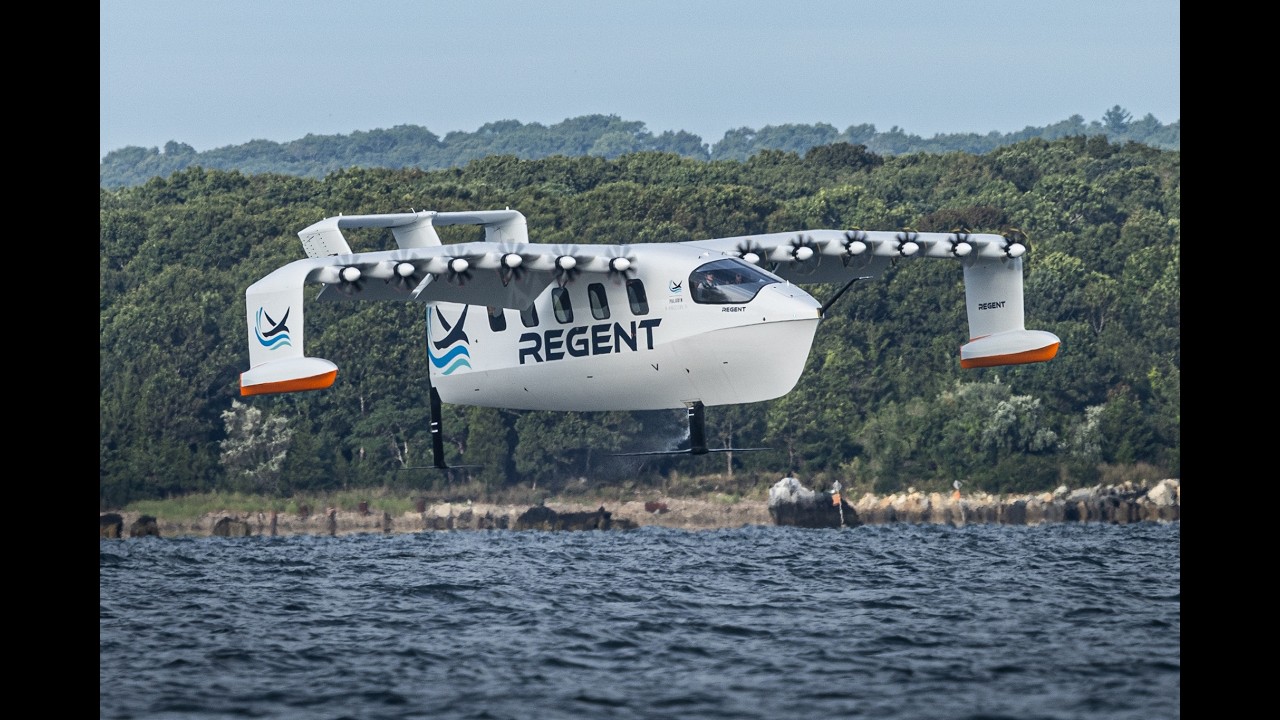
First crewed flight of REGENT Viceroy "seaglider, " an electric-powered wing-in-ground-effect vehicle under development by REGENT Craft Inc. of Rhode Island, (REGENT is capitalized because it is an acronym, standing for “Regional Electric Ground Effect Nautical Transport”). 12 passengers will be carried on flights of up to 180 miles (290 km) over coastal waters, with retractable hydrofoils used during the take-off run.
Without a doubt, that was the plane. I don’t believe that I’ve ever seen one before yesterday. It sounds like a nice airplane, at least on paper. Thanks.
Except Oshkosh. 
So do you think he tried to climb out of the turbulence and stalled it? The 150 is designed as a trainer and it’s not shy demonstrating a stall.