You’re way over thinking it. I was never a fighter pilot but I learned to breathe like one in high G maneuvers which for me comes from certain rides in an amusement park. How different was their uncontrolled descent from the first drop on a roller coaster? IOW, they may have been very intentional.
Scared people breath hard. Scared people also sometimes key the mike inadvertently. The recording I heard didn’t so much sound like labored exertion breathing as it did just deep breathing without talking. Not calm, but not panicked.
If someone deliberately keys the mic I would expect… something. May Day, Heart attack, runaway trim … something.
True, and then the person may be urgently focusing on the “aviate” part of the process and not in a position to communicate.
Particularly with the advent of headsets and mike switches on yokes, a lot of “death grip on yoke” situations will key that mike with no deliberate intent or awareness.
I just saw a T-shirt.
Front: What doesn’t kill you makes you stronger.
Back: [silhouette of a UH-1 tail] Except tail rotors. They will straight up kill you.
I wonder if they meant tail rotor as in “Walk into” or as in “Fail in flight”?
Tail rotors are very versatile killing machines.
If properly used with a butterfly net they’re great for making salads.
Gives Salad Shooter a whole new meaning. 
Salad Spinner too.

“Injuries incompatible with life”. Ouch
That’s the sort of mess you clean up with a firehose and a putty knife.
I didn’t notice your turn of phrase in the article. But does sound like a familiar phrase of translated Russian bureaucratese.
The FAA, where they not happy until you’re not happy!
Got an update from a friend who was building his second balloon. Given he’s both experienced & meticulous, I believe it to be airworthy if he says it is, but…
Without knowing more details (and I know nothing about ballooning), the FAA isn’t there to protect pilots. It’s there to protect the general public from pilots.
When it comes to experimental aircraft the feds are actually quite obliging. You can fly military warbirds, homebuilts, kit planes, etc. But there is a process. If that experimental balloon caught fire and fell on a mall or an elementary school people would ask why didn’t the feds regulate it more strictly.
And it’s tough to have the necessary experience on hand for specialty stuff like that. If the guy wants to fly his experimental category ballon in public airspace he’s got to cooperate. He’ll just have to suffer through being more knowledgeable than the regulators. He’s not the first.
In many ways it’s better to have a Fed who has no idea looking at your stuff than a Fed who does have. The worst of all worlds is somebody who has no clue but thinks they have quite the clue. Sigh. At least all policemen know how to drive.
I expect all 4 of them came out mostly because “Cletus ain’t never seen a train wreck before”. IOW it was the only opportunity in their entire careers to see an Expermental class balloon and they were curious.
I get that balloons are the red-headed stepchildren of the aviation world but if they don’t have the necessary experience shouldn’t they ask something before blindly signing off? They have now given him a certificate that it is airworthy w/o knowing if it really is or not? How is that protecting the public if it falls out of the sky on it’s maiden flight?
-* He has not only stood it up once (not leaving the ground) already & gone back & made some adjustments to the parachute top but is planning for the first ‘flight’ to be a boring shakeout, an hour or so of tethering only; going up 30ish feet at the end of a rope; that way if anything catastrophic does happen you’re at a survivable distance from the ground & don’t need to worry about finding a LZ because you’re currently over trees or a lake or something else that you may not want to land on.
-** building a balloon isn’t that complicated; a lot of fabric, a lot of thread, a bunch of space, & a lot of time in front of the heavy-duty sewing machine. First one sews the (square/rectangular) panels together into vertical gores, then attach the (12-24, or more) gores together to complete the round balloon. There is a specific fold used to sew; similar to placing your two palms together, one thumb up & one thumb down, now curl your fingers into each other such that there are 4 ‘layers’ - proximal phalanx R, distal phalanx L, distal phalanx R, proximal phalanx L; now sew thru all 4 layers. Don’t forget your load tapes, either webbing or kevlar or metal cables (in sheaths).
I wouldn’t recommend you building one from that simplified one-paragraph description, just like I wouldn’t recommend you performing surgery from a doctor writing out one paragraph but you at least understand the basic concepts of how it’s done.
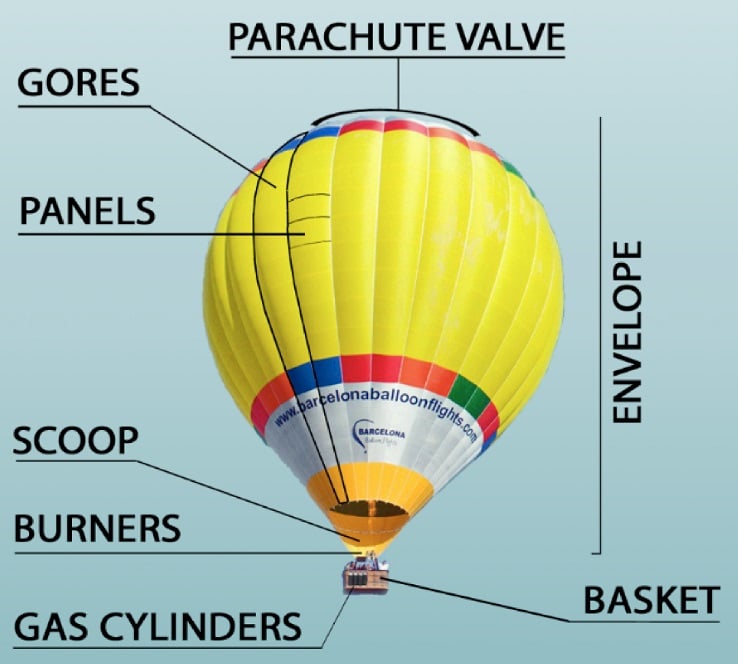
Why am I reminded of various Warner Brothers cartoons where the plummeting chump pulls the ripcord on his parachute and anvils, kitchen sinks, or sharp cooking utensils fly out?
How does he meet the 51% rule? He stitches the fabric and weaves the basket–but is buying so many major components.
Can you give a quick explanation of the 51% rule!
51% or Major Portion Rule for Experimental-Amateur Built Aircraft
The builder of an aircraft is the person who builds the major portion of the aircraft. When you build 51% of the parts and do 51% of the assembly of the total, you have done the major portion. The FAA calls this the Major Portion Rule. In order for the aircraft to be certified under the favorable Experimental Amateur-Built category, the 51% builder must be an amateur (e.g., building the aircraft for education or recreation per FAR 21.191)