Re the safety of Li-ion batteries. How many do you have in your own home right now? Do you worry about them catching fire? Just off the top of my head, I have at least 10, including a Li-ion battery pack hefty enough to boost-start a car or truck. I don’t worry about fires.
It’s not that they can’t happen. Of course they can. It’s all about probabilities and cost/benefit tradeoffs. I’m probably much more likely to fall down the stairs and break my neck than experience a battery fire.
At this point we have +/- 125 KW of Li batteries inside the structure–1 EV, 1 battery backup bank (20kwh), plus all our devices. We don’t charge to 100%, though.
I’ve had a motorcycle battery get hot and expand while charging.
I’ve had a starter battery get hot and expand while jumping a motorcycle.
Luckily they didn’t ignite. I stopped the charging process and relocated the batteries outdoors.
We know it can happen. There has already been a fatal crash of a cargo plane from lithium batteries. Of course that involved much larger volumes of them and they were not accessible.
The First Air Voyage In America took place on this day in 1793 when Jean Paul Blanchard took off in a balloon from Walnut Street Prison (across from Independence Hall in Philadelphia) & flew to NJ. Among the spectators was President George Washington
Benjamin Franklin helped fund and witnessed the 1st unmanned hydrogen balloon that took flight on Aug 27 1783 in France. It flew for 21 kilometers and landed to an audience of frightened peasants who attacked it with pitchforks and knives. Fortunately for them they didn’t go the Mary Shelley route with torches.
Unfortunately he died before the American demonstration. He was a great proponent of the effort.
I thought Air & Space was one of the best aviation publications around. When I was an instructor I had a few articles saved that I had my students read. Will see if I can find and post a few.
That bang might be somewhat bigger than you expect. When that liquid Argon stops being liquid, which it will do very quickly due to the very large temperature difference, it will want to occupy a space that is 800 times as big as before…
In doing so, it will absorb about 70% of the heat energy that the same volume of water would consume when going from room temperature to steam.
Here are some great articles from Air & Space. One involving a cat getting a ride in an F-16, and another cautionary story about not allowing outside forces to rush you when preparing to fly. Then a strange and dangerous way of balancing fuel tanks:
Of course several, and I do occasionally worry about them.
Your question seems to be missing the point though. Rarely will a device with a li ion battery at home be subjected to the same kind of unknowing, mindless abuse that the contents of overhead bins are subjected to all the time. The likelihood of something going wrong is much higher, and the consequences a lot worse.
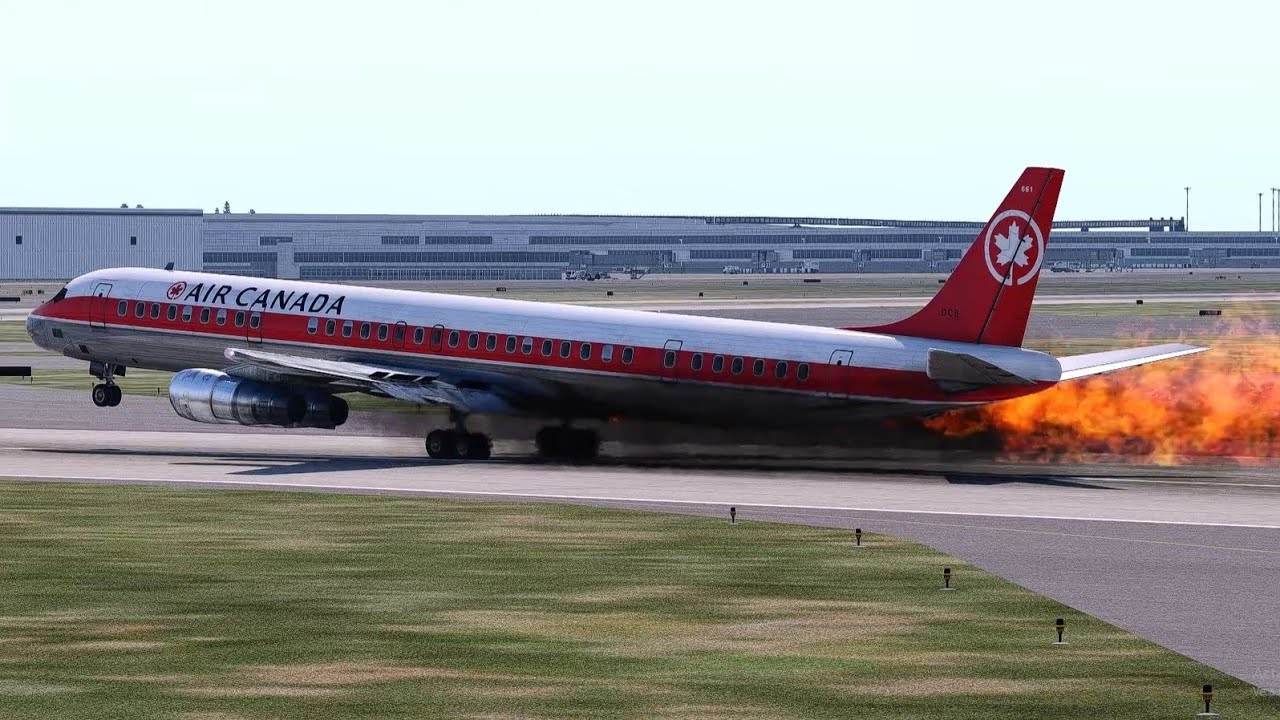
This is old stuff, but it hit close to home and I remember it vividly from my youth. Air Canada was renowned for its safety record but it had two fatal DC-8 crashes. This was one of them. It’s a particularly good animation with minimal commentary. Still gives me the chills.
It’s difficult to edit a post with an embedded video, but I just want to add that to this day it’s unclear to me what would have happened if instead of the natural instinct to throttle up and go around, the captain had thrown on the reverse thrusters and brakes and tried to come to a stop. I suspect it may have been survivable even if there had been injuries or even some fatalities. I recall gruesome news stories at the time describing pieces of flight attendants’ uniforms hanging from tree branches.
Also hitting close to home is that many years ago, still in the DC-8 era, my parents – who always took the train everywhere and were averse to flying (I think it was mainly my mother who had a fear of flying) – made plans to visit my brother in Palo Alto and had no choice but to fly. It was a very similar flight – a DC-8 Montreal to Toronto, where I met them at the airport, and then all of us went on to SFO.
I tend to think – perhaps unfairly – of those early jetliners – 707s, DC-8s, and Lord knows the early de Havilland Comets with their metal fatigue issues – as death traps. Aircraft safety has certainly improved immensely since those days.
Sorry, I don’t get the allusion. But no, I don’t live in Prague. That city sounds like an awesome experience though.
They all were great stories.
I had two close calls with inadvertent overweight ops in the 727. Neither of which I contributed to causing, but I’d have been just as dead if we’d been a little heavier or it’d been a little hotter or the wind slightly less favorable or anything had gone wrong during takeoff.
Any aircraft will fly heavier than the book says. But only up to a point. That CH-46 pilot took it right up to the bitter edge. I was a little more fortunate and we had more margin than that. But in all three incidents the outcome was happy mostly because of luck - it being a solvable problem given the application of enough skill.
There is a Colombian freight operator Aerosucre. Who made a sorta-policy of always flying overweight. More revenue, doncha know. Of course every now and then they wreck a jet doing that. Cost of business, doncha know.
There’s been a hell of a lot of learning about what not to do. The airliner accident rate is a tiny fraction of what it was in the early 1960s. Some of that is down to improved airplanes. Much more of it is due to improved airports, weather info, and pilot operating procedures and cultures.
Such as not tolerating individual idiosyncratic deviations from written procedures based on half-baked concerns about nebulous risks.
A lot of aviation history has to do with mechanical innovations that at first were untrusted and hence misused. Which misuse often caused more trouble leading to a feedback loop of rumor that the gizmo is the problem, not the crusty old farts’ misuse of it.
Thanks for the history lesson & cite. The name sounded slightly familiar but I’d never known anything about it.
Given 1600s medical care, getting tossed from a window sure sounds like a crippling at best and a death sentence at worst. If the would-be killers were smart enough not to use the ground floor windows. It seems these folks missed that vital detail, doing no real harm to their victims.
The Russians have perfected the technique of starting from higher.
Aerosucre:
There’s a particularly famous clip that gets included in lots of YouTube aviation compilations of an Aerosucre 727 just barely making it off a dirt runway as it roars past a few people and a car.
What’s not usually shown or even mentioned is that about a minute later they crashed and killed almost everybody aboard. The original vid didn’t have a good view of the crash through the dust wake and is usually chopped off. Aerosucre Flight 157 - Wikipedia.
The saddest thing about this particular tragedy is that it was so preventable. A standard protocol, strictly followed, about how to handle spoller deployment would have resulted in a perfectly normal landing.
 It seems these folks missed that vital detail, doing no real harm to their victims.