Note the person is Canadian, which may make a difference. The jumpseating procedures for U.S. pilots definitely have some safeguards to prevent this sort of thing.
No:
The indictment did not identify the airlines that let him fly for free except to say they are based in Honolulu, Chicago and Fort Worth, Texas. Representatives for Hawaiian Airlines, United Airlines and American Airlines — which are respectively based in those cities — didn’t immediately respond to emails from The Associated Press seeking comment.
Canadian airline, which again may matter.
When I was an airline pilot the procedures had a few checks, which I suppose I’m not meant to disclose. But one was a database which should have caught a former employee attempting to continue using the system. We’ll see.
Cockpit access on US airlines for jumpseaters was/is subject to real time employment verification via a computer system. Here is one pilot union’s fact sheet for their members which mentions some of that. There are other obstacles to imposters in the cockpit, but that’s one of the hard-to-fake ones.
The process by which a (purported) crewmember can hitchhike in a passenger seat is more variable. But I’m rather surprised anyone could pull that off more than a couple of times with good luck.
Note the plane is not pointing up upon clearing the bow. Mr Ely managed to get salt spray on his face before climbing.
There were a lot of 1st associated with Mr Ely. First take off from a ship, 1st landing on a ship, and 1st use of a tailhook. He was an ambitious young man who liked to push the envelope. He also wanted to be part of the future naval aviation he demonstrated was possible.
Eugene Ely
Ely communicated with the United States Navy requesting employment, but United States naval aviation was not yet organized.[7] Ely continued flying in exhibitions while Captain Chambers promised to “keep him in mind” if Navy flying stations were created.[7] Captain Chambers advised Ely to cut out the sensational features for his safety and the sake of aviation.[7] When asked about retiring, The Des Moines Register quoted Ely as replying: “I guess I will be like the rest of them, keep at it until I am killed.”[7]
Sadly he did not take the advise of Captain Chambers and died later in 1911 in a crash while demonstrating the Curtis Pusher. The plane is worth mentioning by itself. It was designed at a time of trial and error by Glenn Curtis. It was originally a plane that used a canard for pitch control but it was later found (by accident) to be unnecessary and thus was born the Headless Pusher
Great cite; thank you. A pic of the entire ship hosting his takeoff is instructional. See here and scroll down:
You’ll notice the “flight deck” is short and sloped. He was barely moving when he cleared the prow. You’ll also notice the first takeoff was made at anchor, with zero wind over the deck due to ship’s motion. In all a situation where the deck (heh  ) was stacked for failure, not success.
He was brave bordering on foolhardy. And skilled and determined. An appropriate hero for a fierce age.
Lots of interesting folks from the early days of aviation who died quite young. They would probably be astonished at how safe we’ve made it in this day and age.
Then there are the rare folks like Chuck Yeager and Bob Hoover - perhaps the two least likely people in history to die of old age given all the dangerous stuff they did.
Good catch. I didn’t even think about that. And apparently nobody else did either.
And if they’d listened to Hoover as a test pilot more of them would have reached old age. He also mentored aerobatic pilots like like Sean Tucker and probably kept them alive longer.
A Luxair flight made an emergency landing in Nice yesterday after seeing warning lights about issues with the right-side landing gear. The Nice airport was disrupted for over an hour as traffic was cleared and the runway was closed to handle the urgent situation.
Investigators quickly determined the problem was just a sensor, and there was no actual mechanical fault.
It’s noteworthy because someone captured a video of the textbook emergency touchdown.
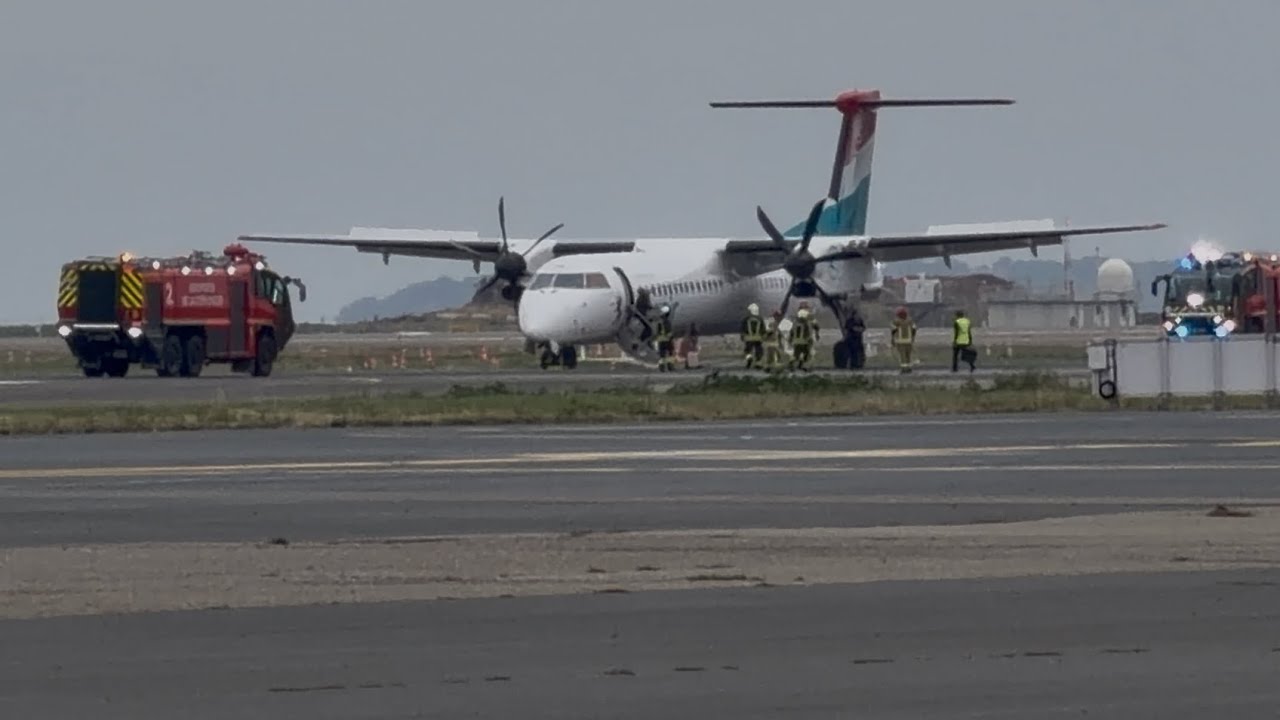
Note the starboard propeller isn’t operating; they shut down the engine as a precaution. They also land at an angle, touching down on the left side first before carefully dropping the other side.
Just a well executed and professional emergency procedure all around.
Good. Two of the saddest accidents (IMHO) in history were caused by BOTH pilots trying to figure out if a “gear not down” warning was for real, when one of them should have been flying the plane.
Looks like the CRM for this one was spot on.
Yes, which means the article’s lead “that passengers were never in genuine danger” is not true. There’s always a risk when pilots have to deal with an issue.
Three distinct thoughts …
That darn fire truck almost drove across our POV at just the wrong time.
A real careful look at the touchdown shows them wobbling in the crosswind, then touching down first on the right (bad) side, then the left (good) side. That’s not meant as a criticism, just that in typical swirling winds it’s difficult to make one side or the other be first for sure. Unless you’re willing to set up a rather large slip which may be prohibited by the aircraft manual. And creates some incremental risk of damaging the gear you think is the good one.
I wonder if the engine shutdown is part of the written procedures for a gear unsafe indication, or was somebody ad libbing to reduce potential aircraft damage? If the latter, that was a mistake that deserves correction, not praise. A single engine go-around with gear stuck down is a dicey proposition in many types and is not a situation you should enter into lightly. The Dash 8 has rather larger = draggier gear than most airplanes. IIRC @Richard_Pearse used to fly Dash-8s and can perhaps give us the straight scoop.
Aviation Week’s biz av section highlighted this vid in a recent article. It’s introducing the TBM 980 single engine turboprop with the shiniest latest of avionics. The bald guy is an Aviation Week correspondent and the guy with hair is the CEO of TBM. Which is now wholly owned by the French conglomerate Daher.
The vid’s only 2-1/2 minutes, so not a big investment.

I know this doesn’t count for much, but of all the aircraft in which I have significant playtime in MS Flight Simulator, I enjoy the TBM 850 the most. Just a lot of fun, very versatile, very fast.
if I could buy a plane in real life, this would be it.
If I wanted to toodle around the country flying myself, a TBM would be real high on my list too. Assuming I had the bankroll. Which I do not. Come on Powerball!
It appears that today is the 20th anniversary of the Challenger 605’s first flight, according to a Bombardier post on LinkedIn, which is pretty cool. The 605 was upgraded to the 650 in 2015 (entry into service) and the program is still in production. The CRJ is a direct derivative, but production has stopped on those.
It all started as the Challenger 600 in the 1970s, entering service in 1981 if I’m not misremembering. Gotta drop this National Film Board documentary about it - enjoy the burnt orange, cigarette smoke, misogynistic attitudes and a pretty cool development story!
Several of my customers operate these and I have a soft spot for them.
I flew the Dash 8 300, not the 400, but I can’t imagine there’d be that much difference in the gear unsafe procedures. Shutting an engine down isn’t any part of it, and if an alternate gear extension is performed the gear can not be retracted so the go-around performance wouldn’t be very good on one engine. There’s either something more to the fault they had (engine failure causing a gear indication problem?) or they were getting inventive.
I’ve always thought highly of the breed since I first read about the start of the development effort.
I was a CRJ-700 pilot in training for 1 whole day. I was really looking forward to flying the machine, but events intervened. I wish there’d been a way to keep the books, but back then they were made of dead trees, not electrons, and the company wanted them back ASAP.
watching this vid - mostly to see 1970-80ies business being conducted…
- marketing has changed very little, those were always BS’ers
- manufacturing - huge changes (you dont see people smoking on the assembly line w/out any protective gear, anymore
- businessmeetings: the proverbial old-white-male galore …
so culturally a really interesting film.