Oh, if the LP is under warranty, having the nut filed should be covered.
Good points on filing the nut, I’ll try that first. Also a good point about about the warranty covering it.
Huh, I thought Grovers were the more usual choice on a 3-n-3 style headstock. I’m looking at the StewMac site, and the Grovers and Schallers are about the same price, but the Grovers sound like a better tuner @ 18:1 ratio, vs the Schaller 12:1 ratio. What makes the Schallers more desirable, or are they about the same as the Grovers all else being equal? ETA: and I sure won’t wait till one breaks, I’m pretty fed up with them.
I never really considered the ratios too carefully, but you’re probably right on that. I’ve never had a set of grovers, but they look like quality tuners, and they have ones that look “correct” for a Les Paul. Additionally, they seem to be the ones with the hollow peg that you can put the tip of the string down in (I hate little clipped pokey ends on the strings).
Totally agree - I like those tuners where I can tuck in the string end and keep things neat.
Nothing to add about the nut - definitely file it or get it filed before you look to replace it. As for the tuners, if you are a tuning fanatic, the higher gear ratios can enable a bit more fine tuning. Heck, who am I to talk - I like Klusons and open-back tuners on my acoustics. Whatever you do, don’t get a small-body Martin with a slotted headstock and old-style 3-on-a-side tuners. Eeesh.
Gotoh 510s are the absolute best tuning machines available nowadays. Gotoh also make cheaper models, but the 510 range are the best.
Grovers are pretty close, though, and a little cheaper. In practical terms, unless you have super-magical laws-of-audio-physics-defying golden ears, there’s no difference.
I have both Gotohs and Grovers on different guitars, so I’m not just pretending to know what I’m talking about, by the way. I use both on a daily basis, and have replaced quite a few sets of crappy tuning machines on my own guitars and for other people.
The gear ratio - 12:1, 18:1, etc is widely misunderstood. What it actually means is this: to get the hole that the string passes through to revolve 360 degrees (a full circle) you need to wind the tuning key 12 times = 12:1 ratio.
Effectively, this means that a higher ratio gives you more tuning precision, but the price is more winding to get to the same place. I don’t think that’s much of a price to pay, but I have certainly heard of people who hate winding so much that they prefer lower ratios and have swapped higher-ratio tuning machines back to older, lower ratio, tuning machines.
As for the tuning machines with the slot & hole for string ends, that’s pretty rare: Fender-style Klusons and copies thereof are the only ones I know of. To the best of my knowledge, Grovers have never been made like that.
It’s a Grover, and it’s a Kluson copy. I imagine it’s more sturdy than a Kluson, though.
edit: aaah!, but it’s only 6 on a side! the bastards!
Can I ask a stupid question? For folks who hate certain kinds of tuners - how come?
I have old, stable guitars - I change the strings, stretch 'em out while installing, play them a bit to get the metallic sheen off and get that last bit of stretch out of them, and I am good to go. I check with a tuner whenever I pick up a given guitar - give a minor tweak here or there. When I down-tune my A and high E for Open G tuning, I use the tuner, dial them in, play, then dial them back.
I don’t run into any nagging tuner / tuning issues - when I pull a guitar out of the case that, for some bad, neglectful reason I haven’t played in a while - it’s pretty much in tune; very little tweaking required. True of all of my guitars. I have a couple with typical closed-back (not sealed; just stamped metal boxes) Klusons and a couple with even older open-back geared tuners.
I recently had a small-body, old Martin - with a slotted headstock and 3-on-a-side cheap-ass classical-style tuners. They were a pain to change the strings on, and the some of the tuners would catch and give rather than turn smoothly. Made establishing a stable tuning a pain.
I am curious what your experiences are. Believe me, I know - tuners can be a topic of passionate debate - but I’ve never really had issues. In my experience, there’s two kinds of people: folks who are passionate about tuning and hear every thing, and folks who figure a little slop never hurt anyone. Neither is better! I am clearly in the latter camp - but I learned early on that a responsible band-mate keeps his instrument in tune at all times - so I got in the habit of checking the tuning every time.
…in other words:
ETA: Also I said “to the best of my knowledge”.
Mine objection to the stock LP Klusons is the gear ratio feels really low. Really, that’s it. I want a turn of the knob to equal few turns of the string, so it’s easier to hit that spot, and it makes me nuts to overshoot a couple or more times. I’ve never had locking tuners and I’m not all that interested in them, nor any other fly tuner features.
I have Waverly open-backed tuners on my favorite acoustic and I hate them because they take so much force to turn, compared to the buttery-smooth Gotoh 510’s I used to have on another guitar. Really fine adjustments are hard on the Waverlies. Otherwise, though, I am pretty tuner-agnostic.
If you put your strings on properly, most tuning machines will work. Really crappy ones do unwind - I’ve seen people on guitar forums denying that this is possible, but I have personally experienced it.
The difference between usable machine heads and good ones, though, doesn’t have much to do with tuning itself. It’s definitely nice to have the extra-fine tuning, but really it’s about durability: in a humid or dusty environment gears get gummed up, a fairly light knock can bend a post and make winding difficult/impossible, and so on.
I’m sure you take good care of your guitars, WordMan, but I’ve had people bring guitars to me (in my capacity as someone who knows how to do guitar maintenance) that have taken a bit of abuse (and not a lot of abuse) with one or more of the cheap OEM tuners kaput.
Grovers and (high-end) Gotohs can and do survive getting knocked around and having beer spilled on them. They’re not indestructible (though I’d say the Gotoh 510s are pretty close) but they can take a lot of abuse and keep working.
Now, I don’t spill beer on my guitars, or play punk rock gigs and dive into mosh-pits, but I do care about durability and precision, so I like to have nice tuners. I don’t always replace/upgrade, but if the OEM tuners feel dodgy to me, I don’t think $50-$70 is that much to spend, plus I can replace the OEMs and keep the upgrades if I sell the guitar.
Interesting. I’ve never tried Gotohs, I’ll have to look into them. I have had Grovers and Schallers, and I found them both acceptable.
Huh, that’s certainly what I understood. I’m scratching my head wondering what the widely-held but incorrect interpretation could be.
Yep, and that’s what string winders are for.
Hmm - have you put a drop of machine oil on the gear? As I mentioned, I have a couple of guitars with open-backed tuners - those are Waverly’s. I haven’t needed to oil them - they adjust smoothly.
Do the Waverlys have a screw at the end of the tuning key? Like the screws visible in this picture?
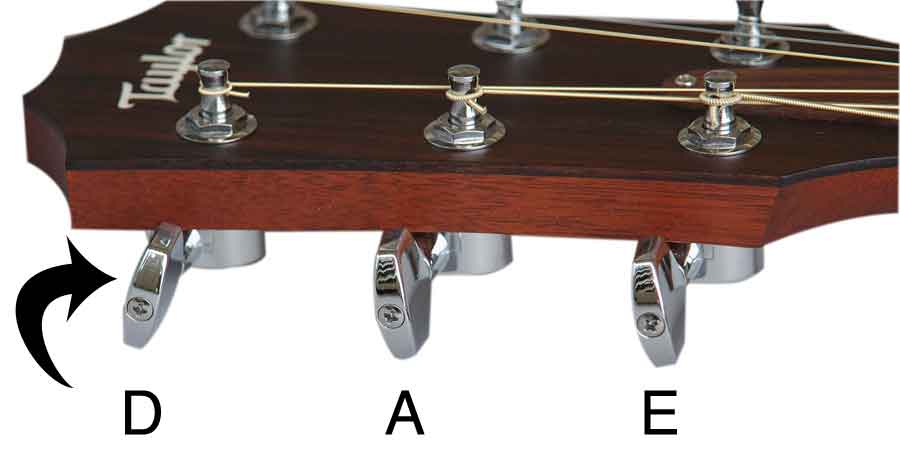
Because if they do, you can loosen the screw a little* and it will loosen up the key a bit.
*NOTE: VERY SMALL ADJUSTMENTS ONLY, by which I mean tiny fractions of a revolution. Loosen it too much and the post won’t turn.
All that makes sense; thanks. Just curious.
And yeah, I take basic care of my guitars - keep 'em in their cases; don’t leave them resting anywhere stupid, etc. - nothing obsessive. But a 1948 Martin is going to have it’s share of wear ;), so I don’t sweat it.
I’ve thought about that but there’s so much controversy over oiling open tuners that I don’t know what to do. Some people say that if you oil them, it just attracts gunk that sticks on and then damages the gears.
No, I don’t think so. I have the gold set on this page:
What I have done with other guitars is take the strings off, using a peg winder, and put the tuning machine through a revolution or two. If there is dry stuff, loosen it - if the issue is corrosion of some sort, you won’t be able to wind it all the way through and you can decide if you need to swap them out. If there is oily gunk there and won’t brush off, why not try a drop of oil?
Note: Shakester is right; if you can adjust the screw a smidgen, start there…
I was just saying that people on guitar forums will confidently express opinions as absolute facts without knowing the most basic facts about what they’re opining about. So, you know, people saying a higher ratio is “better” without actually knowing what the ratio does.
No adjustment screws, then.
I’d say adding a drop of oil is OK as long as you don’t leave the guitar in a dusty grimy environment.
Yeah, back in the day, the war of escalation in the Gear Ratio wars was a big deal - around the same time that heavy guitars were valued and locking trem’s were the rage - i.e., late '70’s through the hair-metal 80’s. Can’t recall specifically why - but I remember 16:1 and even as high as 20:1. I can see some dude sitting there like an idiot, spinning the heck out of a high-ratio tuner…
I think that when Eddie Van Halen inaugurated the whole guitar-building and customization craze, coupled with his intro of the shredder/Super-Strat got folks focused on certain features. I remember when fingerboard radio started to get scrutinized - again related to the needs for an EVH-type of guitar - folk went nuts described how their neck had a big radius - if the original Fenders had a 9.5" radius, theirs would have a 20" radius!!!