XBOX here. The original RS had noticeable latency, unplayable through HDMI, playable but noticeable (50-100ms) using analog. RS2014 on XBOX has no noticeable latency using analog, it’s awesome!
Mrs G is getting a bit annoyed with me playing “Space Oddity” for hours and hours
I have the 2014 version only. I tried to buy a song download (Soul Man, awesome riff) and it wouldn’t let me; said I needed to have Rocksmith first. I suspect it doesn’t realize that Rocksmith 2014 is a valid prerequisite for that download.
A few more things I’ve noticed:
I’m not wild about the built-in tuner. As soon as you get one string in tune for a fraction of a second, it jumps to the next one. My strings seem to waver in pitch a little bit[sup]*[/sup], and I’ve also heard that you should always come into tune from flat so that the tension across the nut is correct. I’d like to force the tuner to stay on one string so I can adjust a little bit.
I’m surprised there’s so much movement up and down the neck. Most of the beginner stuff I’d been learning was in first position, or at least stayed in one position for the most part. Rocksmith seems to be recommending arrangements with few notes and lots of shifts. Maybe all the songs are that way, but I’d like to try some that are more notes and fewer position changes.
Some of the fingerings seem a little odd. One song was in fifth position on the low E and A strings, then it had me drop to the second fret on the A. Why not just play the seventh fret on the E? (I tried it, and Rocksmith can’t tell the difference.) That said, I’m (mostly) impressed by its ability to detect which notes and chords are played.
Kinda wish it wasn’t so anxious to ramp up the difficulty. It would be nice to have some time to get comfortable with a song, but it seems like the first time I manage to get through a passage it changes.
Is that a sign I need new strings? Any recommendations?
New strings? I wouldn’t think so. By “waver in pitch” do you mean go a little flat? That’s normal with fresh strings; they always stretch a bit when you first put them under tension and the wraps around the tuner post need to settle in a bit. If the strings have been on a while they’re probably stretched enough and there are 4 possible things to make them go flat when you’re tuning. The wrap around the tuner post, tuners, neck bow, and the bridge.
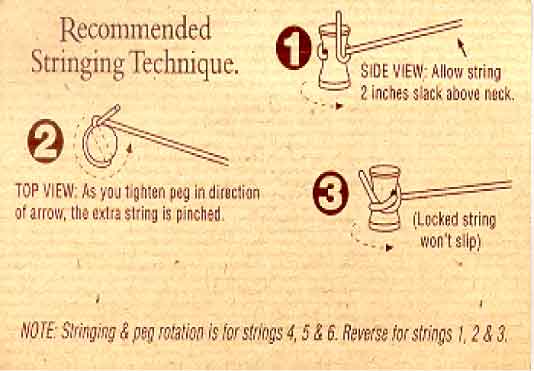
Wrap issues: Strings can slip a bit around the tuner post. Here’s how I string my guitars and I’ve had pretty good results this way. I like at least 3 wraps around the post when I’m done and don’t let a wrap cross over other wraps.
B. Tuners: OEM tuners on less expensive guitars can be crap and slip. I like Schallers but good Grovers are good too. I’d check the wraps (#1) before I’d go replacing the tuners though. A set of strings is less expensive than a set of tuners.
iii. Neck Bow: I just included this to eliminate it. If you start off restringing by taking ALL the strings off first and tuning each string as you, well, string it, by the time you get the 3rd string on, you’ll have put enough “pull” on the neck to change the bow a bit and the first string you’ve put will be flat. But if you’re just retuning and not making any more adjustment than a whole step in pitch, it’s not the neck bow.
Bridge: Is it mounted solidly? Do the parts you adjust for intonation move fore and aft or up and down (well, down)? My soft tail Strat needed 3 tunings to get it dialed in. If I ever get another Strat, I’ll get a hard tail for it.
I think #1 is most likely the cause of your problem. It’s the least expensive to take care of anyway.
Watching the ‘needle’ on my tuner, when I pluck the open string, the needle starts in one position and then goes down (flat) just a little bit, then settles in position. It doesn’t take long, just a half-second, maybe. If I pluck the same string again, it does the same thing, so it’s not the tuning peg slipping.
Maybe that’s just the normal way that the tuner works; it has to analyze the incoming signal and maybe it takes a few vibrations to lock in. With my stand-alone tuner, I watch it so that it settles in on the correct pitch for each string. The one in Rocksmith is hard to describe if you haven’t used it, but it tells you which string to tune. As soon as it thinks that string is in tune, it jumps to the next one. For me, it makes that jump too quickly. I want it to stay on one string until I know it’s correct.
A regular poster to the Vintage Corner found a gorgeous, under-the-bed sunburst 1936 Martin flattop. Wow.
Do you guys want to hear about stuff like this, or is it just Antiques Roadshow wankery? A guitar is always a tool first, and I don’t like any bling on my guitars, but a cool, old guitar with a history as a great tool? Swoon.
Speaking for myself, I think it’s very cool. Of course, I love the Antiques Roadshow.
Apropos of nothing, I have a violin in my closet that my grandfather made and taught himself to play in the 40’s. I need to take it somewhere and get it checked out/tuned up.
It’s a bit of both. I love hearing about these instruments, but I don’t understand the value or history of them very well. If I found one I’d have no idea what I had or why it was cool, but it’s great sharing your geeking out about this stuff.
This is an actual physical phenomenon. The attack is slightly sharper than the sustain. The harder you pluck (within reason) the more you see this effect.
If you’re using a digital tuner, just pick it where you would normally but let the initial attack pass. Or just do a 12th fret harmonic - it will sustain longer anyway…
Lots of electronic tuners are jumpy and frustrating. If Rocksmith’s tuner is too frustrating, buy one of these, stick it on your headstock, and use that to tune up at your leisure. I own a couple of those and they work pretty well and are very inexpensive.
Oh, okay, I didn’t know that was a known phenomenon. I guess I didn’t notice it before; thought I had gotten something wrong when I restrung my guitar once. I assume that you tune for the sustain to be on the correct pitch.
And ZenBeam is right; Rocksmith seems to jump to the next string too quickly. I’ve been using my stand-alone tuner before I start the software. I’ve played just about all the E standard songs that it has (not all that well yet, of course), though, so I’m not sure what I’ll do once I get into the alternate tunings.
Yes, simultaneous (with two of their cables, of course). I’ve only played Nonstop Play, but you can also select Play a Song, Session Mode, Head to Head Score Attack, and Duet Score Attack. When you go into multiplayer, you load a second PS3 profile, so it knows how good each player is. (That’s for RS14. The original has multiplayer, but I’ve never used it.)
I discovered that from the main page, if you go to Tools (the Start button on PS3), there’s a little Tuner bar in the bottom left corner. Strum an open string, and it tells you the pitch it’s tuned at, and how far off it is. It varies over time, so you can’t nail it to +/- 0, but you can get a good feel for how accurate Rocksmith can tell your tuning. Also, you can tune each string without it jumping to the next.
Nonstop play is pretty nice, but I wish i could save setlists, so I could make sets with each of the main tunings.