Its amazing how little is in that box now. The circuit board is barely 3x2 inches. Smaller than the 5 inch speaker.
I’m not sure just how much interest this will be to people, but as a fan of Peter Hammill (not especially noted for his guitar work) I received a notification that, now he’s getting older and needing to downsize, he has some items in a big UK guitar auction coming up soon…
I don’t expect his items will interest many of you, but there are plenty more to view. Maybe too many as there are hundreds of items, at 20 per page. Just realised there is a search function though!
This is the link to Guitar Auctions at Gardiner Houlgate.
(Hammill’s equipment is shown on page 24 (lots 527 - 537) on day one of the auction.)
I found a 432hz based song. I Don’t Want to Talk About It by Crazy Horse ( Neil Young’s band)
Starts with Am G with hammer ons. They use a D in the chorus.
It sounds off in 440hz. I rarely run into 432hz tuning. It’s required to play along with the record.
The slide part is very good. Makes me want to learn slide guitar.
Link https://youtu.be/NBz_2EqJ5wI?si=-cB-pmPk2fjuQYEt
Heheh, fixating on 432hz based A is silly. Just play it a half step lower. If 8 hz is magic, why not go further?
I’d usually play that song in standard tuning.
I noticed it sounded a little off playing with the record. I got curious and the alternate 432 tuning dialed it in.
A cover band would want to use 440. It’s too much hassle for everybody to special tune.
I haven’t tested this list, but it’s interesting.
It’s not so common these days, but a few decades ago if a band consisted of guitarists (without any concert pitch instrument like a piano), they might get in tune together without worrying about tuning standards?
And usually if they were in tune with each other, it didn’t really matter.
Unless perhaps you are gifted (or cursed) with absolute pitch, it was fine.
I’m not sure I could tell the difference between 432 and 440 if all the instruments are in tune together without checking against a reference tone?
Looking at a few others. Stevie Ray Vaughn was well known for tuning down a half-step, presumably to make heavier strings easier to bend.
I’d always heard that Hendrix often did so too, but now that I listen to some of his more well-known work, a lot of it is in 440 concert?
That’s true. I’m not 100% sure that song is in 432. It sounds off when I strum Am Am7 and G Gsus4 in the verse. I changed my strobe tuner to 432 and it sounds much closer.
You may be right that all the guitars may have tuned together without a reference. I’ve never been good at tuning my guitar to a record. I’ve seen guys do it.
The Stones Wild Horses also uses the G to Gsus4. You can clearly hear when they hammer onto the open B string. Very distinctive motif.
On top of that, this is the kind of thing you’d rarely notice before the age of digital playback. Only high end turntables had pitch adjustment and a strobe to calibrate it. With consumer tape machines and with most turntables, you were going to listen to the recording at the pitch all of it’s mechanical idiosyncrasies played it at. That isn’t necessarily the original pitch it was recorded at.
Heck, even with professional recording gear it wasn’t necessarily calibrated as well as it should be. So pitch drift sometimes did get unintentionally introduced in the mixing and mastering stages.
Seriously, the fixation on 432hz=A is madness. A being standardized to 440hz is pretty arbitrary, and 432hz is just an alternate arbitrary standard.
After a long wait, my PureSalem Classic Creep bass is supposed to be mailed out next week or the week after. I’m excited, and now I’ll know how big it is and can search for a case. I’ve never had a green bass before!
Many, many famous and not so famous tunes were recorded “down in the cracks” or something other than A=440, higher or lower. Sometimes I wonder if 440 was actually the exception if not the rule. Anyone trying to play along with popular hits will soon discover this.
I once had a belt driven turntable that started out accurate and got less in pitch as the belt stretched. Drove me f’ing crazy and I finally had to get rid of it. I guess I had a pretty good ear. Digital music was truly a revelation, and anything but 440 would be incredibly jarring to me now.
Don’t they correct recorded music to accurate pitch these days? I’d be very surprised if that wasn’t the case. I mean, a few cents out of true is of course expected, but my (example) Led Zep collection doesn’t seem to be out of true for the most part. Otherwise listening to one track then the next would be jarring as heck.
Agreed. I hadn’t even been aware it was a ‘thing’. Now that I look it up, It seems to be an odd mix of new-age woo-woo and wannabe audiophile snobbery. Very silly.
Audacity is very handy for this: it lets you adjust pitch of a recording by a fraction of a semitone without affecting speed or timing.
I’m not impressed by 432 either. Supposedly the sound is slightly unsettling because we hear 440 A tunning from cradle to grave. I personally don’t notice that difference.
I only wanted my guitar tuned to the record. I sometimes will tweak the media player a few cents to achieve that tuning. Wham’s song Last Christmas is off about 25 cents IIRC.
I will try tuning my guitar down a half step and see how that works with I Don’t Want to Talk About It. I think it’s Crazy Horse only hit. The Rod Stewart cover is more widely remembered.
Personally if I’m trying to work out chords I prefer to adjust the recording to a 440 standard, rather than trying to tweak the guitar every time. Unless there’s some particular reason why you really have to play with the actual original recording?
You may have a very good ear. I had a turntable that played everything a bit fast. I never noticed it myself, but my friend said that every record he heard on it sounded like the Chipmunks to him.
Well, most music is recorded recorded digitally these days. If I pay for studio time, I still often get my bass track and the drum tracks initially recorded to a rented tape so we can saturate it and get the compression and distortion you get from that. Since it gets bounced to a digital track pretty much immediately from the same machine that recorded it, drift isn’t as much of a problem as it would be if the tape was moving between machines.
If an older recording had drifted as its multi track tape and stereo masters got moved between machines in the production process, I’d assume they’d usually do their best to correct that while they were making the digital master. I do have some early CDs that didn’t get so much as an EQ adjustment when they transferred it to digital, though. They don’t sound great, and I’d be surprised if anyone had tried to pitch correct those.
Interesting. Do you feel it is worth the extra complexity, though?
Supposedly digital processing can approximate almost any analog effect very closely these days?
Not knocking your process at all: we use what we are comfortable with!
Hehehe, yeah, I’m aware of that being quite possible, and technically wayyyyyy more flexible. And even though the drummer I normally work with is a little fixated on tape; we’re really paying for the studio time to have the nice big room that’s all set up to record drums, the selection of mics, and the compressors that are attached to a guy that knows those particular units really well.
So since that drummer is normally a “one take and done” guy (I can generally keep up) and the tape machine is sitting right there, paying $50 for a tape rental seems kind of like a no-brainer. If we’re trying to emulate tape saturation later, we would probably use more than $50 worth of studio time trying to tweak it.
Plus, there’s something nice about the mental finality of “ok, that’s completely done, can’t really change it much without a bunch of work, move on” when you put something down to tape. Even if I bought my own place to set up a studio, I’d be on the fence about buying a 1" or 1/2" tape machine. Plugins can do it pretty well, but the real thing is pretty easy for the limited use of the base tracks, and it makes you more likely to say something is “done” and move onto the next thing.
Something that is likely to require a lot of punch-ins or re-takes? No, I never want to record that to tape again. Lead parts such as vocals, guitars, even keys should generally be recorded digitally. There’s usually at least some futzing around with those, and that’s just too much of a pain with tape. Throw the plugins at those.
I am well aware of all kinds of recordings being played back on good equipment that is still in the cracks. Probably was mastered that way in many cases, or in an equally large amount of cases just went straight to wire or cylinder like that.
But what I want to know is, how many people really cherish their delay pedal(s)? Yeah, yeah, black Friday, whatever, but I’m not am ****o* “Prime” member, so I don’t get any sweet savings.
But I’m feeling the need for some tight slapback on the Squier Tele…which, really, I’ve put the archtop in its hard case since colder weather is coming and I just “play” guitar at my desk at home with a space heater going. The Telecaster is not bothered by direct application of raw power in the form of heat.
So, that one does everything I can pretend to do on guitar, from James Burton or Keith Richards, to Wes or Pat, but stays in standard tuning to just do regular things. Yes, I should have a second cheap Tele that stays in open G, but whatever.
So, to me, a little delay pedal should be ideal, not only for giving some slapback for the country picking, probably into that blue Boss compressor, but also, just flick off the compressor, and leave the delay on for more regular music, aka jazz, and leave the reverb out of the equation altogether, which means a simpler rig. No reverb pedal, no nothing. Delay, compressor (the Boss is quiet as a pedal, so just stomp it off as needed), and straight to the little TC BAM200.
And, since many delay pedals have a limited added bonus of a small-capacity looper, use that as well. For practice, not performance.
Eh, it seems to me that for under two bills (really, under a bill and a quarter would be better) I should be able to find a reasonable delay pedal that can do me up the slapback (which can easily be dialed in as a subtle little reverb-type effect) and serve a purpose as a little looper.
How do you all roll with that?
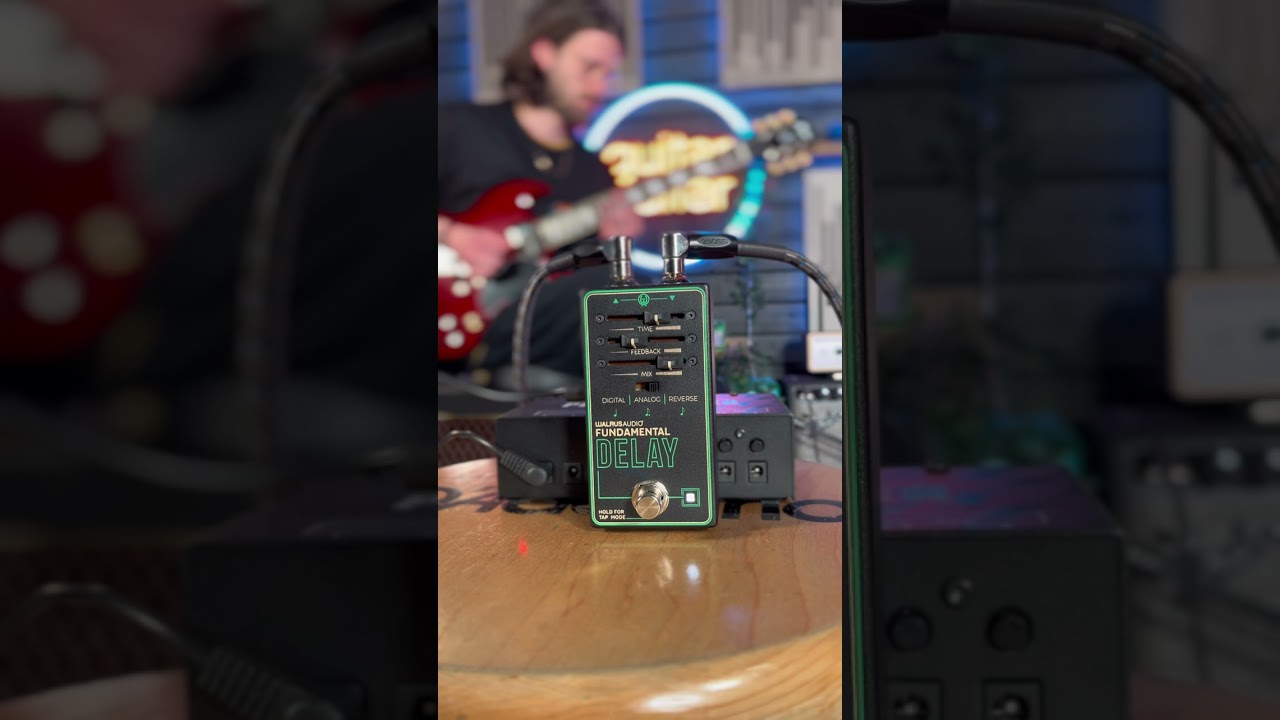
I’m looking at the Walrus delay. The one in this vid is about $100.
Youtube short