In a studio environment, you might instead run it straight into the desk and use the studio monitors and/or headphones to hear what you’re doing. You could use the XLR outputs or even the USB cable for that
On stage you’d run it directly into the board, and you’d either get your sound back through your IEMs, the floor monitors, or if you wanted stage volume, you’d run it through the FRFR cab.
If you really wanted, you could run it into an amp set as clean and neutral as you could, but then you’d want to turn the cabinet simulation off on the Tone Master as simulating a cab into an actual amp and cab could easily make things muddy. Of course you could also use the thing just as an effects unit into your amp, turning the amp simulation off entirely and just using the EQ and simulated stompboxes as normal.
Where it gets fun is that this unit has enough spare processing power is that you can set up the routing to do all these things at once, as well as taking microphone input and running an entirely separate audio path with effects for vocals.
The one thing people are unlikely to do is run the output into a powered speaker and then mic that up, as the cab IRs already include 4 or 5 simulated mics in 20 32 different on and off axis locations. But I don’t know, maybe mic-ing it works too?but the main conceit of this or any of the high-end modelers is that they’re producing a finished signal that’s ready to go straight into a mix.
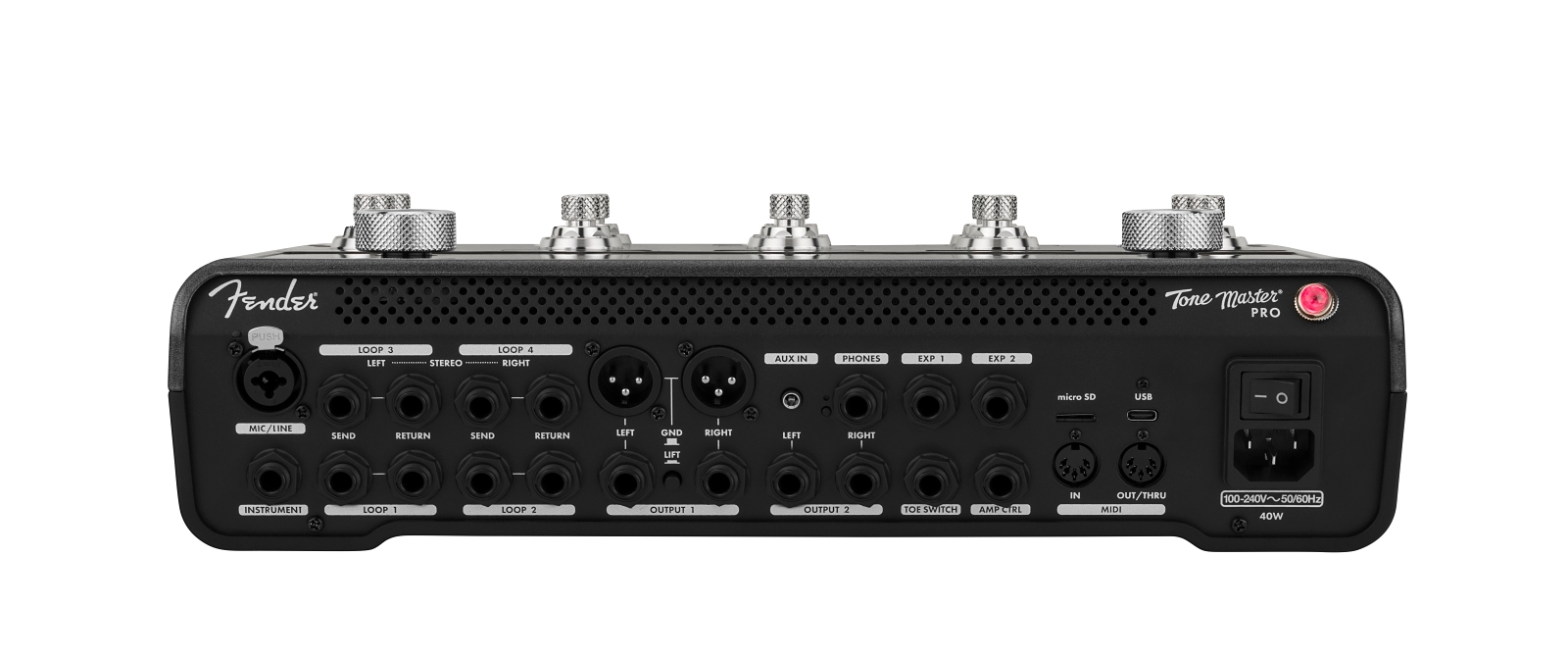
Holy cow. I just took a look at the back panel and it’s insane how much connectivity it has:
And it has a dedicated signal path for mic/vocals? The hell? Nice piece of tech. No idea if this will bust out for Fender, but it is impressive.
I should add: I learned a new acronym today, FRFR. Thanks. Is that what you’d use at home? If I was gifted one of these I might initially hook it to my HTR (powered monitors + subwoofer) until I figured out something better, but that seems suboptimal.
So get this: it doesn’t have a dedicated path for vocals. It has enough processing power to separately route any two kinds of inputs through their independent signal chains. And then rout them to separate outputs. Or not. You could run separate effects paths to a point and merge them to a single path, in stereo panned as you like or mono.
I think the powered monitors solution is actually a great solution. The key with any of these modelers is that you want a transparent, uncolored setup for hearing the output. Headphones, monitors, or an FRFR can all work because the accurately present the sound created in the unit. That’s as opposed to a guitar amp which is meant to be part of why a guitar sounds the way it does. Vintage Celestions as in a Marshall stack have a very unique sound all their own. If you wouldn’t want to run your stereo out through it, you wouldn’t want run a modeler through it (unless you turn off the speaker simulation altogether).
I keep trying to sneak up on what you do as a monitoring solution with this thing, and you keep being super super helpful with what you could do, and awesome. But what do you do? thanks!
Ah well, do as I say, not as I do. I wanted to demo the Fender speaker that pairs with this unit, but they’re out of stock nationally so I have to wait.
In the meantime, I use headphones out of the back of the unit, headphones out of my laptop running Logic Pro, or when I want to move some air, I connect it into the power amp in of a Boss Katana Artist.
The Katana does color the sound a bit, but surprisingly little, mostly because I can bypass the preamp and effects sections and go straight to the power amp. The cabinet sound is more neutral than most because it’s meant to simulate a number of types of cabinets already.
I will probably get the Fender speaker and sell the katana, but I’d like to try one out first.
I play with two guitarists (tomorrow is practice day…JOY!!!). One of them plugs straight into a smaller tube Marshall combo and that’s it. He doesn’t modify anything except his guitar volume and that works for his parts The other guy has the Line 6 equivalent of that cool Fender unit and he runs it into a Line 6 FRFR cab. He’s the better guitarist (not that guy 1 is a slouch) and he does all the parts requiring modulation/effects. Together, they sound great (at least in my IMHO). My bass is running straight into an Ampeg combo that “guy 1” has in his garage where we play. It’s getting very cold and his garage is uninsulated – I’m hoping we can move to my insulated, detached garage that has an actual built-in heater…I may not get to 60s, but I can get to 50s. I need to buy my own bass amp and if we would start playing in my own garage it would be a great excuse to give my wife She sees my two guitar amps and thinks I should be covered for bass as well (I do use them for bass, but at low volumes so I don’t kill them).
I bet that Fender unit into their FRFR cab is probably a lot of fun.
As far as I can see this has a lot of amp & cabinet sims.
Plus all the usual effects: reverb, chorus, etc etc.
Does it go any further in processing or modeling, though?
For example, can it do polyphonic pitch shifting, at least a few steps up and down, without sounding unnatural?
There’s a chromatic pitch shifter and a Digitech Whammy built in, but no polyphonic shifter yet. That’s coming in a future firmware release. Fender have committed to bringing many more amps and effects over time. As an example, there’s really no bass-oriented rigs in here other than a tube preamp for DI. No tweeds or brownface amps either. All coming soon-ish, supposedly.
Do you have an example of a polyphonic pitch shifter that you think sounds good? It’s never been an effect I’ve thought to explore so I’m not very knowledgeable, but what I have played with always sounds really processed.
I just threw the chromatic pitch shifter into one of my presets, then did the same with the harmonizing pitch shifter and the Digitech Whammy. The chromatic and harmonizing shifters sound just ok. About like every other example of them I’ve ever heard. Would be nice as part of a signal chain or an coloring effect blended into the mix, but I could never imagine using the effect by itself instead of a capo, playing in different tuning, playing up or down the neck or double tracking.
I will say it sounds better tuned down than up. I could fake a convincing bass tone in a mix. You’d know right away hearing it solo, but in the context of a song it would work.
The Whammy pedal sounds good to me, but it’s a different effect and for getting some wilder Tom Morello type sounds IMO.
I just watched a video for the Eventide Pitch Factor pedal, which I gather is more or less the gold standard for pitch effects. The built in effects in the Fender are less flexible (the Eventide does automatic arpeggios and other slick stuff) but the Fender sounds about the same to my ears as the Eventide for pure pitch shifting ability.
I think I just don’t like the effect. That or I haven’t found a use case where it appeals.
Now I’m a two Squier household. The Classic Vibe '70s Custom in sunburst just arrived today. Significant fret buzz…it’s getting a set of 11/49s and I’ll work on the action once I get those settled in.
The split shaft tuners are a game changer for me. Never used them before, but so simple and nice.
The other Squier Sonic Tele is waiting for a set of 12s in flatwound for which I’m going to substitute a plain G in for the wound G. That’s going to stay in Open G tuning…might just keep the sixth string from the 12/52 set, or put in an 0.042 on the bottom and tune it in unison with the fifth string…no real reason.
Yeah, the CV '70s is a sunburst, but it actually looks really good in person. It has that burnt maple fretboard as well. Of course the infamous Keef black model he used to beat somebody with on stage was more expensive, but this will do.
Neck feels good, and it’s not one of those drippy thick poly finishes. I guess you’d call the neck a pretty shallow C, but the finish feels fine out of the box, not sticky or anything.
My Squier CV, as well as my G&L bass, have the poly finishes on the neck and I’ve never found them sticky compared to the necks on my much older Harmony and Hondo (not sure what was on either, and the Harmony is fairly well rubbed off). Are some poly finishes sticky?

 She sees my two guitar amps and thinks I should be covered for bass as well (I do use them for bass, but at low volumes so I don’t kill them).

