I went to my first legit rock concert since I started playing the bass in earnest during the summer and both bands had bassists that I think leaned into the fuzz on several songs. They were moving some air in the venue. Below is one of the songs the openers played. They opened for Silversun Pickups.
Okay, guitar heads - I’m contemplating getting a MIDI guitar or a ‘digital’ guitar. I have three big questions for the group -
-
Does anyone currently make a true MIDI guitar? EG, a guitar shaped controller for signals that does not involve taking a note from a string and converting it into a digital signal? Transposition is one of the main reasons I’m looking into this, and I don’t want to be distracted by hearing a different pitch from the string than the pitch I hear through the amp.
-
Is there such a thing as a 7- or an 8-string MIDI or digital guitar?
-
Is there such a thing as a MIDI or digital touch/tapping instrument, such as a Chapman Stick or a Warr Guitar?
At present, I need three different guitars to play eight songs. Having something that has a repertoire of alternate tunings would go a long way towards bringing that down to one instrument.
There’s no hurry on this question - I won’t be buying anything until I finally get to move to the US, as everything is cheaper down there, and there is a greater selection available.
What are your thoughts?
That is way beyond my simpleton needs, but sounds cool. The guys I play with occasionally need to put a capo on, but other than that we are in standard tuning. We might get a drop D tuning song at some point, but that’s easy to accomplish with one guitar.
Man, if you - multi-sometimes-really-obscure-definitely-eclectic-instrumentalist that you are - don’t know, well, hell, I sure don’t. I’m only aware of Variax (Variaxen?) at this point, which breaks all of your three parameters and didn’t seem like all that great anyway, plus they stopped making them.
I didn’t know off-hand, but was curious. There is a guitar, Lineage, by Inspired Instruments that is a stringless MIDI controller.
If the issue is just alternate tuning on the fly, there is a product, Performer, by AxCent that can automatically switch tunings. I think Sonny Landreth was using the previous version, Trans Performer, at one point.
Well, it is a question of tuning, but - it’s that for vocal reasons, the steel 6- string is down a whole tone, the electric is down a minor third. (The twelve is also down a tone, but I’ve always done that, so I think of it as standard…) That’s before I do any of the alternate tunings… Going through the album in order -
- Standard tuning on the 12 (dD, gG, cC, Ff, aa, dd) 2. standard tuning on the steel six (D, G, C, F, a, d) 3. drop D, capo 3 on the six (Eb, Bb, Eb, Ab, c, f) 4. drop D, capo 2 on the six (D, A, D, G, b, e), 5. drop D on the 12 (cC, dD, gG, cC, Ff, aa, dd) 6. raised C on the electric (but still down a minor third - C#, F#, B, E, a, c#), 7. Drop D, capo 2 on the six (D, A, D, G, b, e), 8. standard tuning on the electric (C#, F#, B, E, g#, c#).
So, my options are - 1. multiple guitars. 2. The electric and capo up a lot, sometimes as high as the 6th fret. 3. The steel six, capo up a lot and have to sing #6 a semi-tone higher. That’s a drag, as it’s already the highest song on the list. The twelve for all of them is right out.
Then I hear about how Joni Mitchell uses some kind of MIDI/digital instrument that remembers all her tunings, and I think “Ah, that might be fun!”.
I think further about the various touch/tap instruments I know, and I find myself thinking “Hmm, maybe the extra strings and using both hands might solve some of my problems…”. And then, I think “Hmm, maybe if there’s such a thing as a MIDI Warr Guitar, I could scratch both itches at the same time…”.
Sadly, even in Toronto, I haven’t been able to get my hands on a Stick or Warr Guitar to try one out.
I may just have to go to the shops and ask about Variaxes and their relatives…
I own a Variax (JTV-69), and it does seem like the proper solution for you. There aren’t any 7- or 8-string models, however you can simulate various groupings via custom tunings. The customization options for tuning and pickup selection/placement are pretty nuts; I may or may not have some models with '59 PAFs modeled at the 15th fret, just because I could (very wooly-sounding, for the curious).
It’ll handle going from 12-string acoustic (Gibson and Guild models) to 6-string electric (the usual suspects, including a Danelectro w/ lipstick pups) —and when paired with a POD HD500X (my model) or a Helix, you can perform one-step patch/guitar/tuning changes mid-song. When playing at concert volume, using IEMs, or a good pair of closed-back cans I don’t have any problem with “acoustic bleed”, but have experienced it when tracking in the control room with near-field monitors. There’s currently multiple models on Reverb, averaging ~$1K.
Other options for you might be a Roland GK system (aftermarket, designed for 6 strings) or, if you can find one (out-of-production, runs about $2-$2.5k) - an obscure controller called the MISA Kitara.
Interesting to hear from an actual owner. I’ve toyed with the idea of a variax for a while now but never took the plunge… and now they seem to be discontinued… 
I gather you’re fairly happy with it?
Yes, I enjoy it quite a bit - meets my needs perfectly. For the past 5 years or so I’ve been sticking to studio work, and it’s very handy to just turn a knob and get a facsimile of whatever model I want for that song.
Will the models fool someone with golden ears? No, but I’m not making music for them anyways, I worry about the other 99% of people  There’s also something to be said for having configurations that aren’t normally physically possible, such as using a whammy bar with a 12-string acoustic.
TBH, the biggest drag with it is keeping the batteries charged (camera-type batteries) and, since it’s OOP it can be tricky to source replacements for them. That said, it can draw power from one of the floor units, which is how I usually use it.
There is this 
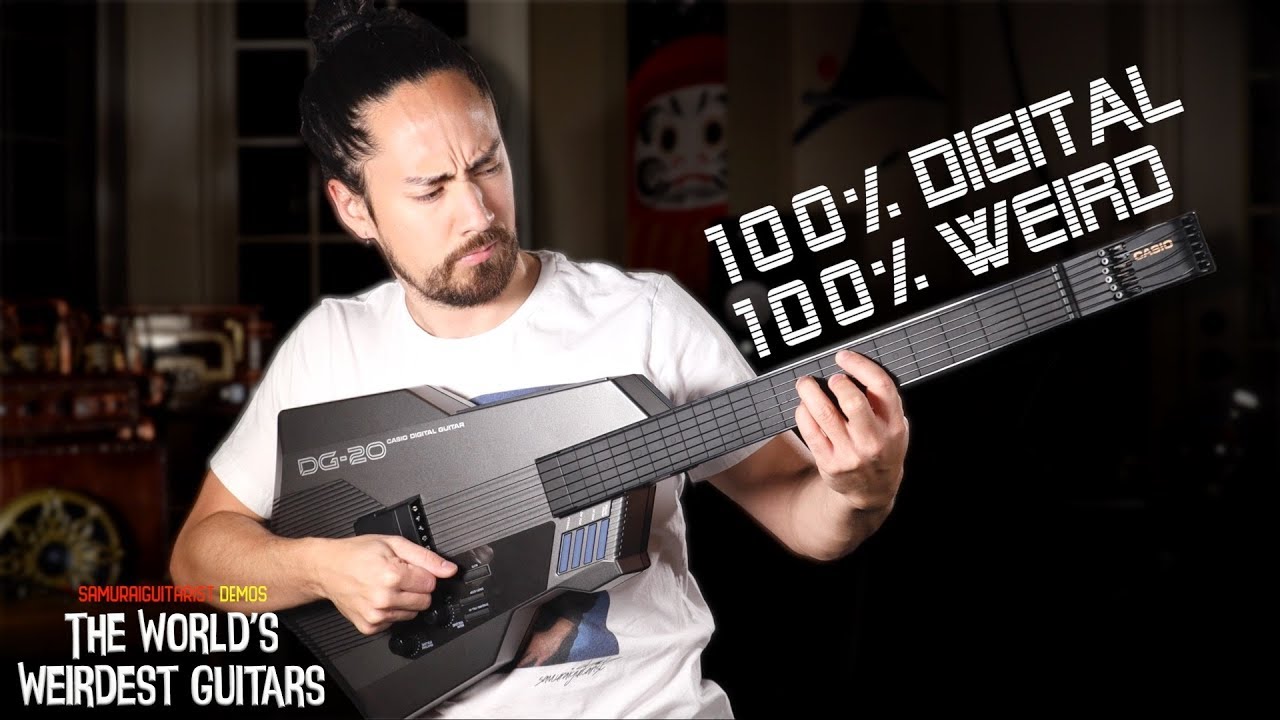
Too bad it is unplayable, according to the review. Also it is not a guitar, in that it is a MIDI controller but the strings otherwise do not do anything.
Why stop there?
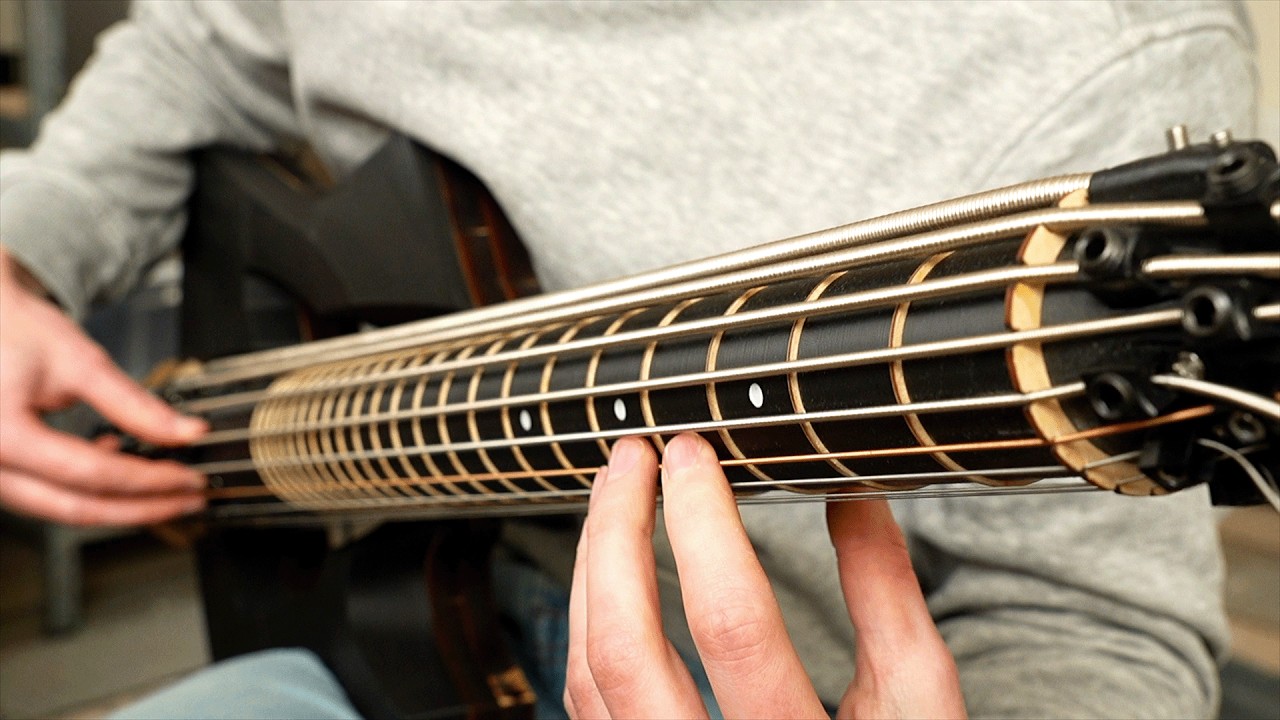
The only first hand experience I can relate is that I had a MIDI guitar, I think it was made by Casio, about 20+ years ago. It wasn’t really usable: the tracking was terrible. There was a very perceptible delay between playing the note and the MIDI output sounding on whatever synth you sent the MIDI to.
Rather put me off the whole concept.
Yeah, I’ve heard about ‘latency’ issues, and that’s a deal-breaker for me. My understanding is that the situation has improved, but I haven’t heard anything recently…
I used the casio on a couple of recordings, but you had to adjust your playing style.
Needed to be very precise, and in fact try to play a fraction ahead of the beat.
Wouldn’t have worked at all in a live context.
Apparently the variax models don’t have a significant latency issue.
Perhaps rsThump can comment?
I’m concerned though that they have been discontinued: if you have problems with the electronics, it’s not something that a regular guitar tech is going to be able to help with…
The latency with MIDI (and MIDI-fied) guitars isn’t playable yet, IMHO. The best I’ve heard is ~25ms which is enough to drag behind everything else. My primary instrument is bass, so I’m pretty sensitive to latency issues—they kill my pocket.
Since it seems like you’re more interested in alternate tunings than controlling other timbres, I wouldn’t bother with MIDI as a solution.
There isn’t any noticeable delay with the Variax. However, finding spare batteries can be an issue, like I mentioned before. I haven’t had any problems with the electronics on my 11-year-old model, and I’ve never heard any of my luthier friends complain about them, other than the fact it’s a modeling guitar.
Now that I think about it, @Le_Ministre_de_l_au-dela, you might want to check into Tronical Tuners, an after-market “robot tuner”. They weren’t well received when used on the 2015 Gibsons (because they applied them to the ENTIRE line), but when used as designed they worked okay. There’s also a lower-end Peavey model that had an integrated Antares system for alternate tunings, but it’s a Peavey guitar…I wouldn’t bother with it.
Sorry about the hijack, but this is shocking to me! 25 ms would indeed be unplayable in my book. Never heard of that kind of MIDI latency with keyboards, e.g., but maybe the guitar-MIDI rigs are still using 1980s tech?
If I’m remembering right, 25 ms would be about equivalent to putting your speaker/monitor 25 feet away from you…not crossing the Grand Canyon, but you definitely hear it. In the early 2000s, when softsynths really became “the thing,” getting audio latency down to 10 or 12 ms was pretty good, and you could work with that. I don’t recall any issues with MIDI latency…using keyboards. Probably people measured things out, but I don’t remember hearing much talk about it at all.
You are 100% correct about it not really being a concern with keyboard controllers. The difference is that a MIDI-fied guitar has a couple extra layers of processing involved, which adds up. With a keyboard controller (and this is a very simplified explanation), the key sends a signal to trigger a specific note (from 0-127), along with some other information (velocity, aftertouch, etc.)
With a MIDI-fied guitar, the signal has to be converted from analog to digital, then analyzed for pitch and dynamic information (among other things) before it can be translated to the correct MIDI note and sent on down the chain. Add in the guitar’s naturally polyphonic signal, and even more processing must be done to break it down into the individual notes. To be honest, I have zero clue how they deal with the fact a guitar can play two E4s simultaneously while most instruments can’t…
You are remembering right about how 25ms would feel to the player who’s used to “instant” response. For a frame of reference, 10ms of latency is where chorusing starts to occur, which is why that was the target 20 years ago (and still is). If you really want some fun, try areal-time, long-distance live-jam…currently that industry is trying to crack the 50ms/650mile barrier.
Brilliant explanation. Thanks! Yeah, when you think about it, even the analog conversion alone is going to likely be pretty miserable…one of these days I’ll have to look into how other MIDIfied acoustic instruments (I think Chick Corea’s Rhodes piano had a MIDI sensor strip … wait a minute, those are still just on-off switches with velocity &c.
Happy to help! You might be right about the sensor strip, too. All you really need is a piezo element and something that can translate the voltage into MIDI. I’ve used cannibalized Radio Shack buzzers (3.5v worked best) to MIDIfy acoustic drums.
The problem is, it’s a Rhodes—they operate on the same principle as an electric guitar does, just substituting metal tines for the metal strings. Maybe he did both?
Eh, probably not…you’re right that the Rhodes uses passive magnetic pickups, not very hot, and not very adjustable, and gives a pretty low instrument level output (yeah, there were models with built-in preamps and all that, but whatever), but I’d bet anything his tech put down a MIDI sensor strip underneath the keys. Probably bespoke, high quality, and not just something ripped out of a toy controller!
Anyway I think Chick pretty much always used effects, like a wah pedal (either cocked or being used to modulate). Pretty sure it was a super fancy Rhodes, teched by an expert to the utmost.
Herbie’s too, when that was one of his main instruments, especially given his engineering education.
Anyway, I’ll stop yammering OT…
So, anyway, them keytars! Herbie did OK with those! Don’t need strings, but it sure looks like a git-fiddle! From the future!