(looks at Fender’s website to see what short scales they have besides the Mustang). Wow, they have a lot of different short scale basses at the moment. Which one didjya get? I’m personally hoping it’s a SS Paranormal Rascal.
I’ve been playing 6-string since the 80s. Bought a bass several years ago and started playing, and loving it. Met a couple guitar players that needed a bass player and I stepped in. I’m LOVING playing bass. I’m getting older, and the physicality and stretching required to play for a couple hours is getting to me (picking up a 6-string is comical right now).
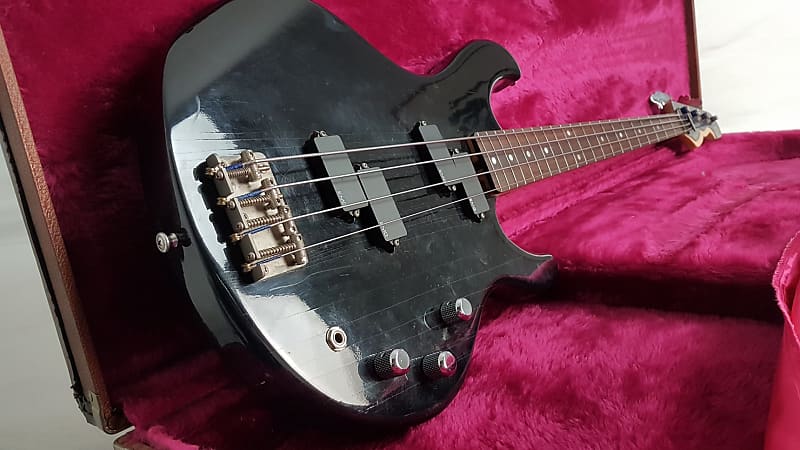
Sorry, it’s a Mustang. And it is 2 lbs lighter than my other bass. That is what I’m most excited about…8 lbs vs 10 lbs. We played our normal 2 hours today and I look forward to a guitar weight soon. And unlike you, I would consider myself a middling bass player but I hope I can get some advantages with a short-scale bass. Yeah, it’s a bit cheating. Also, it will give me a chance to do so work on the full-size bass that I’ve been putting off. I was worried I would put my only bass out of commission.
Heheeh, no reason to apologize. I have just lusted after one of the Rascals since I first saw them. I have no reason to need another bass, but if they offered it in black, I’d probably already own one.
I have one of the newer Mustangs, and it’s one of my favorite basses, even though it’s loaned out at the moment. It’s got an awesome sound (more on that in a sec), and is nice and playable. What color did you get? I got mine when the only options were white and light blue. I picked the light blue, but still am not crazy about the color. Maybe I’ll re-spray it purple.
Heheee, I’m no great shakes, and it’s not even close to cheating. I don’t know why Fender chose a 34" scale for the first electric basses. Short scale basses not only are a bit easier to play, but they have a different sound. With a short scale bass, there’s a noticeable emphasis on the fundamental and fewer overtones.
I actually prefer their sound, and think my Danelectro Longhorn is probably my best sounding (and most versatile) bass. Unfortunately, I hate its copper burst finish more than I dislike the light blue finish on my Mustang. That’s one I’ll probably actually replace pretty soon. I love playing it, but hate looking at it.
That is one of the good things about owning too many guitars/basses. You’ve always got a backup (and I always bring a backup to a show). Break a string or a tuner? No problem, grab the other one.
Of course, right now I have three basses or guitars that I need to fix. Two have broken tuners, the other one has an annoying habit of its set screws backing out of the string saddles, slowly lowering the action while you play it. Since it’s an SX, and normal Fender parts probably won’t fit, I’m probably just going to try replacing the string saddles and their adjustment screws (and then loan it out to get my Mustang back  )
)
I remember this coming up at the office once, and this is what I was able to dig up…
The 34-inch scale length, derived from a physics textbook borrowed from secretary Elizabeth Nagel Hayzlett, a student at UCLA, proved to be perfect. According to Fullerton, Leo tried different scales on his test bench, choosing the longest scale players could easily fret. He saw no use making an instrument some players could not manage. In the 1960s he would develop shorter-scale models that played easier but never sounded quite as good as the originals. Leo’s long scale length provided the string tension that created a more euphonic resonance.
Fender: the Sound Heard 'Round The World - Richard R. Smith, p. 103
I’m the most boring color picker or all time because I love…drumroll please…sunbursts. I have three electric guitars, all sunburst (Japanese V clone is a red burst, old Harmony is a red burst, Tele is classic 3-color burst), my G&L bass is a yellow burst, and the new Mustang is a standard 3-color burst. My old Guild acoustic is the only one that isn’t burst and I’m a little sad about that because I love burst on acoustics too.
Man, that seems like one of those cases where theory gets its face punched in by practice. Or really, that the function of the instrument kind of flies in the face of theory. The thump is where it’s at on the bass, and the SS basses emphasize it.
I have a couple of nice Precisions, and several other basses with the same pickup, some of them short scale. I often use the Precisions. Sometimes it’s because I prefer their colors, plus they’re actually better manufactured basses than most of my short scales, and we’re playing live so the scale difference won’t make much difference in the sound and I’m just used to playing it at this point. Plus, in something like 50% (yep, number pulled out of my hindus) of the songs you hear, it’s a precision you’re hearing. So it is just a known quantity, applicable to almost any style, and the guy running the board already knows where/how to mix it. It’ll sound good.
But, all of those factors aside, I strongly think my short scale basses sound better, even using the same style pickup*. The Mustang growls and thumps better when set to it’s split-P pickup, as does the SX short scale until its set screws back out of the saddles (but it does have a Seymour-Duncan 1/4 lb replacement). If the early short scale Fender basses had better pickups, I’d expect them to have been much more successful.
Hehehe, while I would not refuse to buy a guitar because it was a sunburst (I own a few, after all); if another color besides white was available, I’d pick the other color. Unless the other color was natural or some solid stain. Even then, five of my favorite guitars are either natural mahogany or some variant of Gibson’s cherry finish. So yeah, maybe I shouldn’t pick guitars by color.
But I couldn’t handle the natural maple Jazz bass, no matter how good it sounded. I sprayed it metal flake purple, and I have the complete opposite of regret - love playing it and being seen with it. I do still need to replace its tuner.
And well, my favorite burst is a greenburst. So, I’m a total pervert when it comes to bursts. It could be worse.
*And yes, I believe once in this very thread I proclaimed my dislike for this pickup. I have since stopped worrying and learned to love the bomb. I also have a humbucker guitar that I love the sound of now. Oh well.
New Amp
[Yamaha THR10II with bluetooth](Yamaha Wired Desktop 15 Guitar Amps and 8 Effects and Rechargeable Battery, Bluetooth-Enabled, Standard Color ((THR10II)) https://a.co/d/g76v1iY). It can be used as a speaker for music or as a guitar amp and backing tracks.
It’s an updated version of an amp that I originally bought in 2016. Yahama made made several improvements.
They added bluetooth and an App remote.
Very convenient. Set the Amp for the best sound. Then quickly change the amp profile or volume with your phone.
I love the lunch box design. Weighs 6lbs.
Yamaha has another model with Wireless. I decided to buy the Bluetooth model and use my own wireless.
Xvive U2 Digital Wireless Guitar System The online reviews are very impressive.
I did learn that small plastic-case practice amps are too lightweight. Plugging in a guitar cable would tip-over one that I considered.
The Yamaha has a steel case and is very nicely built. Includes AC adapter and rechargeable battery.
So far it’s working as expected. Looking forwars to see how well it records plugged into a DI.
I’ve had a THR10 v.2 for over 10 years now and still use it often, particularly for low volume playing. I use it with both bass and guitar. Works and sounds great!
I’ve regretted selling my THR10 from 2016 a few years ago.
It’s interesting that Yamaha has kept the model and added the newest features.
Bluetooth is great for playing backing tracks on my phone. No 3.5mm plug wire to get tangled.
I’ll share my dumbness: I was thinking the intonation on my Dano 12 string was off, because it was pretty ragged with a capo on the 5th, which a lot of my stuff (such as it is) needs. It’s always jangly of course, but this was pretty severe. So I looked up capo placement and all this time it was supposed to be right behind the fret, not half way to the next one  When I first used a capo, not that long ago, it bugged me to contact it when playing so I positioned it a bit too far.
Speaking of 12 strings, this from a Reddit guy. What do y’all think?
“I learned a trick tuning pianos for 12 strings. The guitar tuner may show “in tune” for both the base and octave strings, but listen closely and you’ll hear some beating harmonics. To stop those, make the higher octave string slightly sharp. You’ll get a much richer tone when the octaves get more in tune. In piano tuning it’s called inharmonicity. If you were to tune a piano with a guitar tuner, it would sound awful across octaves, as the higher octaves need to be sharper and lower octaves flatter to sound “in tune””
I find if you snug the capo right up against the fret, depending on the fret height, it’ll force the strings sharp, and since they’re different diameters each string will have a different sharpness. I place the capo just a skosh “north” of that spot and it works pretty good.
Octave stretching is a real thing, and you could certainly apply it to two strings tuned an octave apart, but on a guitar, compared to a piano, are there not other considerations that might make you, even on a 6-string guitar, tweak the tuning slightly compared to simply applying equal temperament to the open strings?
That said, try tuning the base string first, then e.g. tuning the upper string to the second harmonic— how does it sound to you?
My ear is such that it took the mother of all janglies to make me do something about it. It’s the opposite of perfect pitch. Thank God for Snark tuners. I’d be lost if I tried to tune it to itself, like back when.
They do make electronic tuners so you are not forced to do it by ear  An ideal one for this would be one of those fancy ones that show more than just the fundamental frequency, but I would try it with a phone app.
I had a different but similar feeling problem with my Huss and Dalton acoustic. One day, when tuning the unfretted b string, I would hear this nasty warbling or beating quality to the note. I spent a ridiculous amount of time trying to find a loose brace or a separating join somewhere, assuming it was some sort of sympathetic vibration coming from a loose part somewhere. I mean I thought about this for many days, if not weeks. It really soured me on that particular guitar. Even thought about how I’d get rid of such an obvious dud.
Then, one chilly day, trying once again to tune it without getting angry, I decided the draft from the ceiling fan was just too much. The second I turned off the fan, the pace of the warble slowed, and then it went completely away. Something about how the Individual pulses from the blades of the ceiling fan just perfectly resonated with that b string open note. I was intensely relieved.
Best part of all of this? Months later, I was playing guitar with the ceiling fan on and heard that warbling again and absolutely forgot that I already knew what the solution was. I’m really slipping.
I had a similar experience with a new bass recently. It sounded like I was getting some odd overtones. Turns out it was something that is not normally in my practice room that was ringing.
Sweetened tunings are often used on acoustics.
James Taylor developed one. The steps are easily found with Google. It’s a built-in option on the Peterson Clip tuner.
Taylor and other Pro musicians felt standard tuning didn’t give them the best sound. They would tweak some of the strings a Few cents off perfect pitch.
This is a debate that has been going on since equal temprament was developed.
That of course was a compromise which allowed modulation to any of the 12 keys with ‘least worst’ deviation from the natural-harmonics-based intervals. Bach made full use of this!
For a guitar, if you know what key the song is in and it does not modulate into rather remote other keys, it might be worth doing a bit of microtuning? And perhaps the fundemental of a lower string on a guitar (especially an acoustic) may slightly shift depending on how hard it is hit?
But I think this is a bit esoteric. Personally I just check the tuning on each string with my tuner before I hit the ‘Record’ button.
Q on Fender basses.
A P bass has a single split coil pickup. A J bass has two single coil pickups. A JP bass has a split coil pickup AND a J single coil pickup.
Why no bass with 2 split coil pickups?
Basses with two split P pickups exist. I’ve mostly seen them on MIJ basses from the 70s/80s. Leland Sklar has one he’s played a lot, and others have used them as well.