And if I’m looking north, movement is right-to-left.
Tell you what, you keep moving the goalposts. I’ll stick with observed reality.
And if I’m looking north, movement is right-to-left.
Tell you what, you keep moving the goalposts. I’ll stick with observed reality.
I’m interested in how you can see the sun while looking north, assuming you live in the Northern Hemisphere. And what goalposts did I move?
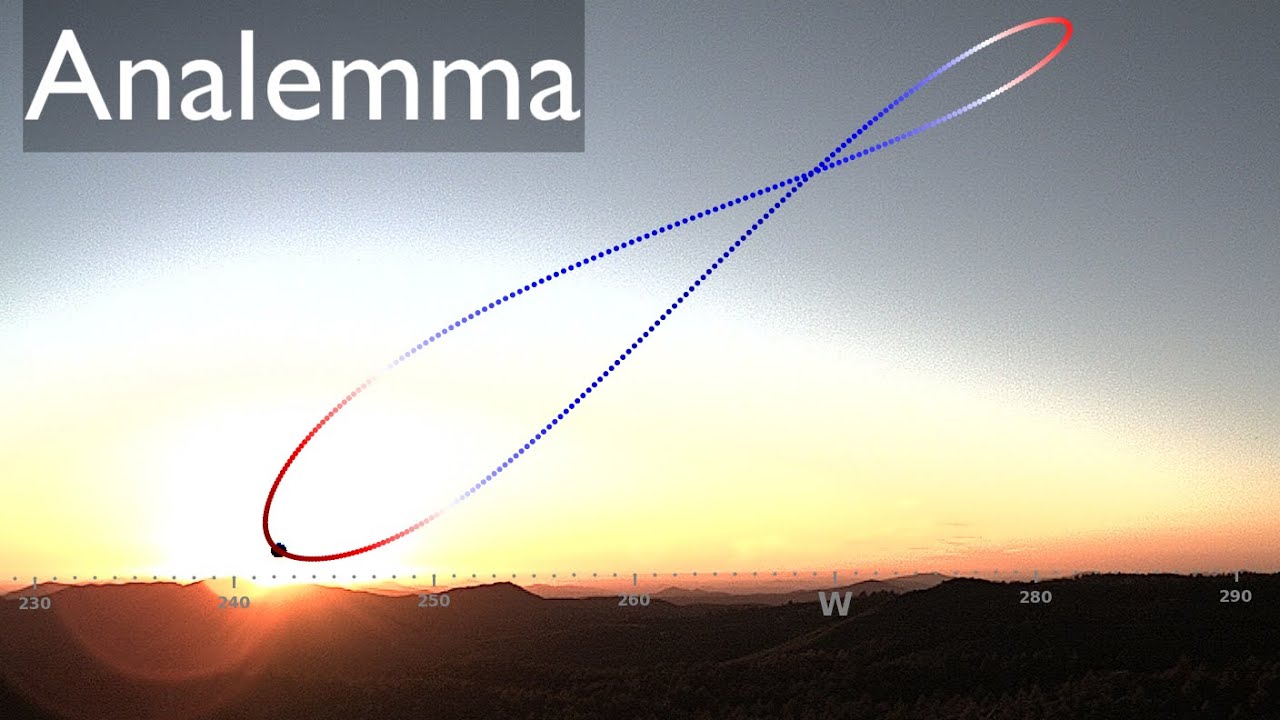
It’s interesting how it makes a figure 8 over the year
The original statement was about sunrises and sunsets. When you look at either a sunrise or sunset in the northern hemisphere, the sun moves from left-to-right as it ascends (sunrise) or descends (sunset).
If you are facing due north at sunrise in the northern hemisphere, the sun rises in the east, which is to your right. You will have to turn your head to see it. But the motion of the sun as it rises is from left-to-right.
So to be clear, we are talking about the motion of the sun when you look at a sunrise or sunset.
I think you are talking about the motion of the sun going on behind you all day if you are facing and looking north. You won’t be able to see it, but yes, the sun rises in the east (which is on your right), and sets in the west (which is on your left). That’s true, but that’s not what anybody is talking about, especially since this takes place behind you.
@commasense was instead talking about filming a sunrise or sunset in the northern hemisphere, and commenting on which way it moves as it rises or sets. This necessitates looking at and pointing the camera at the sunrise and sunset, not imagining what is going on behind you all day.
This is what we’ve been talking about the whole time. Nobody is moving any goalposts.
If you’re in the northern hemisphere and you point directly at the Sun, the direction that you’re pointing will never be north of an east-west line passing through your position. However human field of vision is somewhat larger than 180 degrees, so near sunrise or sunset, you could potentially see the Sun in your peripheral vision while looking due north.
My Prius has an optional compass display on the dashboard, that looks similar to this.
It seems designed to be maximally confusing. A real compass has a pivot in the center of the circle and a pointer that moves on that pivot, with the business end of the pointer near the circumference of the circle. This compass, which it may surprise you to learn is pointing northeast, works completely differently; the business end of the pointer is in the middle of the circle. It’s not only confusing because of the difference from real compasses, it’s hard to read accurately because the tip of the pointer is far (as far as possible) from the label that it is pointing to. It actually took me several years of owning the car before I figured out how to read this thing. For the life of me I can’t figure out why they designed the display in such a stupid way, when it would be just as easy to make it look like a normal compass.
I’m very confused by this whole conversation. My mom taught me not to look directly at the sun.
Have you never watched a sunrise or sunset? The sun is much dimmer when it is very low on the horizon.
It will be at times during the astronomical spring and summer. If you go far enough north, there will be times when the sun will even be visible at due north in lieu of a sunset and sunrise.
I’m only at 40 degrees north, and the sun rises and sets 30 degrees north of east and west on the June solstice.
On very rare occasions, not a problem.
Regularly- likely a problem
I had that happen to me yesterday when I called my new pharmacy. I ended up waiting for twenty minutes to talk to a manager, who told me that the pharmacy staff had left half an hour before (this was after a couple of times that I was hung up on with the “can’t answer your call”).
Next time, I’m just gonna drive there and talk to a human.
That is exactly why I had all of my prescriptions ‘ported over to Walgreens three weeks ago. I’m not going to put up with it.
But mama, that’s where the fun is.
You get Ten Internet Points! And I need to go find that song and listen to it now. The remake, not the Springsteen version.
The cover is the first time I ever heard it.
Manfred Mann’s cover was a number one hit in several countries. I don’t think Springsteen’s original version even made the charts. I didn’t even know that it was a Springsteen song until many years after I first heard the MM cover.
“Blinded By The Light” was the first single from Springsteen’s first album “Greetings From Asbury Park”. Both went nowhere, just like his second album. He only first made the charts with “Born To Run” (both album and single) in 1975. Many people also don’t know that another Manfred Mann’s Earthband hit, “For You”, also is an early Springsteen song. But you have to admit that both covers are great and probably superior to the original versions.
Much depends on the latitude, and also the time of year.
In most of the Northern Hemisphere (at least here in Sacramento, at approximately 38½° of latitude), during the summer, the Sun does, in fact, rise and set more norths than due east or west.
If you had a camera with a 180° fisheye lens, and you had it pointed due north, close enough to the Summer Solstice, the sun would rise and set well within its field of view. If you had that same camera pointed south, it would miss both the sunrise and sunset.
If you’re north the Arctic Circle, and close enough to the Summer Solstice, then the Sun doesn’t set at all, and at its lowest point, it would appear due north.
On a related note, if you could stand at the North Pole and observe the Sun for a year, you would see only one sunrise and one sunset per year.
You would see the sun rise at approximately the Spring Equinox. For three months, it would very slowly spiral upward, making a round trip each day, reaching its highest point at the Summer Solstice, about 23° above the horizon. For the next three months, it would spiral slowly downward, setting at about the Autumn Equinox, after which you would not see it again for about six months, when it would rise at the next Spring Equinox.

I’ve addressed the falsehood about the positions of the Sun in another post, but might elaborate farther in another post, later.
What sources I can find have the complete field of view of human vision ranging from about 120° up to maybe 180°.
In short, yes, the sun will, at some points in its trajectory, at some points in the year, appear north of the east/west line, as seen in most of the Northern Hemisphere; and no, the human field of view is not greater than 180°.