I do not consider any traits “necessary or sufficient for a person to be a man but are either not seen in women or are not positive when seen in women” other than being one or the other.
I reject your characterization of some women displaying “traits that are masculine” as a harmful sexist stereotype. What are they doing that they are acting more male (and therefore less female)? Standing up for themselves? Liking carpentry? Being a strong and decisive leader? Lifting weights? Being a bit aggressive?
Those things do not make them less female and more male. A woman who does those things is not manly … or womanly … because of she possesses those traits. She is a woman with those traits.
You are not to be faulted for having internalized sexist stereotypes of what is “masculine” or “feminine” but hopefully you can recognize how the terms “hyper” or “toxic” come out of holding those stereotypes. It accepts that “men are this and that” and being those “manly” traits is a problem.
What is “non-toxic masculinity”? And how is a man who is that different than a woman with “non-toxic femininity” other than superficial traits and self-identification?
My position is anyone who labels a trait or characteristic one or the other does so by having accepted the stereotypes.
Stereotypes are NOT exclusively buckets we place OTHERS in. They are expectations we impose upon ourselves as well. Stereotypes most certainly are commonly internalized, both positive ones and negative ones.
A man who is acting to an extreme of what he has been taught is the stereotype of “being a man” is responding to living up to the stereotype … and may subconsciously do it most when he feels his being “enough of a man” is in question.
I hope the above clarified for the first section.
As to the second … are any of those things, like having chest hair, a positive specifically male trait?
Terminology that validates the constructs it objects to is not worth putting up with.
THE BETTER TERM is the inclusive “sexist stereotypes” which tell us, from early ages that this or that is what is masculine or feminine (to be potentially too much or not enough of) and that result in features of society that perpetuate them.
A man is not less masculine because he is a nurse and knits and cries at romcoms or hypermasculine because he is an ass who lifts weights and brags about sexual “conquests”. The problem is not that the latter is toxically male; the problem is the widely held stereotype of what male means that the phrases “toxic” and “hyper” accept, with their implication that they are just too big of a dose of it. And that the latter is an ass.
“Toxically male” is not what “toxic masculinity” means. Male and masculinity don’t equate to the same thing. To make the inference you’re drawing, you have to ignore the context in which it’s used and the literal meaning of words.
I don’t agree at all. I am a 35-year-old man. Previously I have been a boy. Nobody has ever told me that “boys don’t cry”.
This is a fairly common phenomenon: a progressive or a feminist makes a claim about something being true in our society or culture, offers no evidence, and simply proceeds forward as if the claim was proven true and universally agreed upon. In reality, the claim is false.
There is no trend in our culture saying that boys or men don’t cry. Quite the opposite, in fact. It’s easy to name countless examples of cultural products in which men do cry. Men cry in the plays of Shakespeare, the novels of Charles Dickens, and the poetry of John Keats. Men cry in popularmusic and blockbuster movies. So this claim is simply false.
Did you see the example I provided of a woman (me) taking on the very worse characteristics of the guys around her? If I had been in a group of women, I probably would have never made a “See You Next Tuesday” reference because no one would have found it funny. But because I was with a group of guys who loved their misogynistic labels and expressions, I felt I had to stoop to such a low to get their respect.
You’re distorting what Manda JO said, by the way. She didn’t say women who display masculine traits act more “male”. I’m pretty sure if that’s what she had wanted to say, she would have said it. No, what she said is that there are women who have masculine traits. Are you now denying the existence of masculine traits, whether non-toxic or toxic?
I’m a woman who’s comfortable in her identity who has no problem admitting to having masculine traits. I’m gonna guess that a significant number of women would have no problem identifying some aspect to their personality that doesn’t fit with the traditional concept of “femininity” and leans more towards “masculine”. Despite what Jared’s would have you believe, maybe they DESPISE jewelry. Maybe they’d much rather watch an action or sci-fi movie over a rom-com any ole day. Maybe they don’t particularly care for babies/kids or being a domestic goddess. Maybe they really like sex just for the sex and could give a flying fuck about the emotional stuff. Maybe they would rather tinker with something in the basement for hours rather than socialize. Maybe they are not especially in tune with other people’s emotions and couldn’t care less about pleasing anyone. Maybe they don’t put a huge emphasis on clothing/cosmetics/grooming. Maybe they aren’t especially verbally or emotionally expressive. Maybe they are very competitive, very assertive, and very self-assured. A woman may find herself checking one of these boxes or multiple ones and still be quite feminine in all other respects. While also never at any time resembling a “male”.
I think it would be smart for a woman with any of the traits I just listed to be aware of certain tendencies. Like, it’s OK for a woman to not care about her physical appearance (within reason, of course). But it’s not OK for a woman to denigrate a woman who DOES care a lot. I know I’ve had to check myself (on multiple occasions) about judging a woman for being a “girly girl”. I’ve been programmed to think that “girly girls” are dumb flibbertigibbets who always manage to get other people to do their work for them. Yeah, dumb flibbertigibbets exist, but I always have to remind myself that they don’t look a certain way. A woman can be dumb and look like they just rolled out of bed, and she can be brilliant and resemble a Barbie doll. I don’t judge the dapper man negatively, so it is unfair for me to negatively judge the stylish woman. It doesn’t matter to me that I can’t identify the source of this programming. I just know it exists in me and that I have the power to push back against it.
I think women who work in male-dominated professions are vulnerable to toxic masculinity-influenced thinking, since we’ve absorbed subtle messages about “who belongs” and “who doesn’t belong”. I’ll never forget this SDMB thread, wherein the OP bashes women who bring stuffed animals to work while having absolutely no problem with the guys bringing in Legos and action figures. Notice how the OP seems to be arguing that if it weren’t for their stupid stuffed animals, women would get more respect and be able to ascend the ranks of management. She might as well be saying, “If women could just act like guys, they wouldn’t be such embarrassing losers!” This is such a shitty and harmful mindset. I really don’t know a better word than “toxic” to describe it.
Scroll down and you’ll see pages upon pages of examples of the trope in popular media. Granted, at this point it’s become so clichéd that most of it is lampshade hanging, but the point still stands - this is absolutely a thing people know about, a thing that is nigh-omnipresent in popular culture, and arguing that it isn’t is pretty absurd.
Many cultures have certain expectations of what a man should and should not be. These qualities are deemed “masculine” and the men who embody them are called “real men.” Common traits include bravery, diligence, endurance and strength. Failing to achieve this standard often meant rejection and mocking, while living up to it meant being stuck in a rigid role. Thankfully, these demands have loosened considerably in many parts of the world.
Some guys just never bothered to care, though.
**Whether or not these tropes are positive or negative, they demonstrate what society considers masculine. **
(Bolding mine.)
It is a long list. And a lot of the entries are things that either are or should be considered overwhelmingly negative. “Real Men Hate Affection”, “Guys are Slobs”, et cetera. And some of them are positive, too! “Papa Wolf”, for example. But this is the kind of pop-culture influence everyone grows up with, and pretending that it doesn’t exist is… well, it’s just fucking silly, I’m sorry.
Another data point: I’ve never been told that either. Not by family, not by friends, not by anyone, far as I can remember. Literally the only place I’ve heard it is on TV.
No one has ever explicitly told me “Don’t get fat because if you do, no one will like you because you’ll be an ugly old cow.”
But I know the message is out there and that it negatively affects the psyche of millions of women.
How steeped are you in the social sciences? Your statement strikes me as very ill-informed, but maybe you are an expert in feminist theory and actually have a good reason to believe what you do. Would you consider yourself to be someone who has been immersed in the discourse well enough to know how much intellectual rigor goes into feminist theory? Or are you just another person who is basing their opinion based on stereotypes and what they’ve “heard” from others? I mean, skepticism is fine, but requiring proof before you believe that men get told different things than women isn’t just being skeptical. It’s deliberate obtuseness.
Yeah, generally there are two groups of people who commonly comment on this kind of thing. The first group has often spent some time familiarizing themselves with the literature around the issue. The second group thinks that toxic masculinity is humbug. To speak extremely euphemistically, it’s rather frustrating. I’m reminded of the folks who talk about “post-modern neo-marxists” as though that’s a coherent concept, and ExistentialComics has the absolute correct response.
Nobody explicitly told me “boys don’t cry” either (well, other than Kimberly Peirce and The Cure). But I did get told I was acting “girly” when I cried. I was called a wuss, a coward, a “pussy”. The insults tended towards feminization, and the implication - “you’re less manly because your show your feelings, and that’s a bad thing” - was pretty fucking clear, even to an autistic 6-year-old. If you managed to avoid this kind of socialization, lucky you. But I kind of doubt both of you missed all of it by sheer happenstance.
The words don’t mean the same thing, true. And the difference between their meanings is exactly the point I am making:
The literal meaning of the word “masculinity” is not what is actually “male” but what is accepted as the stereotype of being male, those things that we define are appropriate to being a man, that we expect a man to be.
One has to ignore the literal meaning of the word and the context to pretend that one is not accepting and affirming the stereotype that aggressiveness, toughness, strength, etc. are is appropriate and expected of a man to be “a man” and that conversely a male without those things is less of a man if not effeminate.
So monstro I do not deny that there are traits are the stereotype of what a man is and that society would define a male without those things as not much of a man as a a cultural construct.
I argue that the terms “toxic masculinity” and “hypermasculinity” reinforce those stereotypes as the cultural construct. Part of the problem is considering and messaging a women watching sci-fi, to use just one of your examples, as a man’s thing (a masculine trait) and housework (domestic divinity, your other side) is a womanly thing (a feminine trait).
Saying that men should have and be comfortable with more feminine traits, and be less manly because that is toxic, and that women should have and be comfortable with more masculine traits, be less feminine … is, IMHO, not useful or helpful in addressing the issue, which is the sexist stereotypes themselves.
Let’s accept that crock you posted above as true, for the sake of discussion.
IF what you want to accomplish is to alter the behaviors and societal structures that are the problems being identified by the terms of the op, do you want to only be understood by those who have spent time familiarizing themselves with the literature around it? Preaching to the fairly small choir is not the most effective approach even if it allows for some smugness.
Since most people are not reading much of the literature, then by your post above most people will think “toxic masculinity” is humbug, and little progress will be made.
My point was that there is a near-perfect overlap between “people who know what the fuck they’re talking about” and “people who understand that toxic masculinity is a thing”. Corollary: the people claiming that it’s humbug don’t. While they by no means make up all the people who have never read a goddamn book on gender studies in their lives (that’s “most people”), the people who have never read a goddamn book on gender studies in their lives are the only people who would say something so silly. Hence my comparison to “post-modern neo-marxism”, a phrase that only makes sense if you have absolutely no idea what any of the words involved actually mean.
The problem is that past a certain point, if you want to understand something, you have to do one of two things:
Trust the experts
Put in the work and do the reading yourself
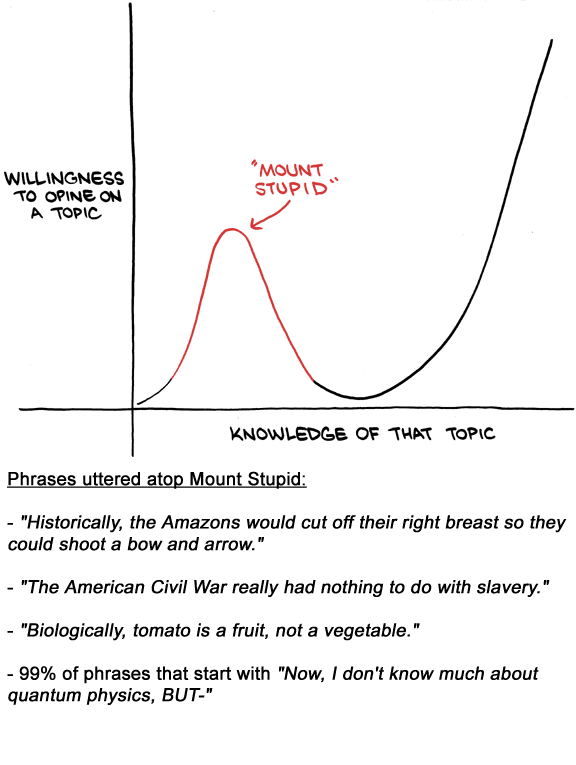
If you are willing to do neither… Well, that’s how you end up on Mount Stupid.
And it’s not like toxic masculinity is that hard of a hard concept, relatively speaking. It just takes a willingness to understand systemic issues (and the inadequacy of individual solutions to systemic issues). And yet some people still get it very wrong:
But… That’s the stereotype of masculinity we’re pushing back on. It’s literally what we’re both describing and decrying! We’re pointing out that the stereotype is usually inaccurate, and should not be held up as aspirational. That masculinity is more than its most toxic forms.
This is a bit like if I say, “there is a stereotype about black people being big dumb brutes. This is a very bad stereotype that is neither accurate to reality nor should be considered something to aspire to”, and you object to this by saying, “Hey, by bringing up that stereotype, you’re reinforcing that stereotype!” Or is it just because we’re putting a label to the stereotype that indicates what it is a stereotype of?
When it comes to social change taking the “trust the experts” is not going to be an effective approach.
I’m not seeing the stereotype being rejected when monstro characterizes certain of her traits as “masculine” … I’m seeing, and I mean no offense here, a cluelessness that she holds the stereotypes as given facts.
Again I come to this from parenting and reacting to discussions about male role modeling as a parent.
We’ve raised four kids to adulthood now (last graduating HS). My take is not to teach what it means to be a man or to be a woman but as best I can what it means to be the best human you can be. My daughter is not masculine or embracing masculine traits because she is tough assertive and strong. My son is not embracing feminine traits by crying at movies and studying to become a social worker. He is a strong man and she is a strong woman. Period.
But it really isn’t all that inaccurate. I will give you that it is becoming less and less accurate as time goes on but stereotypes are stereotypes for a reason, they usually start out pretty damn true.
There were times in our not so distant past that women and men certainly had different duties in life. Without assigning a negative or positive virtue to either, it is simply true.
As we progress further along in this relatively new direction. New sterotypes will evolve.
Years ago, there was a thread here titled “Men, who does the driving in your relationship?”. In that thread, a poster said he was never comfortable as a passenger in a car, and to illustrate this, he told a story of a time where he drove himself to the ER with a knife in his leg and his wife in the passenger seat, because he couldn’t bring himself to let his wife drive even in those circumstances. This was presented as a positive thing in an inherently masculine way: as a man, he was so stoic about pain and had such a strong compulsive need to be in control that his risked his life, his wife’s life, and the lives of the people on the road rather than cede any agency to her. Clearly, he didn’t think less of his wife for being a passenger: it was appropriate for a woman to be content to perpetually ride shot-gun. But as a man, he would be lessened if he accepted that status, even under extreme duress. And it was presented as a funny, flattering anecdote.
To me, that is “toxic masculinity”. The poster had internalized the idea that certain traits are intrinsic and exclusive to men, and that because he was male, it was important that he exemplify those traits past the point of rationality. It was tied into his concept of what it means to be a man. To talk about this, we have to acknowledge the source of the programming: it’s not enough to say “some people push stoicism and self-reliance too far”–that misses the point that people feel like they will lose their status as a member of their gender (turn in your man-card!) if they don’t embrace and exaggerate those traits. We need to talk about how, as a society, we limit people’s full range of expression with very narrow definitions of “masculinity” and “femininity”.
I don’t actually understand your objection to that. Do you feel like we need to leave the terms “masculinity” and “femininity” behind? If so, I can certainly get on board with that. But I don’t think we get there by denying now that some traits that are considered “gendered” --in fact, as seen as essential to membership in one gender and negative in a member of another gender-- are actually positive and should be equally available to everyone, and that other traits–or some traits in some contexts/to some degree–that are considered essential to a particular gender identity are neither essential nor positive. They are toxic in anyone. What part of that do you disagree with?
I think the last paragraph nicely encapsulates what we are talking about.
The guys here who disagree that men are taught harmful things likely have no problem seeing the harmful things that people from other groups are taught…whether implicitly or explicit. They have probably thought to themselves: “It is no wonder black youth act like thugs and don’t value education. Look at the kind of role models they have! Listen to the music they listen to! Look at the values they pick up from their parents! Their culture is toxic!”
Now, I find this kind of rhetoric disagreeble since only a subset of black youngsters are actual thugs and black youth are immersed in the same pop culture as white youth. Self-defeating behaviors perpetrated by black American vannot be divorced from intergenerational poverty and a legacy of oppression. But it is undeniable that black children are exposed to harmful ideas and messages that white children are not subjected to the same degree, and it is undeniable that they can perpetrate these ideas and messages out of a commitment to their identity. I wonder if the conservative white guy who denies men are taught not to cry have the same denial about black kids being taught that speaking “proper” English is “being white”. It is funny that conservatives never demand proof for this claim, but any feminist concept must be backed by a mathematical equation for it to be taken seriously.
It’s literally titled that, because it’s being treated as an extraordinary event: something so dramatic, it’s acceptable for a man to cry. It’s not evidence that men are allowed to cry/express their emotions in the same way and to the same degree as women–it’s evidence that they are not.
If he’d cried when he got thrown to the ground during the game, would people have had the same reaction?