The 400-member New Hampshire House of Representatives has the lowest ratio of constituents to legislators of any state legislative body in the United States, with each member representing only about 3,300 people.
John Stark is known as the “Hero of Bennington” for his exemplary service at the Battle of Bennington, Vermont in 1777. In 1809, a group of Bennington veterans gathered to commemorate the battle. Stark, then aged 81, was not well enough to travel, but he sent a letter to his comrades, which closed “Live free or die: Death is not the worst of evils.”
Stark hailed from New Hampshire and in 1945 Live Free or Die became the state motto.
Hmm, I only count 3 in “Nawth Cahline”. 
The Old Man of the Mountain, also known as the Great Stone Face or the Profile, was a series of five granite cliff ledges on Cannon Mountain in the White Mountains of New Hampshire, United States, that appeared to be the jagged profile of a face when viewed from the north. It collapsed in 2003, but is still a symbol of the state which Donald Trump recently called a “drug-infested den”.
“The Old Man in the Lake” refers to a tree stump in Crater Lake (Oregon). Most of the stump is below the surface of the lake, with only four feet or so showing above the surface. The whole stump has been wandering all over the lake, creating something of a hazard for tourist boats. In 1988 an effort to fix the stump at a permanent location, involving the use of submarines, apparently succeeded. But just when the stump became fixed, a storm happened that continued until the stump broke free from its shackling. “Live free or die” is the NH motto associated with the late Man in the Mountain, and that motto seems oddly fitting for the OR stump.
Twice in my last post I used the preposition “in” when
“of” should have been used. My bad.
Correct! And there’s only 2 in Nawlins, and 5 in Nawlins, Looz-yana.
Crater Lake is a caldera lake, a sinkhole formed by the collapse of a volcano. Yellowstone National Park has a large caldera. When Yellowstone Caldera last erupted some 650,000 years ago, it released about 1,000 km³ of material. By comparison, when Mount St. Helens erupted in 1980, it released ~1.2 km³ of material.
Wikipedia has a fun gif of a caldera being formed in a scale model box filled with baking flour: Caldera - Wikipedia
Taal Lake, on the Philippine island of Luzon, is the 7th largest caldera lake in the world, formed by very large eruptions between 500,000 and 100,000 years ago. The current cone of Taal volcano lies within the lake, which used to have an outlet to the sea. Volcanic eruptions in the 1700s filled the Pansipit River with tephra, blocking the lake’s sole outlet to the sea. Many endemic species of fish have evolved and adapted to the desalination of the lake’s waters; some of them, the maliputo and tawilis, are considered local delicacies.
“Taal”, a 1999 Bollywood musical, was the first Indian film to make the Top 20 list of world box office grossers. It also marked the beginning of the collaboration of director Subhash Ghai and composer A R Rahman. The title is the Hindi word for “rhythm”.
The film industry of Nigeria is nicknamed Nollywood. The term was first used in a 2002 article by Matt Steinglass in the New York Times. Alex Eyengho defined Nollywood as “the totality of activities taking place in the Nigerian film industry, be it in English, Yoruba, Hausa, Igbo, Itsekiri, Edo, Efik, Ijaw, Urhobo or any other of the over 300 Nigerian languages”. He further stated that “the historical trajectory of Nollywood started since the pre and post independent Nigeria, with the theatrical (stage) and cinematic (celluloid)) efforts of the likes of Chief Hubert Ogunde, Chief Amata, Baba Sala, Ade Love, Eddie Ugboma and a few others”.
Two-time NBA World Champion Andre Iguodala of the Golden State Warriors is of Nigerian descent.
Among other roles, Andre Braugher has played a Civil War infantryman (Glory), detective (Homicide: Life on the Street), police officer (Brooklyn Nine-Nine), doctor (Gideon’s Crossing) and submarine commander (Last Resort).
Glory (1989) was based on the personal letters of Colonel Robert Gould Shaw. Shaw was a personal friend of Harriet Beecher Stowe and he read Uncle Tom’s Cabin several times. Uncle Tom’s Cabin, published in 1852, was the best-selling novel in the US of the 19th century and the second best-selling book of that century, following the Bible.
Bruce Springsteen and the E Street band performed “Glory Days” in 2008at the Super Bowl XLIII half-time show with minor lyric changes appropriate to the occasion (football player instead of baseball player, “Hail Mary” instead of “speedball”). During the song, Springsteen told Steven Van Zandt that they were going over their allowed 12 minutes, and Van Zandt responded that they should keep playing anyway.
The 54th Massachusetts infantry regiment and its commander, Col. Robert Gould Shaw, subjects of the movie Glory, are honored by a memorial on Boston Common. Located directly across the street from the Massachusetts State House, it was designed and created by noted American sculptor Augustus Saint-Gaudens. The Latin inscription is typically translated as, “They leave all behind to serve the republic.”
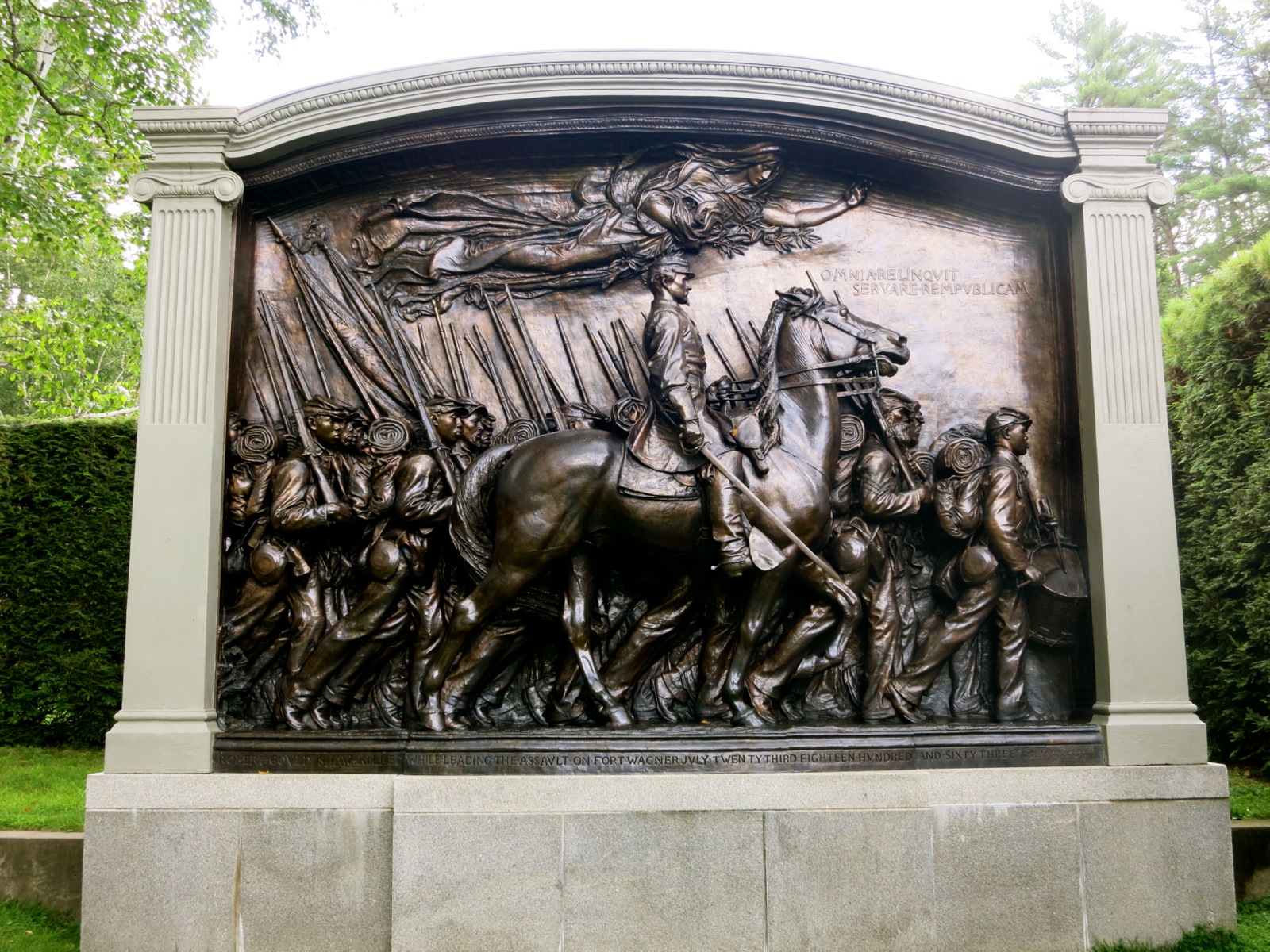
The Boston Common was originally used for grazing cows, but overgrazing led to an law in 1646 that only 70 cows could graze there at one time. Cows were finally banned from the Common in 1830.
The first cows in the Americas arrived with Christopher Columbus on his second voyage.
Christopher “Kit” Marlowe, a noted Elizabethan playwright and poet and contemporary of William Shakespeare, was killed in a house in Deptford, England on May 30, 1593. Accounts vary as to the circumstances of his death, which has been variously described as a drunken brawl, a political- or espionage-related murder, or punishment for his supposed atheism and/or homosexuality.
In his memoir of the Battle of Ia Drang, We Were Soldiers Once, and Young (great read), Gen. Hal Moore mentioned that his Army colleagues were fond of a quote about warfare allegedly by Frederick II of Prussia: “Artillery adds dignity to what would otherwise be a vulgar brawl.”
Frederick II of Prussia, known as “Frederick the Great” and one of the great military leaders of his age, said George Washington’s New Jersey campaign of 1776-77 was “the most brilliant of any recorded in the annals of military achievements.”
The pigment Prussian blue was probably synthesized for the first time by the paint maker Diesbach in Berlin around the year 1706, and quickly replaced the much more expensive pigment lapis lazuli. Prussian blue soon became the predominant uniform coat color worn by the infantry and artillery regiments of the Prussian Army.