The board of the New York City co-op, not far from Central Park, where Pale Male has his nest voted in December 2004 to evict him. After public protests, they rescinded their decision, and he remains in residence to this day.
Research published by the Worldwatch Institute found that in 2012 approximately one billion people in 96 countries had become members of at least one co-operative, or co-op. The turnover of the largest three hundred cooperatives in the world has reached $2.2 trillion.
RPI, Rensselaer Polytechnic Institute, is located in Troy NY and also has sites in Hartford and Groton CT. Theodore Judah, the visionary of the transcontinental railroad, is an RPI graduate. RPI graduates have gone on to found or co-found major companies such as NVIDIA, John Wiley and Sons, Texas Instruments, Fairchild Semiconductor, PSINet, MapInfo, Adelphia Communications, Level 3 Communications, Garmin and Bugle Boy.
The bugle developed from early musical or communication instruments made of animal horns, with the word “bugle” itself coming from “buculus”, Latin for bullock (castrated bull).
Most of the planet’s ungulates are in Family Bovidae. Two of the most populous such species are in Tribe Bovini. Bovini includes five genera: Bos (cattle etc.), Bison, Bubalus (water buffalo, anao, and tamaraw), Syncerus (African Cape buffalo), and Pseudoryx. Pseudoryx has only a single species (saola or “Vu Quang ox”) which wasn’t known to scientists until 1992 and is still sighted only very rarely. DNA evidence shows that Pseudoryx diverged from the rest of Bovini so long ago that some taxonomists want to give it its own single-species Tribe Pseudorygini.
Although it has two long horns, the saola is sometimes called “Asian unicorn” because of its extreme rarity.
Bison are the largest mammal in North America. Male bison (called bulls) weigh up to 2,000 pounds and stand 6 feet tall, while females (called cows) weigh up to 1,000 pounds and reach a height of 4-5 feet. Bison calves weigh 30-70 pounds at birth.
There are two subspecies of bison: the wood bison and the plains bison. The wood bison is the larger of the two and has a taller, square hump. The plains bison is smaller in size and with a more rounded hump.
gImages, wood bison (https://goo.gl/tebaey) and plains bison (https://goo.gl/3yKwba).
A natural population of Plains bison survives in Yellowstone National Park (the Yellowstone Park bison herd consisting of about 3,000 bison) and multiple smaller reintroduced herds of bison in many places in Canada and the United States.
The wood bison’s original range included much of the boreal forest regions of Alaska, Yukon, western Northwest Territories, northeastern British Columbia, northern Alberta, and northwestern Saskatchewan.
Yukon Gold is a large cultivar of potato most distinctly characterized by its thin, smooth eye-free skin and yellow-tinged flesh. This potato was developed in the 1960s by G. R. Johnston, R.G. Rowberry, and Dr. Norman Thompson in Guelph, Ontario, Canada at the University of Guelph, and released to the market in 1980.
In the Rudolph the Red-Nose TV special, Yukon Cornelius is shown tossing his pick axe into the air, sniffing, and then licking the end that contacts the snow or ice, most of the time saying afterwards in disappointment, “Nothing.” This leads the audience to believe that he is searching for either silver or gold, though it turns out that he is actually seeking peppermint, as revealed at the end of the original version of the special. The removal of the scene (for subsequent telecasts) in which he discovers a “peppermint mine” near Santa’s workshop by that method left audiences assuming that he was attempting to find either silver or gold by taste alone. The scene was reinstated in the special in 1998 and has appeared in most of its video releases since then, but currently remains cut from the televised broadcasts.
Yukon is Canada’s smallest territory. Its two major centres are Dawson City and Whitehorse.
Yukon is the setting for Robert Service’s poem, “The Cremation of Sam McGee” set in the time of the Klondike Gold Rush:
“On a Christmas Day
We were mushing our way
Over the Dawson Trail…”
Jim Carrey’s moronic, badly-shorn character in the Dumb and Dumber movies is named Lloyd Christmas.
In the Jim Carrey’s movie of How the Grinch Stole Christmas, Max easily won many viewers’ hearts because of his naturally cute appearance and ability to somehow play the straight man to Carrey’s manic Grinch persona. Max was played by a female dog named Kelley!
Spuds Mackenzie was a dog that was the star of the Bud Light commercials in the 1980s. Spuds was also played by a female dog; her name was Honey Tree Evil Eye. Jackie and Stanley Oles, the humans who owned her, called her “Evie.”
Stanley Baldwin was a dominating figure in the British Conservative Party, serving continuously in the Commons from 1908 to 1937, and three terms as Prime Minister. When he retired he was ennobled as Earl Baldwin.
His son and heir, Oliver Baldwin, was a Labour Party supporter and twice was elected to the Commons. From 1929 to 1931 father and son were both MPs, sitting opposite each other in the Commons.
Winston Churchill, asked to write a remembrance of Stanley Baldwin after the former Prime Minister died, wrote back to the organizing committee, “I wish Stanley Baldwin no ill, but it would have been better if he had never lived.“
Stanley Tools, now part of Stanley Black and Decker, was founded in New Britain, CT in 1857. It’s why New Britain’s nickname is “the Hardware City.” Stanley is still the largest private sector employer there.
Philip Corbin (1824-1910), founder of his lock company that would later become Corbin Sesamee, and Sesamee locks, hailed from New Britain CT. His family lived in West Hartford CT for a time, and West Hartford’s Corbin’s Corners is his family’s homestead.
(My orthodontist, from my jr high school years, had his office in Corbin’s Corners, West Hartford.)
Hartford, CT, is the home of the Mark Twain House and Museum. This house was built by Samuel Clemens and his wife, and they lived there from 1874-1891. Clemens wrote many of his best-known works while living there, including The Adventures of Tom Sawyer and Adventures of Huckleberry Finn.
Justin Kaplan, a Clemens biographer, called the house “part steamboat, part medieval fortress and part cuckoo clock.”
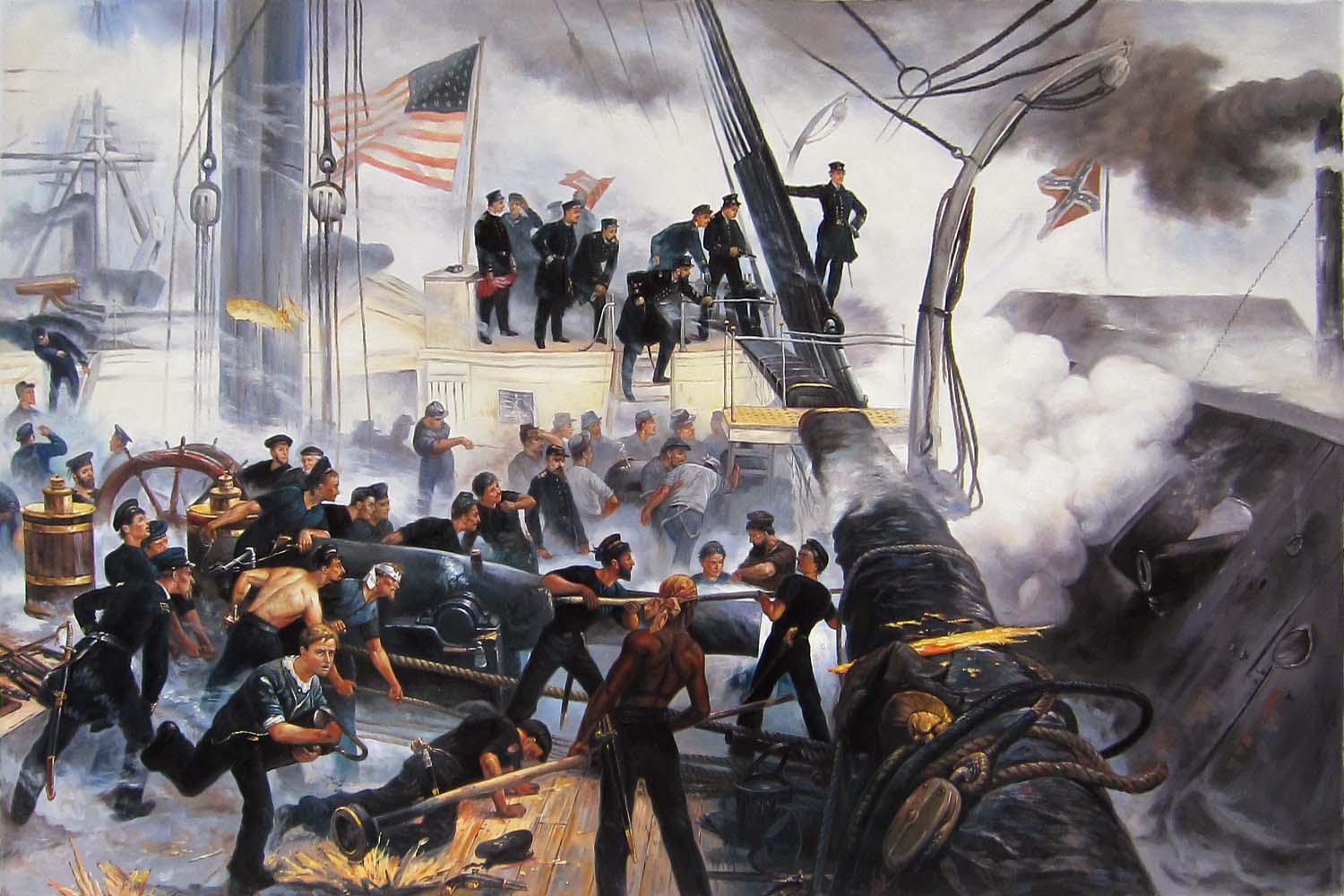
U.S. Navy Flag Officer David Glasgow Farragut led his squadron to victory in the 1864 Battle of Mobile Bay from aboard his flagship, the steam sloop-of-war USS Hartford. When warned of Confederate torpedoes (we would now call them mines) in the channel, he famously declared, “Damn the torpedoes, full speed ahead!” The Hartford lasted until 1956, when she unfortunately sank while awaiting restoration.
A famous painting of the battle, now in the Wadsworth Atheneum: http://www.fineart-china.com/admin/images/stock/003312052549349.jpg
The Atheneum Club in London was formed as a men’s club in 1824, with a focus on attracting members with good reputations in the arts and sciences (hence the name). Sir Humphrey Davy was the first Chairman of the Club.
Humphrey Bogart was born on Dec. 25, 1899, but Warner Bros. long reported his birthday as January 23, possibly out of concern that a man born on Christmas Day wouldn’t seem as villainous as he needed to be on screen. Bogart was raised Episcopalian but was not a regular church-goer.