The best-selling species of Christmas Trees are Fraser fir, Noble fir and Douglas fir, followed by Balsam fir and Scotch pine.
Queen Victoria’s first cousin and husband, the German-born Prince Albert, is often credited with introducing the concept of Christmas trees to the United Kingdom, and indirectly to the United States.
The first White House Christmas Tree was in 1889 when Benjamin Harrison was President.
Only four Americans have been elected President without winning the popular vote: John Quincy Adams in 1824, Rutherford B. Hayes in 1876, Benjamin Harrison in 1888, and George W. Bush in 2000. Interestingly, 3 of the 4 were either the son or the grandson of a former President.
The President and Vice President are not elected directly by the voters. Instead, they are elected by “electors” who are chosen by popular vote on a state-by-state basis. The number of electors in each state is equal to the number of members of Congress to which the state is entitled, while the Twenty-third Amendment grants the District of Columbia the same number of electors as the least populous state, currently three. In total, there are 538 electors, corresponding to the 435 members of the House of Representatives, 100 senators, and the three additional electors from the District of Columbia.
The constitutional theory behind the indirect election of both the President and Vice President is that while the Congress is popularly elected by the people, the President and Vice President are elected to be executives of a federation of independent states. This is to protect the US government from the “tyranny of the people” and risk having them elect a king year after year (This would have happened with George Washington if he hadn’t decided to retire. He was president from 30 April 1789 to 04 March 1797).
The Electoral College is part of the US Constitution and it was written between 25 May and 17 September 1787 at the “Grand Convention at Philadelphia.”
The electoral college started with the first election of George Washington.
Pursuant to the Twelfth Amendment, the House of Representatives is required to go into session “immediately” to vote for President if no candidate for President receives a majority (270 votes) of the 538 possible electoral votes."
By the end of that Christmas earworm The 12 Days of Christmas, my true love gets 364 gifts, or a gift for almost every day of the year:
it goes like this
1st day = 1
2nd day = 3
3rd day = 6
4th day = 10
5th day = 15
6th day = 21
7th day = 28
8th day = 36
9th day = 45
10th day = 55
11th day = 66
12th day = 78
add that up for a total of 364 gifts.
“The Twelve Days of Christmas” is an English Christmas carol which was first published in England in 1780 without music as a chant or rhyme. The twelve days in the song are the twelve days starting with Christmas Day to the day before Epiphany (January 6, or the Twelfth Day).
Epiphany celebrates the revelation of God the Son as a human being in Jesus Christ.
Western Christians commemorate principally (but not solely) the visit of the Magi to the Baby Jesus, and thus Jesus’ physical manifestation to the Gentiles. Eastern Christians commemorate the baptism of Jesus in the Jordan River, seen as his manifestation to the world as the Son of God.
This is, to say the least, debatable. The Supremacy Clause alone suggests that the states were not considered to be independent after the ratification of the Constitution.
Back to the game:
Boxing Day, December 26, is also the feast of St. Stephen, the first martyr of the Christian church.
Saint Stephen is the first of a group of saints known as the comites Christi, or ‘companions of Christ’. These are the saints whose feasts are celebrated during the Christmas Octave:
- Saint Stephen, Protomartyr on 26 December;
- Saint John, Apostle, Evangelist on 27 December;
- Holy Innocents, Martyrs on 28 December;
- Saint Thomas Becket, Bishop, Martyr on 29 December; and
- Saint Silvester I, Pope, Confessor on 31 December
St Thomas Becket’s tomb in Canterbury Cathedral became a popular target for pilgrimages. It was immortalised two centuries later in The Canterbury Tales, Chaucer’s tale of a group of pilgrims en route to Canterbury Cathedral.
Chaucer lived for several years on London Bridge (i.e. The biggest bridge over the Thames). It was not unusual for large bridges to have businesses and residences.
The renowned shrine of St Thomas Becket was destroyed in 1538 on the orders of Henry VIII.
nm.
Quite so: http://www.shakespeare-online.com/images/londonbridge.jpg
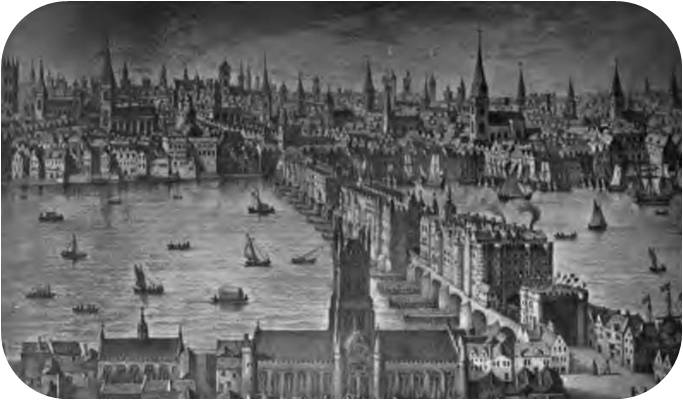
King Henry VIII of England was succeeded on the throne by two of his daughters (Mary and Elizabeth) and one son (Edward VI), but not in that order.
Mary Elizabeth Mastrantonio received an Oscar and a Golden Globe for her role as Carmen in The Color of Money. She is also known for roles in *Scarface *and Robin Hood: Prince of Thieves as well as The Abyss.
Dick James sang the very memorable theme song to the 1950s British TV series Robin Hood. It was used later by Monty Python for the Dennis Moore “Your lupins or your life!” sketch.
Dick James later became a music publisher. His Dick James Music was the home of Northern Songs, the Beatles’ publishing company; the Beatles were bitter when he sold the company without their consent. Later, he was music publisher for Elton John.
President Richard “Dick” Nixon sometimes often welcome groups of visitors to the White House by asking if anyone had a birthday that day… and if not that day, coming up soon. If anyone said “Yes” (and someone usually did), he would play “Happy Birthday” on the East Room piano and invite everyone to sing along.
Nitpick: Mastrantonio was nominated for both awards, but did not win.
In play: “Yesterday” by The Beatles was once listed in the Guinness Book of World Records for having the most cover versions: 2,200. It’s since been surpassed by George Gershwin’s “Summertime” (from the 1935 musical Porgy and Bess) which has been claimed to have over 30,000 cover versions.
At its peak, the Guinness Brewery Park Royal, London, was the largest and most productive brewery in the world. It closed in 2005, and production of all Guinness sold in the UK and Ireland was moved to St. James’s Gate Brewery, Dublin.