Just because it is, in some ways, an astonishing achievement, it does not make it a great *artistic *achievement. Since the creators didn’t understand perspective, if someone else who had mastered perspective had made a similar tapestry but with perspective built in, that would have been higher on the artistic achievement scale.
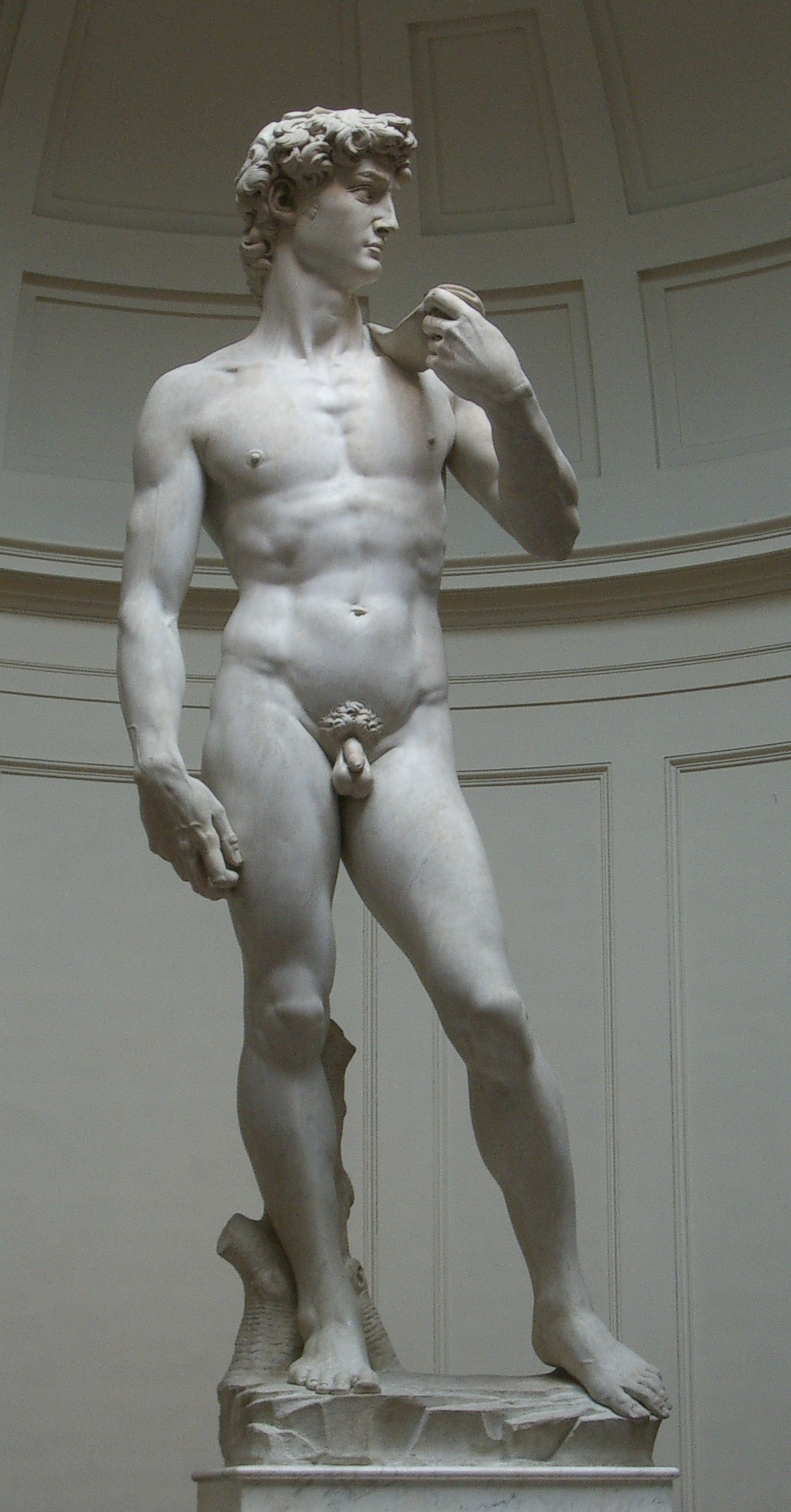
OTOH, things like Michelangelo’s Pieta or David do represent pinnacles of art, because it is hard to see how anyone could have done them better.
By the way, in response to many posts above, I’ll attempt to illustrate the idea expressed in the OP by the following example:
Assume you have a friend, and you didn’t know this guy had an artistic side. One day, he informs you that he has been working on something for the past six months and it’s in his garage, and would you like to take a look at it?
(Scenario A) You go and take a look and you see this. (Assume for this example that he was the first to come up with this, i.e. he didn’t copy from Michelangelo)
Most likely, your response would be something like “Holy shit dude, that’s freakin’ awesome! I never knew you had such talent!”
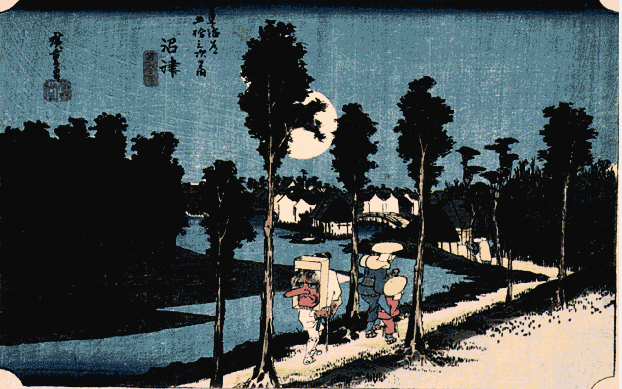
(Scenario B) You go and take a look and you see this.
Most likely, your response would be something like “That’s pretty good dude, I like it”. But you would not be knocked off your feet by his amazing artistic achievement, like you would if you saw the piece in Scenario A.
Again, “better” based on what criteria? Would this painting have worked better with proper perspective?
Here’s a semi-famous anecdote: composer Karlheinz Stockhausen was asked by a music magazine what he thought of a number of pieces by young electronica artists. He said of Richard D. James that his music was too repetitive and he should stop using those “pseudo-African” rhythms immediately. Richard D. James replied that, obviously, Stockhausen doesn’t know how to dance.
In short, you have no idea what you’re talking about. You are discussing this in terms of “art”, common and pop ideas of art, and not Art, not the formal body of discourse historians and artists have been contributing to for thousands of years. The difference may be semantics, but it very much exists.
For instance, the three main criteria for judging a piece of art is intention, context, skill. All of these qualities are relative.
For example, perspective is largely an artifice, a convention for making things “look about right.” Evidence A): 3 point perspective didn’t exist until the invention of photography. Evidence B): Our cone of vision is actually curved, and none of the great masters utilized this. Discovering perspective was an artistic achievement, but it’s discovery does not discredit the thousand year tradition that came before it. It also does not discredit any other cultures where perspective was not wanted.
This leads me to: intention. The great Japanese wood block prints were not trying to be a “window on the world” as the European tradition was. The Japanese didn’t give a shit about depicting an idealistic world with idealized human figures that idealized ancient mythologies (the Bible). Similarly, West African sculpture was not supposed to be an idealized depiction of the human form per the Roman/Greek tradition. Those Indian temples mentioned above didn’t give a rats ass about Jesus. Your ideas are completely unfounded if you try to reconcile what something is with what it was never trying to be.
That just leaves skill. With what they intended to do, did they succeed? Given the context of the work - where and when it was made - is it of superior quality?
With all of this said, I do have to say that Western art is superior, but in one way only: Modern Art. Modern art is such a tremendous achievement, which took into account most of the Western tradition, but also the African and Japanese traditions as well, not to mention all sorts of different countries along the way (Gauguin most notably). Abstract art, cubism, surrealism, and I’d even say photography is such an astounding development that it goes unmatched in other traditions, as far as I can tell.
Why is the latter more valid than the former? Why should anyone give a rat’s ass about the “formal body of discourse”?
The three main criteria for you, and I guess many professionals in the art world, but why do these have to be the main criteria for the rest of the people? If a piece of art looks like crap, I couldn’t care less about the “intention” or the “context”.
“Look, here is a piece that consists of a mirror with some spit on it. The artist wanted to portray the futility of modern life, and his self-loathing. Amazing piece of art!”
But again, “looks like crap” is both subjective and transient. I used to make fun of people who stared at minimalist paintings. Now, I’m the one staring.
Thomas Kinkade always gets brought up in these discussions. I’m hardly a fan, but apparently he’s making good money, which means that some people don’t think his paintings look like crap.
You bring up Mozart and Beethoven. I love them too. However, a few places decided to take care of punks and skateboarders who hung out in places like subway stations by playing classical music… and it worked, the kids thought it was unbearable.
The problem in this discussion is that the value of art (or anything) is not uni-dimensional. You can’t say La Pieta is as good as it gets and thus this other piece is worth 0.43 Pieta, while that one is worth only 0.201 Pieta.
I think the proper term you are looking for is 'Anything Not Composed By Bach, Mozart, Brahms, or Beethoven. Or, more broadly, anything not composed by Dead Europeans. The “art” that you favor bears a striking similarity to the “art” that is covered in a high school Intro to Western Civilization class.
I too remember the thrill of that class in 9th grade; the wondrous new vistas revealed to me when I was taught that there was music beyond Casey Kasem’s AT40-- that there was visual art greater than what I saw on the front of my breakfast cereal box! Chopin, Picasso, Rodin-- the all-time greats for ALL-TIME! None better anywhere!
It was enough to satisfy me for a few years but then I realized that there was still even MORE art that existed! It gradually dawned on me that art was not invented in 15th century Flanders. I’ve been grooving on my ever-expanding horizons ever since.
If someone else who had mastered color had made a similar sculpture but with color built in, that would have been higher on the artistic achievement scale.
To continue the slight hijack - Yes: Here is a link to the first part of Mani Kaul’s 1983 film Dhrupad. The introduction is a really beautiful, skilled, and highly emotional rendering of rag Bhairav (IIRC) by brothers Fariduddin and Mohiuddin Dagar (cousins of Saiduddin Dagar and teachers of Ritwik Sanyal who I mentioned in a previous post). The image quality i very bad, but the sound is ok..
Well, I studied East Asian art history, so–surprise surprise–I don’t agree with you either.
So to answer your questions–yes, yes, and no. Does this really surprise you? There are no “experts” who can magically decide the value of art, and if there were such posts to be had, it would be a bloody reckoning indeed as modern art historians/Asian art historian/Islamic art historians/Greece and Roman art historians/etc. battled it out for supremacy. You don’t really seem to be interested in looking at any examples, but I think it might be interesting for other readers of this thread, so as an amateur Asian art historian, I will post some of my personal favorite works that also might appeal somewhat to the typical American/Westerner.
That said, I don’t hold out much hope of converting you. Art is entirely subjective. If you think that
Perspective is one of the most interesting issues in the East Asian art tradition. Put simply, the Japanese do not give two flying fucks about Western style perspective. You are of course welcome to your opinion, but it is kind of like saying “*Given *that any food that uses chili peppers or strange foreign spices must be by default disgusting, is it just me or is American cuisine from the 1950’s the pinnacle of deliciousness, or what?” Well, if those are your criteria, then that’s probably yes.
I think it is interesting though, because if you argue that perspective is most important on the “artistic achievement scale”, the conclusion we must draw from that is that you do think that realism is most important. Otherwise, what are you basing that conclusion on? And of course, if realism is most important, then anyone with a few bucks and a moderately steady hand is capable of producing the most unbelievably perfect portraits and lifelike landscapes that the world has ever seen.
At any rate… here’s my list! I will just include my main two areas of expertise (e.g. I took a few classes about them in college.)
Not anywhere nearly complete enough, but I’m getting tired already… needless to say I can provide many more examples if necessary.
But if it took in all of those qualities, how can it truly be said to be Western art? Yes, at the beginning of “modern art” as we think of it, most of the artists were Western. But at the time, most non-western people were busy trying not to starve to death, get shot in the head, thrown in jail, etc. For my money (and a lot of other people’s) much of the most interesting art right now is coming out of China.
I think that concerning music, it’s difficult to go past our “training”. Even a very elaborate piece of music from Asia will tend to sound weird and unappealing to most of us because it follows very different composition rules.
As for architecture, I find the OP’s claim plainly ludicrous . Non-European and absolutely stunning architecture, regardless of what you like in architecture, is all over the place.
Regarding painting and sculpture, it’s obvious that the OP follows the concept : more realistic=better, an idea that is more than highly debatable. Look only at the evolution of European art since the 19th century for instance. We find this kind of extra-realistic art only in Greece, imitated by the Romans, and during a short period of European history, as far as I can tell. I don’t have much of a dog in this fight, because generally speaking my appreciation for painting and sculpture is limited, but even then, it isn’t necessarily the most realistic works I appreciate the most. I’m completely non-plussed by the painting the OP linked too, for instance. Yes, it’s realistic…but completely unappealing to me. Even staying within the frame of classical European art, I’ll take a much less realistic primitive Italian painting over that any day.
Crafts haven’t been mentioned, either : glass works, furniture, jewellery, fabrics and costumes, pottery, tapestry, wood carving, etc… and in this case too, stunning pieces are found all over the place, regardless of your standards for excellence.
So, yes I completely disagree with the OP (and again, am especially completely baffled by his claims about architecture), and it’s not because I want to be politically correct.
By the way, I wanted to add : contrarily to many previous posters, I’ve zero formal training in arts or history of arts. I don’t hang out in artistic circles, either. So, it’s not because I’ve read big books, or attended lectures that I appreciate this piece of art more than this other piece.
Basically, I just go with what I like. I like a piece of art because it resonates with me, because for some undetermined reason I find it just stunningly beautiful, because I feel an emotion when I look at it. It might be also because I’m impressed by the skill required to produce it, but this happens more often with craftsmanship than with art in my case.
Yes, I recognize that the David required an incredible skill. Actually, classical sculpture just amazes me from this point of view. I can’t even begin to understand how you can make that starting with a big stone. It borders super-human powers to me. On the other hand, I’m going to cross the entire antique sculpture department of the Louvre barely looking at the statues, because I don’t feel much emotion watching them. Then I will be all “ooh” and “aaah” staring at some non-realistic medieval enamel or primitive wood carving.
What matters from my completely uninformed and uneducated point of view is what a piece of art conveys, what I feel while looking at it. And expressing something doesn’t have much to do with realism. If it were the case, my holiday pictures would beat the Mona Lisa any day.
Regarding music, I think it’s really different. An ex was a music teacher, and particularly interested in non-European music. She most certainly could appreciate the value of even the apparently simplest forms of music (like your “just drums”). But she also would listen to Asian music that I could tell was as elaborate and complex as European music, but would be unable to appreciate because this music was just alien to me. It wasn’t harmonious, it just wasn’t pleasant to my ears.
I assume that a deep and/or formal knowledge of music would have allowed me to come to like it too, but I suspect that it’s a much more difficult enterprise than appreciating other non-European arts (in which case, I just look at them and am captivated. No training required). I think our ears are trained from an early age to appreciate the arbitrary rules of composition of western music, and that it’s difficult to extent our horizons (there are non-European musics I love, but those don’t seem to be as different in their structure).
On the other hand, I doubt that an hypothetical alien who would listen to both samples carried by a spaceship could tell which one is superior. In all likelihood both would seem like a cacophonous mix of weird sounds to him.
Oh, you can have any ideas you want to about art, it’s just that there are criteria by which to judge art, and it’s not just aesthetics. Aesthetics is a form of intention, the Europeans wanted an aesthetically pleasing object and it shows. Other cultures may have wanted to worship God through the art they practiced. Modern art didn’t give two hoots about aesthetics, until post-modernism, where the anti-aesthetic aesthetic was in full force.
The point being, if people never intended for the art to be aesthetically pleasing according to the Western tradition, you can hardly be surprised that it isn’t.
[QUOTE=Polerius]
Just because it is, in some ways, an astonishing achievement, it does not make it a great artistic achievement. Since the creators didn’t understand perspective, if someone else who had mastered perspective had made a similar tapestry but with perspective built in, that would have been higher on the artistic achievement scale.
[/QUOTE]
If it’s not a great artistic achievement, what is it? A great sewing achievement? A great cloth achievement?
I’m confused. You spend the entire thread arguing that Western art is better because it’s more realistic… and then start talking about how Modern Art is a pinnacle of artistic achievement.
Thanks for taking the effort to put together all those links. I checked them all out.
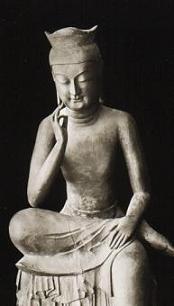
I think they are all interesting, but I couldn’t find any examples that were truly great. For example, The Miroku Bosatsu from Koryuji is not that impressive, which I think is due to the fact that the proportions or the positioning of body elements is a bit out of whack. It just doesn’t seem “alive”.
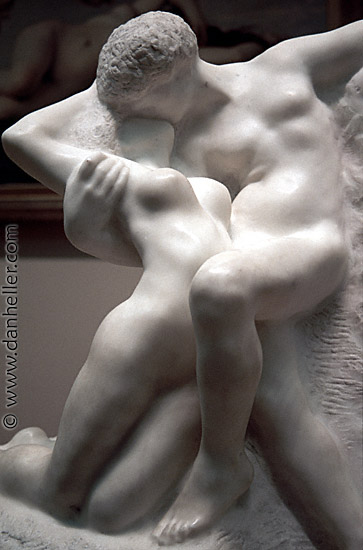
A statue doesn’t have to be real-life perfect for me to appreciate it. Take Rodin for example. His statues (e.g thisand this) aren’t that “polished” to look as much as possible as the real thing, but he was able to make them look alive. I’m not trained in the arts so I don’t have the vocabulary to express what it is he achieved, but, to me, he was able to make his statues seem very dynamic, even though they are made out of cold, hard, stationary, stone. In thisimage, the woman’s body seems to be writhing and you half expect it to move.
I’m going to add something else.
I think (and I’m probably not alone) that the OP is making the assumption that western art is obviously superior, hence that people pretending otherwise can’t be sincere. They neither can actually like non-European art more, nor objectively think it isn’t inferior.
So, they must have another reason to pretend so. They want to be politically correct, or they’re snob, or they’re lost in some intellectual cloud, or something.
It reminds me furiously of threads about food snobs (“You can’t possibly think that a good meal is so much better than a regular one that it’s worth paying four times more, so you must be a snob”) or about people who “pretend” that the great classics of literature are really much better than a run of the mill book, and so on (there are plenty of similar examples).
So, I would urge the OP to believe it when ordinary people say they appreciate non-western art (like me) or when people more educated about arts say that no, western art isn’t superior and that stating so displays a certain level of ignorance about non-European art (or even just about art).
There certainly are food snobs, literature snobs, art snobs, etc… But there are really people who appreciate more and/or know more about food, literature, non-European art, travel,cars,wine,movies, etc… than the generic you. I’d like people to stop thinking that if they can’t appreciate or enjoy something it means that nobody else can, and that everybody else is just pretending. It’s a way too common mindset, and it’s quite irritating.
OK. I’m going to take you to task about architecture, because this one is really bugging me.
You mention that the Parthenon is an unparalleled achievement. Can you tell me in what way it is superior to the Taj Mahal, which is often mentioned as the most extraordinary monument in the world?