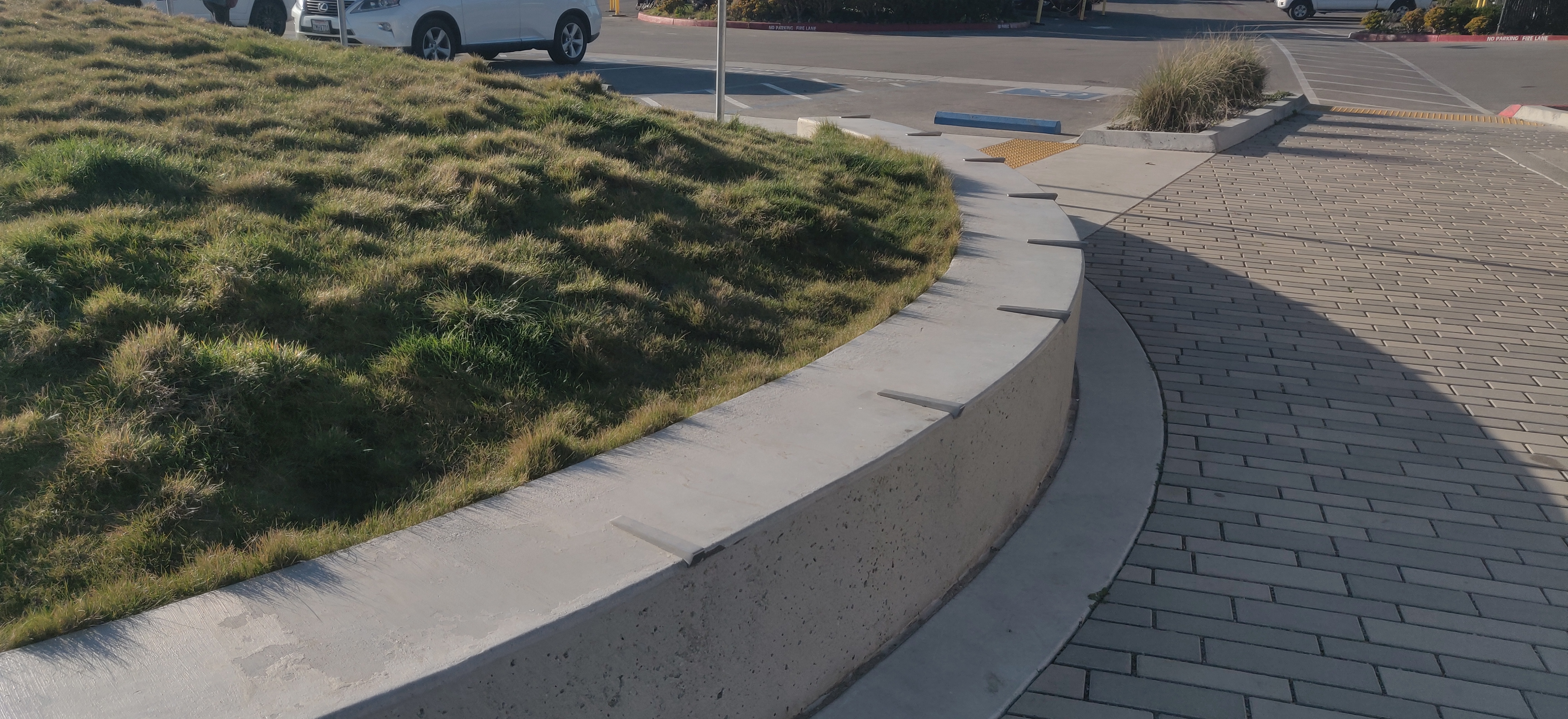
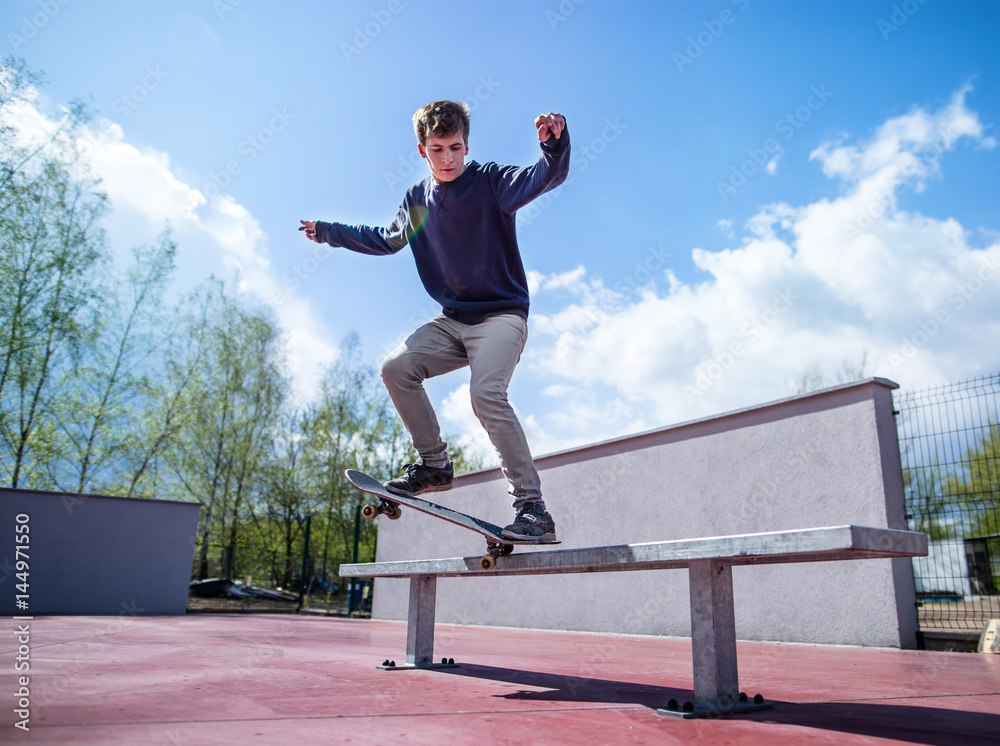
In a number of places, I’ve seen concrete benches (or low walls that might be used as benches) with metal objects attached at intervals, like this:
Sometimes they are decorative, shaped like leaves or other things; other times like in this photo they are just straight pieces of metal. I had assumed that they were intended to divide up the bench into individual seats, although I don’t know why that is desirable. Why do they care if I want to sit closer to my wife or farther from a stranger?
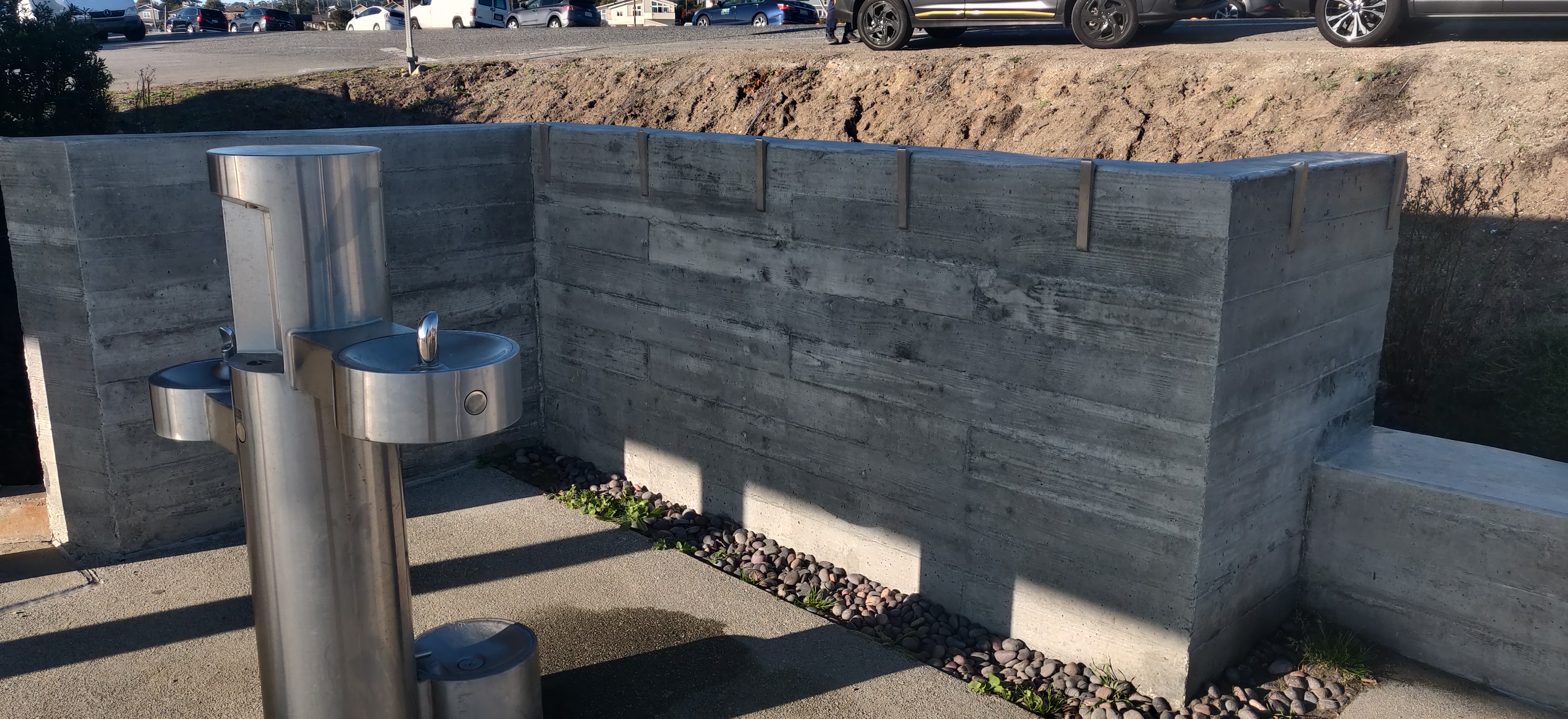
But then I noticed at the same place where I took the previous photo, there was a tall wall with the same objects attached to the top of it:
This clearly has nothing to do with seating; the wall is at least 4 feet high. So is there some other purpose for these things?
As said, to dissuade skateboarders. They’ve been putting in occasional textured sidewalk squares in some locations for the same reason.
The bench studs also deter homeless from stretching out and setting up camp. Some places have been installing studs on their heating grates in their vestibules to deter folks from coming in and sitting on them.
Since the FQ itself has been thoroughly answered …
Those devices have been around for 20-25 years now that I know of.
I’m wondering if they just recently came to the OP’s area, or just recently came to the OP’s attention, or has this question been sloshing around in their head since the turn of the century? I’ve sure got a few ancient wannabe FQs I’ve never gotten up the gumption to ask.
I’ve noticed them for maybe 10 years, definitely less than 20. But yesterday was the first time I’ve seen them on a wall that clearly couldn’t be used for seating, which suggested to me that my assumption about their purpose might be mistaken.
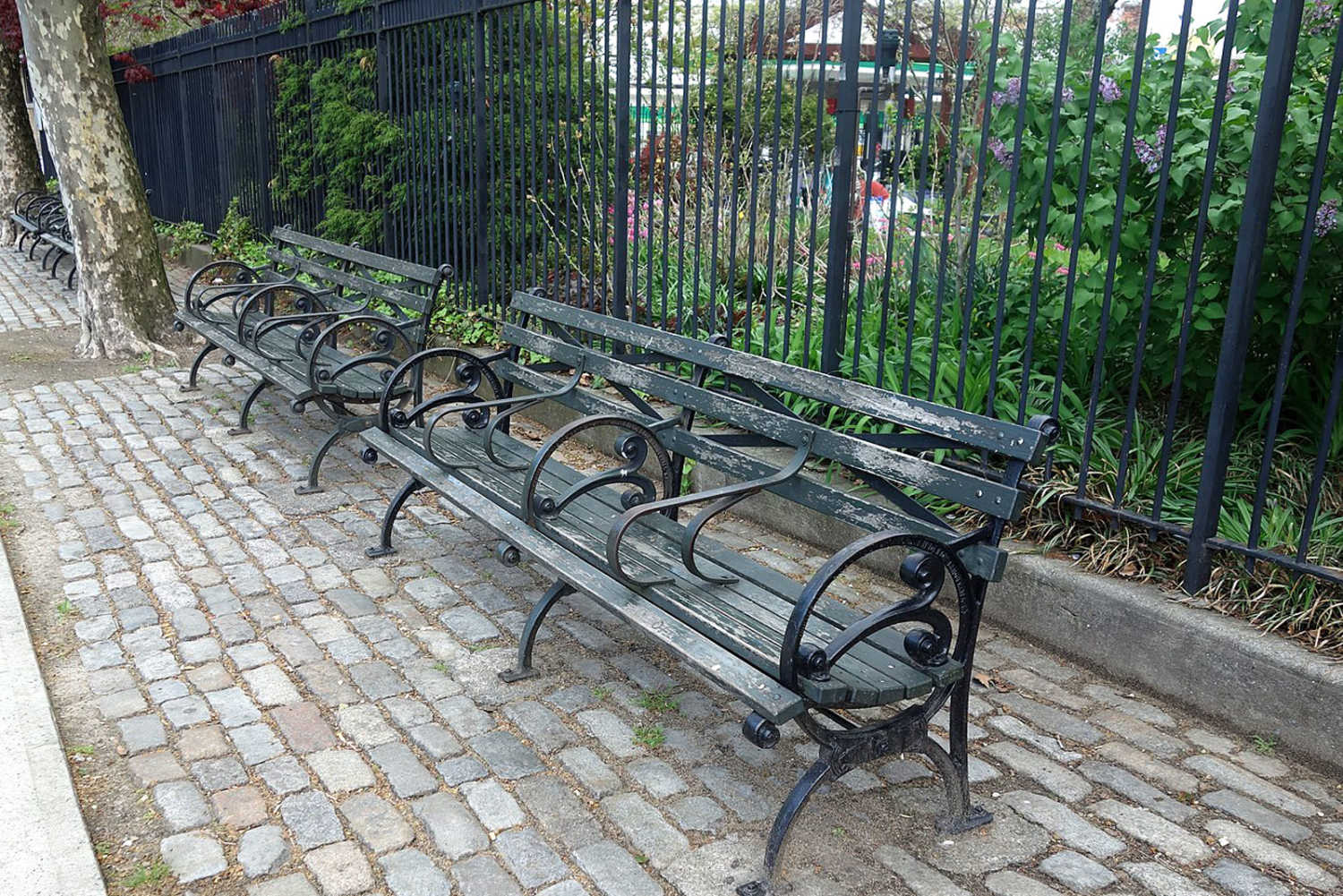
And, sometimes, the anti-homeless-sleeping attachments on benches are quite large and elaborate. TIL that there’s even a term for it: “hostile architecture.”
Also, TIL that those devices are specifically placed there to discourage a skateboard move called “grinding” (as noted in @thelurkinghorror 's link), in which the skateboarder slides along an edge (like in the pictures in the OP) on the metal truck(s) of their board, rather than on the wheels. Grinding is known to cause damage and wear to the edges of those surfaces.
IIRC there are similar grinding-like maneuvers commonly done with BMX bicycles and their axle pegs. The same Hostile architecture - Wikipedia features work against them.
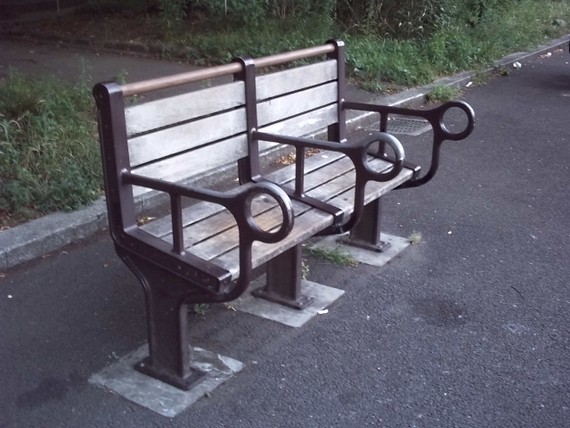
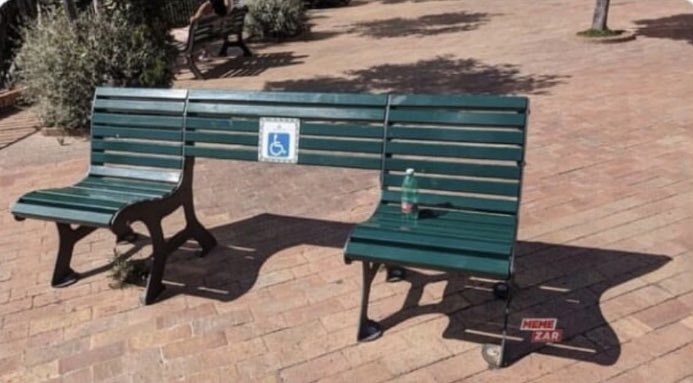
I always thought this one was funny. As I read in the caption the first time I saw a picture “the person is in a wheelchair, they can literally sit anywhere”, IOW, there’s no reason to cut out the middle of a park bench for that.
I could, though, see cutting the end off of a park bench for wheelchair access. Like, if there’s a whole layout of them, in front of an outdoor stage (there’s a setup like that at a park near me). That way, a person in a wheelchair can still sit with their family or friends, without blocking the aisle.
I get it. It’s one thing to be homeless, but it’s another to not take care of public spaces or make a nuisance of yourself in them. Despite what some people think, they’re not any more entitled than anyone else to use public spaces, and they’re certainly not entitled to mess them up, stink them up horribly, or hog them by laying across the benches others may need to sit on.
I mean, is a homeless person sleeping on a subway bench more entitled to lay on it than an elderly person who needs to sit? Is a homeless person entitled to make a bathroom nasty because it’s the only place they have to go, versus someone else who just wants a clean bathroom?
They are “entitled” by the fact that they exist, and have to be somewhere. And being homeless, they have no choice but to be in those public spaces. They aren’t going to magically vanish because they are inconvenient or unsightly. They can’t be blamed fairly for something they have no choice in.
Stuart Semple, perhaps best known as the inventor of the world’s pinkest pink, is also an advocate against the creeping advance of hostile architecture and hostile design. There’s a whole lot of commentary about how these different ways of discouraging inconvenient people from hanging around your part of the free-open-accessible to all urban landscape is intended to drive them away. Not to give an alternative, let alone address the issues that underlie the cause of homelessness and disadvantage, but just getting them to clear off.
And as for accommodating the kids who actually listened to their parents and got out of the house and off their phones for a bit of exercise …