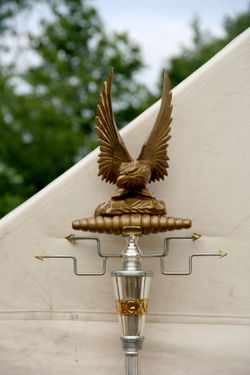
By which I mean the aquila of the legions, the physical object carried by the aquilifer. The loss of one was a disgrace to the entire legion.
Wiki says they were made of silver or bronze and small enough to conceal in a girdle (stop that snickering), but what happened to the objects themselves? Were they just melted down, discarded in the dirt or what? One would have thought they would have been of great value to collectors, more so than its worth as metal, and of political value to those who came later who thought themselves successors to Rome.
All I can find Googling is this bronze eagle, which at the time it was discovered was thought to be off a standard but modern archaeologists think it’s from a larger statue.
Value to “collectors” (if any could be found after the fall of Rome) or politicians is much less than value as some metal that can be turned into a knife or something else useful.
Remember, these are people who burned marble statues to make lime for cement. Survival comes first, comfort second, and then respect for history if they have time.
True, although I thought even at the time they could be more valuable sold off rather than simply scrapped. What of the Eastern Roman Empire? Wiki notes that they were still in use by Isaac I Comnenus who reigned from 1057 - well after Rome’s fall. What are the likely fates of Byzantine Eagles?
If they survived that long then they would have probably been looted and melted down during the Sack of Constantinople in 1204.
"The Crusaders looted, terrorized, and vandalized Constantinople for three days, during which many ancient and medieval Roman and Greek works were either stolen or destroyed. "
Why would they? Why does the Eastern empire care for a legion that might be disgraced. I think the idea even of the antiquities and of the collections comes from the Rennaissance, I do not think it was a strong idea or a real practice before.
They had museums in 530 B.C.. Wasn’t thinking in that sense though, more that wealthy private collectors might want one as a conversation piece “…and here’s the Eagle of the Ninth, moving on to my piece of the True Cross…” It is, granted, more likely that whoever got their hands on them did just melt them down ASAP, maybe not knowing what they were.
Just a thought. They objects obviously had immense value to the Romans (death preferable to losing it) and the currency of Rome’s ideas held value while the Empire itself fell apart.
Reasons of that sort are really the only ones that could just conceivably have saved them. Comparable cases would be the bronze peacocks in the Vatican Museum, which are generally assumed to have come from Hadrian’s Mausoleum and which survived only because they were reinterpreted as Christian symbols and re-used as part of the decoration of the Fontana della Pigna in the courtyard of the old St. Peter’s.
But a surviving eagle only had to be melted down once…
They belonged to the state, not to individuals. So they were unlikely to be buried with anyone.
A victorious enemy might have kept one as a trophy, but in the chaos of the Dark Ages, it would probably change hands many times, eventually ending up with someone who melted it down for scrap metal.
When Vesuvius erupted, Pompeii and Herculaneum were in a peaceful part of the empire, so there was little need to have a legion in the vicinity.
Except for grave goods, the odds of ANY hunk of metal surviving a millennium and a half are pretty slim.
If an unarguably genuine Eagle did randomly turn up I wonder how much it’d be worth. Let’s say a guy with a metal detector had one of the luckiest finds in history, and ended up auctioning it at Sotheby’s. You have to wonder what’d it go for.
Say whaaat?! They’d be a lot of Italian farmers in jail.
Wonder what happened to the captured eagles. Defeating the world’s greatest empire and capturing their standard would be something you’d want to tell the grandkids about. Then their grandkids need a bit of cash, don’t care about grandaddy’s old stories and the smelter is only around the corner…
I was thinking of Charlemagne and his successors as imperator Romanum gubernans imperium, they could conceivably value one as part of their whole ‘we’re Romans, no seriously you guys’ schtick.
[QUOTE=Mr.Kobayashi]
I was thinking of Charlemagne and his successors as imperator Romanum gubernans imperium, they could conceivably value one as part of their whole ‘we’re Romans, no seriously you guys’ schtick.
[/QUOTE]
Or Clovis before him - he was sent “the ornaments of a consul” by the Byzantine emperor Anastase the Ist when he got baptized - mostly as a symbolic thing of course. No details on what these ornaments were exactly, but since consuls were military governors, they might have included an *aquila *or two for his, ahem, “legions”.
I got a feeling the Byzantines, “Emperors over the oikoumene (i.e. the whole of the known world)”, had to use a **lot **of air quotes over the centuries