Is it called a cruiser? Are those Terriers? What other armament does it have?
A Belknap-class cruiser? In 1963 it would have been classed as a DLG frigate.
Maybe the similar Farragut/Coontz class?
The two gray/black smokestack/mast things are more similar on that class than on the Belknap?
Compare:
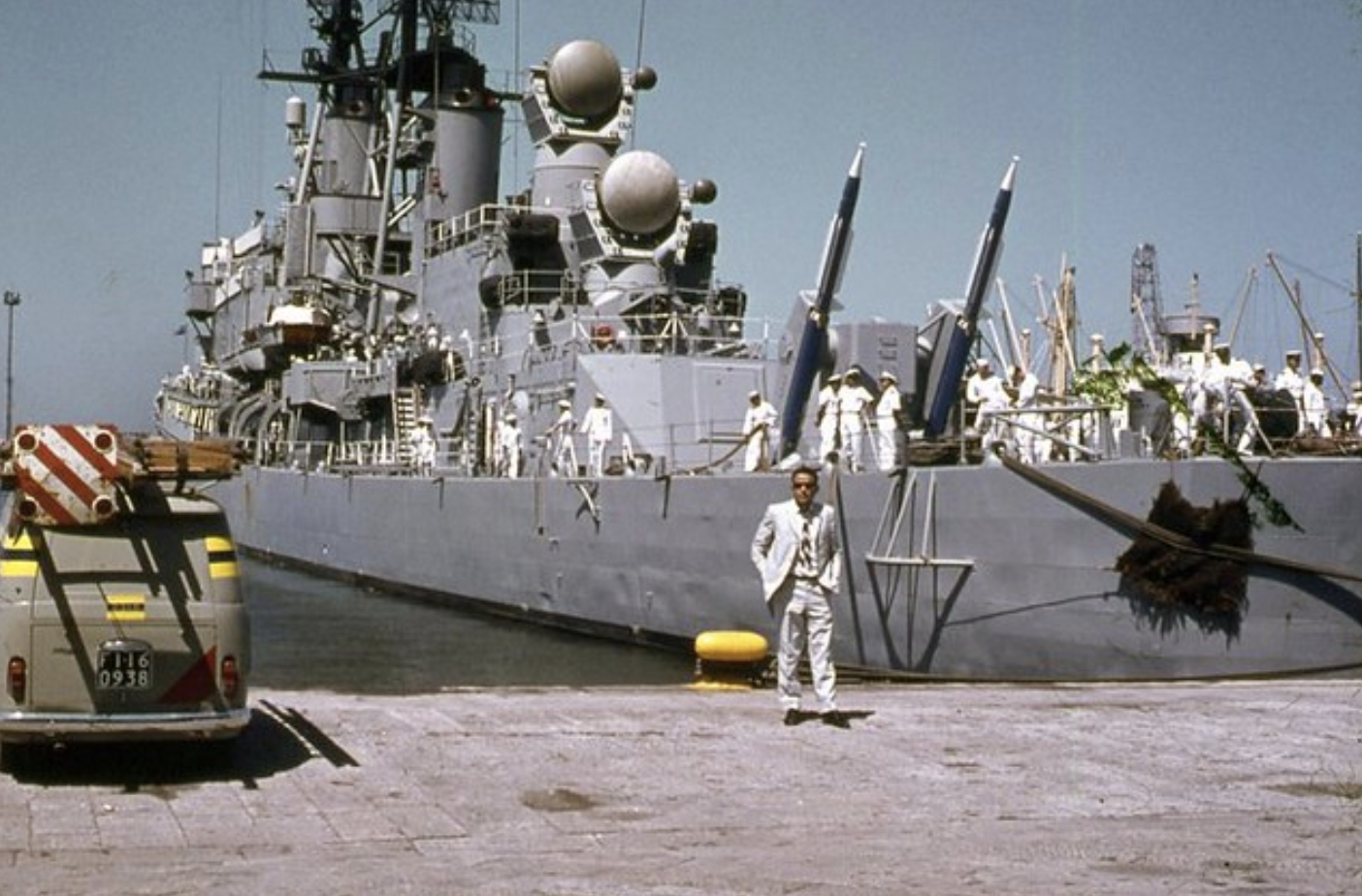
vs:
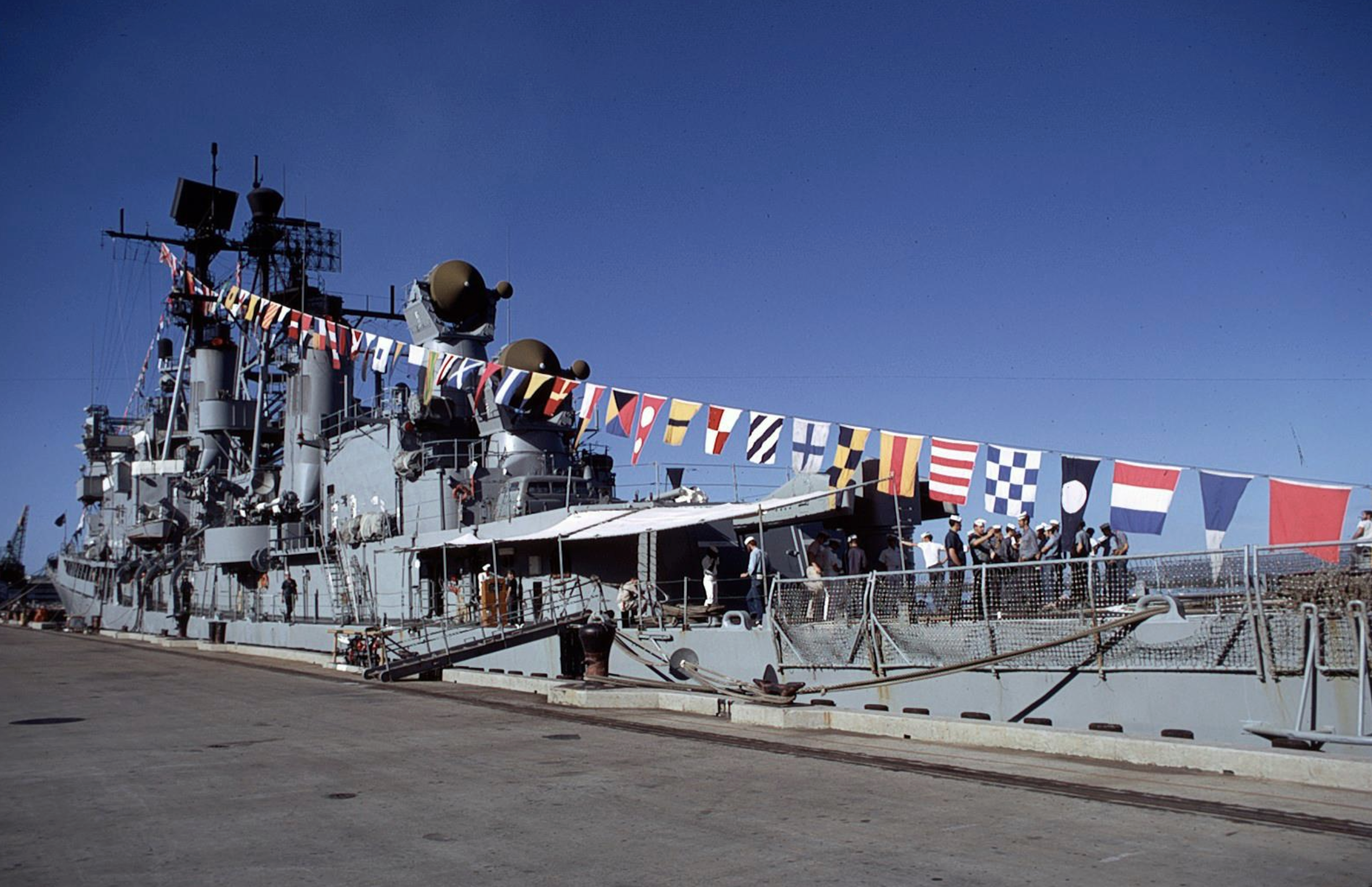
(from the USS King website)
I think ships of that class went through a few retrofits (and I think could be fitted with several generations of similar missiles)… in 1962, the radomes then looked more like this:
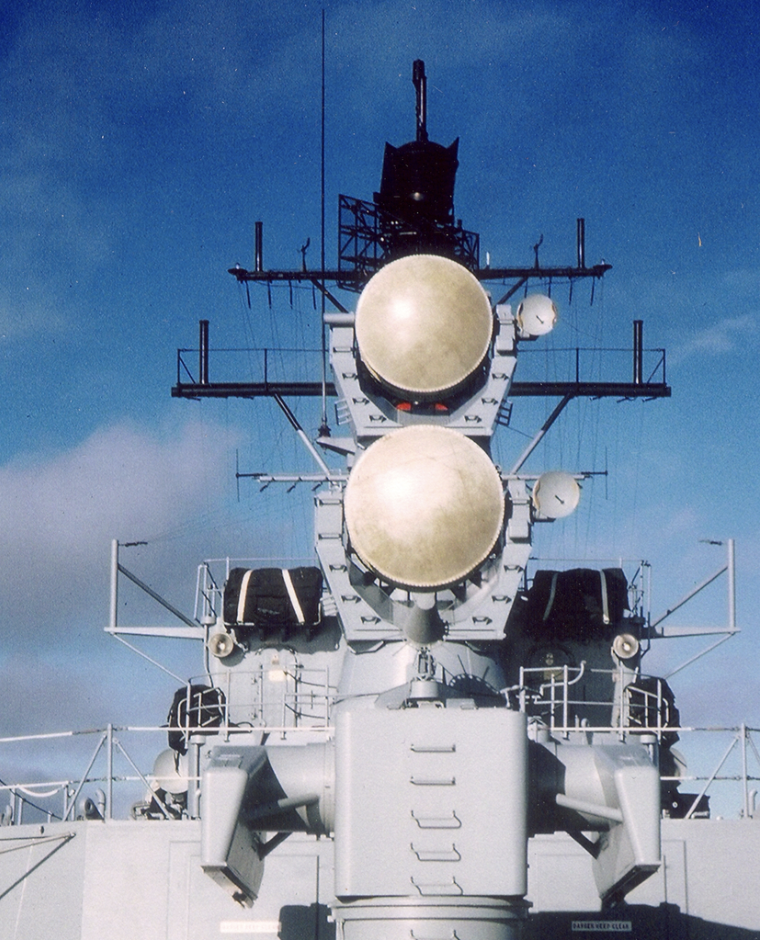
(from the same website)
Agree w @Reply. I think it’s a Farragut class destroyer. The men are too large versus the hull for it to be any sort of cruiser. This has some decent pix and references: Farragut-class destroyer (1958) - Wikipedia.
Yes, that looks about right. And for my part I was thinking it might almost be easier to identify the missiles, and then work from there. Which, for my part, it was (there were many flavors of cruiser and destroyer in the mid-60s, but only so many guided missile cruisers/destroyers, and only so many kinds of guided missiles, and we have a much better view of the missles than the ship):
It looks to be a pair of RIM-67A missiles, and Farragut looks to be the only class of destroyer it was deployed on. And I agree that the size of the ship, and particularly the freeboard, makes it much more likely to be a destroyer of that era than a cruiser (of course nowadays, the only cruisers we have are built on a destroyer-sized hull, but then again the destroyers displace almost as much as a pre-dreadnought battleship).
ETA: And that picture of USS King in the wiki for the Farragut class looks like it’s a near-perfect match for the reverse aspect of the same class of ship (starboard bow as opposed to port quarter).

The King website has this note on the cruiser vs destroyer vs frigate designations, and the 1975 reclassification: USS King (DLG-10/DDG-41)
the U.S. frigate (DL/DLG) classification was eliminated on 30 June 1975. All the gun frigates (DL) had already been stricken or converted to DDGs. Most of the DLGs became cruisers (CG), but the smaller Farraguts became destroyers (DDG).
As for the missiles, I think the ships spanned the lifespan of both the Terriers and the RIM-67s (which were the Terriers’ replacement) and could’ve carried both.
The same fire control radar could be used for both: AN/SPG-55 - Wikipedia
(Though I’m not clear why some were white and some were black)
Ah, the white ones might’ve been the earlier AN/SPQ-5 - Radartutorial for first gen Terriers? But it’s still not an exact visual match.
That era, 1950s-1960s, was one of near constant refurbishment of surface combatants. Progress in electronics and missiles was much faster than the hulls and machinery aged out. At the same time, the hulls from just pre-WWII and the first couple years of WWII were aging out and/or just too small to accommodate modern systems. So nearly every ship the Navy owned in late 1945 was either gone, or had been renovated twice or more, by 1969.
Going back to the OP’s pic, or really any USN pic from that era (say end of WWII to start of Viet Nam), we sort of have to identify not only the class, but ideally the specific ship in class, and which renovation generation it was in when the pic was taken.
IOW, if that is in fact the King, we can probably also find pix of the same King with very different armaments and radar gear. So we need to do our identification by inclusion, not by exclusion.
I looked at several ships of that class but could not find a detailed enough picture from that angle to say much one way or another. In the OP, her number was covered with that black mat thing on purpose.
I think the King in particular was in the Pacific during that time; she just happened to have the better pictures due to the website.
On the other hand, the license plate on the car was a FI plate (possibly for Firenze, or Florence, Italy), but many ships of that class visited Italy during that time period.
I wonder if it’s possible to look up that particular license plate in Italian archives and track down its owners and ask them or their descendants about this pic. Might find a stoked grandkid.
Also, side note, this task (historical warship ID) is apparently something AI is terrible at, at least for this particular class of ship. Maybe there weren’t enough high quality photos in the training set.
All the ones I tried made extremely confident and wrong IDs, pointing to completely different ships of foreign navies (apparently, Italy also used the Terrier missiles, but I could not find a ship that looked like this). Then, when provided with contradictory evidence, it started hallucinating hull numbers that weren’t there.
The Terriers in particular were on everything, and similar fire control radars in similar arrangements were also common.
What’s special about the Farragut class was that the Terriers were mounted on the stern, and the radars were on those little platform things (three total, highest to lowest) with a thin fence around each, and the two smokestacks were learning backward at that angle, and without the protruding “branches” that the Belknap and others had.
USN ships don’t have numbers at the stern.
I have no idea why that mat thing was hanging there; it’s not in the right place to be a docking fender. Perhaps they crane provisions over the stern onto the quarterdeck there, and that’s to protect against any dropped stuff.
I think that might actually just be something smeared on the photograph. There is also a smear above the rail. I have no idea what the branch shaped thing is, but it doesn’t seem to belong there.
ETA: Looking again, the “branch” is a cable running to the dock.
Yes. And that hawser enters the ship via a hawsehole on the port side, but is tied off to the dock behind the stern off-camera to our right. So it turns the corner at the hull’s edge where the stern meets the port flank. And that dark brown shaggy-looking mat is an anti-chafing mat. A big blob of frayed rope mesh that protects the line from the sharp corner of the ship, and the ship’s paint from the line. We can see the very light lines that support the mat are cleated off right there at deck edge near each side of the deck corner.
The shadow of the hawser on the hull is that strange curved hoselike thing seemingly flowing out of the mat at lower right.
I am mystified about the green stuff. It’s simultaneously got some very straight lines but also looks vegetative / natural, not manmade. That might be schmutz on the image that wasn’t there in real life. Might.
I don’t see any reason to believe it’s King specifically, but it could actually be the lead ship of the class, USS Farragut. My go-to for something like this, just for a broad-brush assessment, is navsource.net:
That page indicates Farragut was photographed in the Mediterranean in the fall of 1962. So, on a hunch it might still have been there in 1963, I checked the deck logs and found the ship was actually moored in Naples New Year’s Day, 1963.
https://catalog.archives.gov/id/213585627?objectPage=3
That said, my initial sense is that the picture is perhaps from later in the year, spring or summer, because the sailors are in *whites (by which time Farragut was back stateside). I suppose if someone really wanted to know the specific ship, they could check the deck logs (start on the first of the month for, say, May, June, July, August, and September 1963 and see who who is at least is out to sea in the Med, then zero in on a date in Italy from there).
*But then for all I know, it was customary to only wear whites in the Med or some such thing in those days (if it were me, I’d say seasonal uniforms are stupid and just tell everyone to bring one set of dress uniform to make best use of limited space on deployment), so I wouldn’t discount the possibility completely.
So I think I’ve narrowed it down to either USS Macdonough or USS Dahlgren. The deck log for Dahlgren shows it was in Naples June 1, 1963. The deck log for Macdonough, unfortunately, seems not to be available due to an error, but secondary sources (wikipedia and navsite.de, which I have generally found to be reliable, similar to navsource.net) indicate it deployed to the Mediterranean in the summer of 1963 as well.
And if I had to flip a coin, just because MacDonough is longer than Dahlgren, and judging by this photo…
…I really think that if it were MacDonough, we’d at least be able to see the first letter or two of the ship’s name painted on the transom on the edge of frame for the photo in the OP.