[QUOTE=RedRosesForMe]
I’m not talking about “its” vs. “it’s” so much, as I’m sure even someone who has mastered that rule can admit it is a bit confusing.
[/QUOTE]
Confusing, perhaps - but it’s among the simplest and most regular rules in English: if you mean “it is”, use “it’s”; otherwise, use “its.”
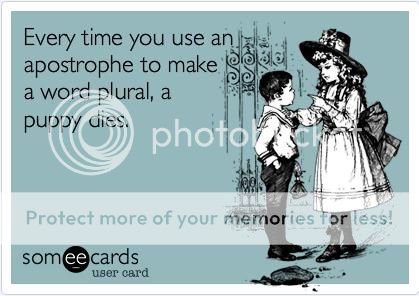
There’s no doubt that the overuse and misuse of the apostrophe is peaking right now. Someone thanked me in an email today by writing, “Thank’s”. I now see wrongly used apostrophes all over the place - they are very common on the internet, which is expected, but now I see them them on all sorts of signage, even on billboards.
As a writer, I feel it’s a dangerous trend… this is the type of thing that can greatly mangle and obscure the meaning of a word or sentence. Anyone who values clarity of expression should be concerned.
Contributing factors? How about lousy grammar and punctuation instruction at the grade school level, epidemic-level ADD, and the prevalence of texting in the culture? Whatever the reasons, it sure does seem to have reached critical mass.
I wonder though, if this isn’t part of the ongoing evolutionary mechanism of the language. We no longer easily understand Victorian English, for instance, because the language has simply changed a lot since then. I wonder if a lot of those changes initially may have looked like improper usage and mistakes. If a mistake becomes the dominant usage, isn’t it just a matter of time before it becomes standard usage, and therefore, correct?
Are misused apostrophes due just to sheer laziness? Is it that people just can’t be bothered to make the distinction between a possessive and a plural? Come on folks, it really isn’t that hard.
Correcting correspondence generated by my employees was the biggest headache I had at one job. I think there was one person in there (other than the admin assistant) who understood grammar and punctuation basics. I refused to allow a letter to go out looking like a 4th grader wrote it, which caused some bitterness among the masses. Hopefully they are better off for the experience.
Actually, much later than that. One of the more interesting bits of historical trivia regards the variation of spellings and grammar during American Colonial times. I have read how an academic of some stripe basically re-created the accent of somebody famous (Daniel Boone, perhaps?) by paying attention to how he spelled words.