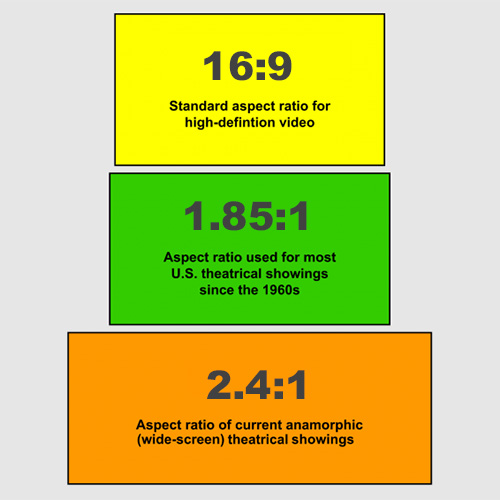
TVs used to have an aspect ratio of 4:3, but these days they’re almost all 16:9. However, this means that most made-for-theater movies are still letterboxed, with black bars at the top and bottom. Many movies are 2.39:1 instead:
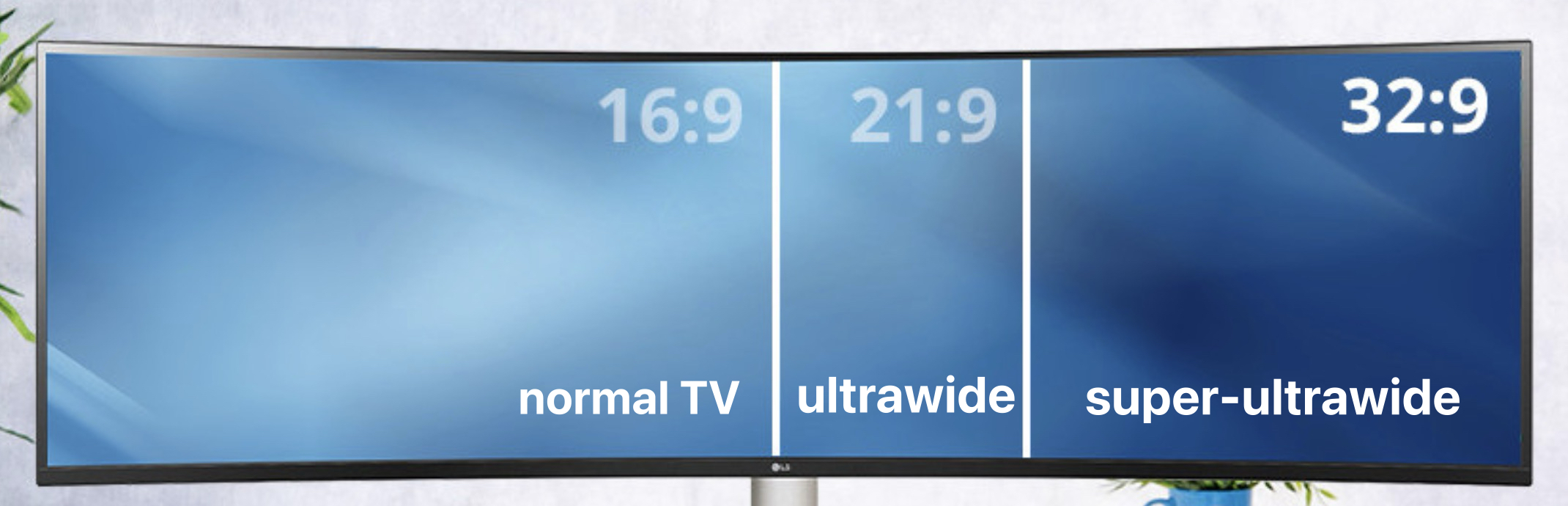
Lots of theatrical movies are at (around) 2.35:1, but there are still plenty made at 1.85:1. And most TV series are 1.78:1. So on an extreme widescreen TV, most available content would be pillarboxed. Companies tried making them, people didn’t buy them.
Because 16:9 (or roughly 1.85:1) is the best compromise and natively accommodates the vast majority of HD television programming and many movies, while movies in the roughly 2.35:1 widescreen format appear only somewhat letterboxed compared to what they looked like on old tube-type TVs with a 4:3 aspect ratio. Meanwhile older movies and older TV shows are “pillared” with black bars to either side. With a 2.35:1 TV the vertical bars would be enormous, and they would be there the whole time you were watching normal HD broadcast content.
Movie theaters generally have to accommodate both 1:85:1 and wider aspect ratios, so even there, widescreen movies are effectively “letterboxed” even though it may not be obvious. It’s more apparent in mixed IMAX and conventional format movies like Interstellar, where you get the full enormous screen in IMAX scenes, and a letterboxed version in conventionally filmed scenes.
Here’s a cool thing. For a few years, around 1998-2003 I think, while they were transitioning from 4:3 analogue to 16:9 digital, some UK shows were framed for and released in 14:9, a halfway ratio between the two. That meant you could chop off the sides on an old TV, or chop of the top and bottom on a new TV, and you wouldn’t lose any crucial information in the image. Or alternatively, if they were scaled with visible black bars, they were so slim as to not be a bother.
I’m not sure about modern theaters (I stopped “going to the movies” a long time ago) but I remember old theaters having curtains on either side of the screen that were positioned to cover unused portions, adjusted for each aspect ratio. I think the curtains were actually closed over the screen until the movie (or ads) started playing, then drawn back to the right position?
Today I learned that you can sort IMDB movies by aspect ratio. (It can’t be an all-inclusive list, though.)
(Edit, I see it is a list made by one person, not a searchable field on the site. And was last updated 3 years ago, which explains why nothing later than 2021.)
We turn back to Film’s little brother Television. In the late 1980s, when the plans where being drawn up for the HDTV standard, Kerns H. Powers, a SMPTE engineer suggested this new aspect ratio as a compromise. 16x9 was the geometric mean between 4x3 and the 2.39 the two most common extremes in terms of aspect ratio. This means that images of either aspect ratio would have relatively the same screen area when properly formatted in 16x9 with letter boxes.
And so, out of a compromise, the 16x9 aspect ratio was born - the default widescreen aspect ratio for all video products from DVDs to UltraHD “4K” formats was born.
I don’t know why anyone would care enough to select movies by aspect ratio. My TVs and my tablet all being 16:9, I tend to prefer movies in that format, but it’s no big deal if they’re 2.35:1 or whatever other widescreen format.
I watch a lot of movies on my tablet, not because I’m an invalid but because a bed is just a comfy place to watch movies at night. And when the movie is 2.35:1 or something in that range, the media player software lets me zoom in with a quick “expand” gesture of two fingers. It cuts off the two sides a bit but it’s generally a nicer experience.
I’ve never been a fan of super-widescreen. I don’t see the point. My understanding is that it was invented when TV started to compete with movie theaters, in an effort to make the movie experience different and special. I call bullshit. The most immersive movie experience I’ve ever had was traditional film IMAX on an absolutely gigantic screen with an aspect ration of 1.43:1, which is pretty close to square. It filled your entire field of vision, left, right, top, and bottom. It was spectacular! And it wasn’t “widescreen”.
I work on developing the tech for Apple Immersive Video, a bespoke format for VisionPro, where the Field of View is roughly 180 degrees both horizontally and vertically. One of the big challenges is for directors and cinematographers to learn how to use all that extra screen and how to block out scenes to get the viewers to look at what they want them to see.
I wanted to bud in “yelling nonsense”, as my gut-feeling is that the human field of vision is way more widescreen than that … except, it isn’t … about 1.5:1, it turns out …
TIL, (Tomorrow I will have forgotten): human f.o.v. is about 1.5 : 1 … and its more oval than rectangular with decreasing periferic vision.
On a related note, I just took delivery yesterday on a new 65” TV to replace my 55” one. It’s not much of an increase, but my wife and I are getting sick and tired of directors using text messages for essential plot points and shooting the cell phone screens so they are just a small fraction of the image. This is compounded when the image is letterboxed. It may be perfectly legible in a movie theater, but I can’t read the damn things at home. My current TV has a “zoom” setting where I can increase the picture size and I was always having to back up the streaming, switch to “zoom,” and then re-watch the scene. C’mon directors!! Make cell phone screens (and documents) more than 25% of the shot!
The dimensions of the monolith in 2001 were in the ratio 1x4x9, the squares of the first 3 integers. 16x9 TVs are driving human evolution by taking that one step further.