I imagine it’s less of a factor now, but when I first spent time in Japan 30 years ago, it was widely recognized that limited dairy in the Japanese diet before the war meant that osteoporosis was quite common in the elderly, leading to pronounced kyphosis (stooped back). Post-war introduction of dairy led to younger Japanese being taller and probably to less of an issue with osteoporosis as people aged.
You make an excellent point. I spent very little time in the country when I was in Japan, but it’s possible that the people I saw in the city came there late in life to live with their children, after spending their working life doing that kind of work.
Interesting to consider, but I suspect that getting up off the floor once a day probably isn’t going to make that much difference; rather I think that the amount of walking required to get around in Japanese cities tends to keep adults thinner and healthier than their counterparts in the US who drive everywhere, and so better able to get up on one’s own after a fall, at least until quite late in life. When I was living there as a 30-year-old, over 45 years ago now, I think I was never healthier, running up two flights of stairs a couple of times a day to get to a railway platform (almost no escalators then) and barely being puffed from the effort.
As others have noted, tatami are not readily movable. Tradition ones are about 182 x 91 cm (about 6’ x 3’) and several inches thick and the traditional ones are 30 kg (66 lbs) plus.
Ones for modern style homes can be somewhat smaller and lighter.
People sleep on futon on top of the tatami, although some people may have an additional mat between the two.
As tatami get older, they lose their cushion and it’s harder to sleep on them. Unfortunately, older tatami tend to go with thinner futons, in my experience.
Japanese homes are changing to fewer tatami rooms. When I was first in Kyushu in the early 80s, typically only the kitchens and bathrooms had flooring, with all the rest of the rooms being tatami.
As missionaries, we knocked on doors all day and taught people in their homes. For the entire 16 months I was there, I only visited a couple of houses that had Western style living rooms with sofas and not tatami. For everyone else, we would sit on the tatami floor.
I lived in four different houses and two apartments and all the bedrooms were tatami. The few places had a “dining kitchen”, a kitchen large enough for a dining table as well. That would be flooring and not tatami.
My ex-wife’s family’s house in Tokyo was build in the late 70s or early 80s and only had one room that was tatami.
A lot of apartments now have no tatami rooms. The house we built in 2008 also had no tatami rooms, which was common then.
Fewer homes now have traditional toilets (and even 45 years ago when I was first here, there were few “toilet holes” but rather floor level toilets that you squatted above).
Traditional lifestyle involved sitting on tatami floors which makes you get up and down off the floor many, many more times a day than just once a day when you wake up. When I was first here 45 years ago, most people ate on low tables while sitting on the floor.
People would sit under a kotatsu (a low table with a heating element and blanketing around the sides). They are quite warm and if you wear a hanten (a quilted jacket) you can stay warm even if the room isn’t that warm.
When we moved back to Japan three years ago, we looked at a wide range of houses and apartments ranging from new to 60 years old. The changes were quite obvious.
@aceplace57 After answering, I started to think about how Japanese houses might have layers of doors that help to block the wind - like you have a ring of outer rooms surrounding an inner room, and so you can create a large air gap between you and the outside… But then I thought, no the average person, traditionally, would have just have had a single-room house… And then I remembered that the oldest Japanese houses had a fire pit in the middle with a hole in the roof for the smoke to get out.
So I did some investigation of house construction for commoners during the pre-modern period and the overwhelming bulk of material says that “Japanese people have traditionally had freezing cold, drafty houses during the winter, and they just suck it up”.
In general, they have almost no insulation and, traditionally, they had - as said - a giant hole in the ceiling. There was no chimney until the late 1800s.
As I understand it, due to the whole country being relatively close to the ocean, and nearly all of the construction being wood and paper based, the primary concern in construction was in keeping the humidity down. Air drafts help to keep mildew from growing on the wood and paper.
But so consequently…their houses were cold during the winter - despite how much their walls might have blocked the wind.
Japanese have generally focused on self-warming rather than room-warming. They had portable heaters (a metal box full of charcoal) that they’d stash in a pocket of their thick, padded clothing; they had tables (kotatsu) where you sandwich a thick blanket under the table-top, so it drapes over your legs and lap, and - again - there’s a metal box on the bottom that traditionally you would fill with hot coals. They had various tricks like this.
But, in general, their faces would have been cold throughout the winter.
Another consideration in Japan is the threat of earthquakes.
Buildings of joined lumber withstand those better than brick and stone.
Lightweight wood and paper constructions were less likely to kill you during a collapse.
Not saying that was the only concern, just one of them.
I’ve recently read Japan’s rural cities are depopulating. People move to the cities.
It’s the same here in the US.
Rural houses in Japan are going cheap.
It doesn’t sound like they’re good candidates for flips and renovations.
It’s a different engineering model compared to our US brick homes.
You are right that it’s not planting rice and sleeping on futons as the primary cause of kyphosis, but its also not really that simple as the decrease primarily coming from more milk. Japanese scientists are studying this and the answer apparently is not just one weird trick.
Studies are not required to understand that getting up from a bed is much easier than from the floor.
Building regulations were changed in 1981 to prevent houses from completely collapsing in moderate earthquakes. Under the old regulations, many homes would collapse, especially if the epicenter was close.
The bulk of Japanese population was in what is now Tokyo area (Kanto) down through Kyushu.
House construction was designed to handle the hot, humid summers rather than the colder winters of Tohoku (including Sendai). Japanese didn’t start to migrate to Hokkaido in larger numbers until the 19th century, and they didn’t attempt to change construction until fairly recently.
As @sage_rat notes, houses that trapped humid air allowed mold to grow, essentially in the tatami, so allowing drafts was better than preserving heat.
Something we found out that was using tatami on Western stype flooring allowed mold to grow on the bottom of futons unless the futons are picked up every day. They have hinoki bed slates which can be folded and you put the futon on them.
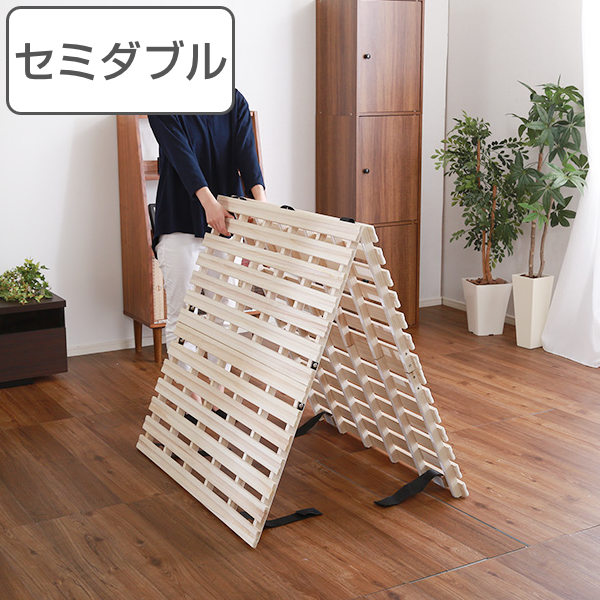
This lets the mosture escape the futon. Tatami breathes better so they aren’t needed. A while after I came back to Japan, I got covid and was sick enough that I didn’t put away the futon everyday, and the bottoms got moldy. That’s when we found these.
All right, there is an obvious difference in the height of your centre of gravity, but am I going to trash my joints if I sleep on a futon for years on end?
Is anyone saying that?
The obvious answer is that getting up off the floor is harder with bad joints.
Many people feel that stretching and exercise throughout their lives prevents arthritis and joint stiffness.
That’s why healthy and active people perform yoga at 26. They hope to be flexible and physically active at 76.
Same thing with getting up and down off the floor. It’s trivial for a 12 year-old. The Japanese used to do it throughout their adult lives.
Japanese sat on floor mats. They slept on floor mats. Getting up and down was their daily routine.
Is there medical proof that this practice actually improves flexibility in Seniors?
I think genetics is key. Some people are predisposed to arthritis.
Think of the lifetime jogger. 2 miles every morning for 35 years. Needs a new hip and his right knee aches.
The guy that never exercises and enjoys time on a sofa has a good hip and knee at age 55. Or maybe not. He might have early arthritis too.
No one ever said Life is fair.
Genetics are hard to ignore.
I’m not sure about flexibility but being able to get up off the floor by yourself is highly correlated to living longer.
And while, yes, genetics might help, those genetic benefits might be things like a desire to get out and be physically active or to enjoy the flavor of vegetables more than others. Looking at someone older, who appears more healthy than most, and deciding that they must just have “genetics” overlooks that not all of genetics is height and eye color. Some of it is personality, palate, sociability, etc. You can choose to do the things that they’re inclined to do by nature.
In Japan, living on the floor is something that most of everyone is forced to do by the local paradigm, along with eating more fish, and walking instead of driving by car.
In general, there’s no reason to think that they should have better genetics than Americans. Italy, Switzerland, and Spain have fairly similar lifespan expectations as Japan. Most likely, the biggest difference is activity and diet - both things that a person can choose for himself.
Living on the floor is decreasing and I don’t know the percentages but it may no longer be “most.”
Also, people living outside large cities depend on cars and don’t walk that much.
And, just a reminder for everyone, Japan isn’t a static society and there are huge differences between urban and rural areas.
I think most people can understand that America isn’t a monolithic society, and yet a lot of people want to try to make Japan into that.
The kimono is no longer as popular either?
Western clothing is popular?
I spent some years there and I never went south of Sendai. People always ask me some type of sterotype or cultural questions and I usually had no idea what they were talking about. Just assumed it was a tourist thing from Tokyo or Osaka or the popular Okinawa
I went to Japan a few times in the mid-90s, mostly Tokyo but also to a place out in the sticks, and I didn’t see a single kimono.
You would probably have to go back to the 19th century to find a time when the majority of Japanese wore kimono and other Japanese clothes.
There are a lot of sterotypes about Japan, that is for sure. Most people don’t realize that the craziest ones seem crazy to Japanese themselves.
The biggest one I got was the misconception that they eat dog. (I would guess they compounded China and Japan stereotypes) When I asked my buddies (Japanese) they talked about forbidden meats which, while agreeing dog is forbidden, the most exotic were; horse, bear, and turtle. We all agreed dolphin and whale were too much. The most exotic I tried was various parts of a chicken… on a stick.
You could readily get whale sushi as well as horse in the 90s. My hosts knew better than to serve it to Americans.