On my first trip to Japan, about 30 years ago, I was dining alone in an upscale little place in Sapporo. After a succession of delicious dishes, I was served something thick and rubbery. I got worried that I was eating Flipper so, in very broken Japanese, I asked what it was. I didn’t understand the answer at all, but phonetically wrote down “takonoatamadesu”. When I got back to my hotel, I was relieved to decrypt that to octopus head (I didn’t know back then how smart  are).
are).
I had horse sashimi once in Japan. A friend who spent an academic year there tried whale a few times. I wouldn’t eat whale. (I saw it for sale in Norway many years ago, but didn’t buy it there, either.)
When i visit Japan, i try to find hotel rooms with tatami mats. They are so much more practical than Western style rooms. A Western hotel room is often completely filled with the beds, and feels cramped. The traditional Japanese room, in contrast, feels spacious, because as soon as you get up you fold the bedding out of the way. Also, the tatami mats smell wonderful and i find them comfy to sleep on.
It’s called bazashi, and it’s not really uncommon. It’s not a daily staple but people eat it.
When I was first here, some people served raw chicken!!! Torizashi. I was 100% certain that they were trying to pull a fast one on the stupid gaijin, but apparently it’s a delicacy in southern Kyushu. It carries a high risk of food poisoning, of course. I didn’t get sick but haven’t tried it again.
Lately, we’ve used AirBnB type of inexpensive hotel rooms which have more space.
I’ve never understood Fugu / puffer fish.
Why would any rational person take the risk of serious illness or dying?
An incompetent chef is not going to be the cause of my demise. Unless the idiot kills me with food poisoning.
There’s a reason there’s a F.U. in Fugu. 
They still do. I visited in September, and went to a few square dances. After the dances, most of the dancers went out to an “after party” at some restaurant, and i was invited along. Two of the places had food i don’t remember, but one, they told me as we were walking there, was a “chicken sashimi” place. I thought they were kidding me, but that’s what it was.
I checked the incubation period for salmonella to see if i risked unknowingly bringing it home to my husband (immune compromised from cancer treatment) and decided i had enough time to try it, so i did. According to Google translate, the menu warned that this was risky, and also promised the chickens had been slaughtered the same day they were served.
It tasted fine. Nothing special. It was extremely fresh. I have zero interest in trying that again. After the raw chicken course the place served us cooked chicken - simply fried with the skin on, but no breading and minimal (if any) seasoning. The fried chicken was fabulous.
(A different place served skewers of fried chicken skin, and we had to say how many skewers we wanted before we got there so they ordered the right amount. That place was mostly remarkable for the large drinks they served us.)
Friends who visited the same square dance club a year ago were also taken out to eat weird food, and we wonder if they were playing a game of seeing what the gaijin would eat, but they were established restaurants with other customers. 
Apartment buildings too? Because that wouldn’t make much economic sense.
Unless things have really changed, since I lived there, I’d think that most homes have at least either the main dining table or the main bed on the floor (or close to it)? And a semi-healthy number of izakaya had recessed tables so you sat normal, but you still had to stand from the floor?
I’m having trouble finding trustworthy driving numbers. Apparently almost everyone with a driver’s license views it as an identification document more than a thing to allow driving. That said, the number of motor vehicles per people is reasonably high… But it’s not clear if those are privately owned cars, or if it includes buses, delivery trucks, etc.
Just a longer due by date.
If you think about it, that parking garage collapse in New York would be unlikely to have happened if it had been a depreciating asset.
I am actually trying to think when was the last time I slept on an actual bed in Japan and I am having a hard time remembering. When I lived there, and every time I visit, I always sleep on a futon, either at the house I stay or at Ryokan. Maybe at a hotel was the last time I slept on a bed in Japan? The house I lived in and stay in when I am there has both rooms with tatami and ones with hardwood floors.
When sleeping at the house on the floor (non-tatami) I always have a shikibuton (a tri-fold mattress) that goes underneath the futon. I roll up the futon in the morning and store it in the closet giving me space to move around which is good because I also had a desk in that room for work.
I remember staying at friends apartment and it was the same thing. We rolled out the bedding in the evening and rolled it back in in the morning. Empty space in general is seen as a valuable so stowing away things that you aren’t using so that you have more space is a good thing.
//i\\
Technically, shikibuton is a hyponym of futon— the name says it all.
Buildings only depreciate (and collapse) if they’re not maintained - with proper maintenance, a well-built building should last forever. At least, that’s the European approach to construction.
I guess the Japanese were so enamored with their post-war building boom that they assumed it would last forever. With their aging population, I suspect they’ll find that’s not true.
At lot of the construction for new houses is for multi-generation families. They will take down the existing house and make “two”, where one is for the parents/grandparents. Some will have it within the same structure, some will have it like a small, kind of side house. They are set up so that the older members of the family have their own space, with their own entrance, with some shared spaces between the two groups.
//i\\
You can’t? Because. . . ?
Please clarify, because there is a lot of misinformation out there, so before I respond, can you say more about what you mean?
Are you saying that there are laws preventing this or that it doesn’t make financial sense? You posted a link that shows a depression scedule which doesn’t reflect the market.
Imagine two Japanese people staying in America for a while. One lives in a really liberal neighborhood in a large metropolian and the other lives in a rural, deeply conservative area. The two will tell you completely different accounts of what Americans are like.
I have no idea what your experience was like in Japan, how long you were here, etc., but your beliefs don’t seem to match I’ve seen and what my Japanese friends are telling me.
Obviously, I have my own limitation as well, so I looked into it. I asked my wife, who works in the real estate market and has seen thousands of listings; a good friend who is also in the real estate market and has worked in it for more than 35 years; another good friend, a designer who works on remodeling homes, and a number of other Japanese friends as well.
The designer works with people who are remodeling older homes, and the vast majority of them are removing tatami rooms and replacing them with flooring. My wife and my friend’s companies sell a lot of properties, and again, there are a lot of bedrooms and dining areas with flooring.
There are some reasons. One is that once people started sitting on chairs and sofas, people got used to not getting up off the floor. Tatami mats are harder to keep free of dust and such, and some people have allergies. Traditionally, families often slept in one room, but that has changed so children get their own rooms at an earlier age than they did before.
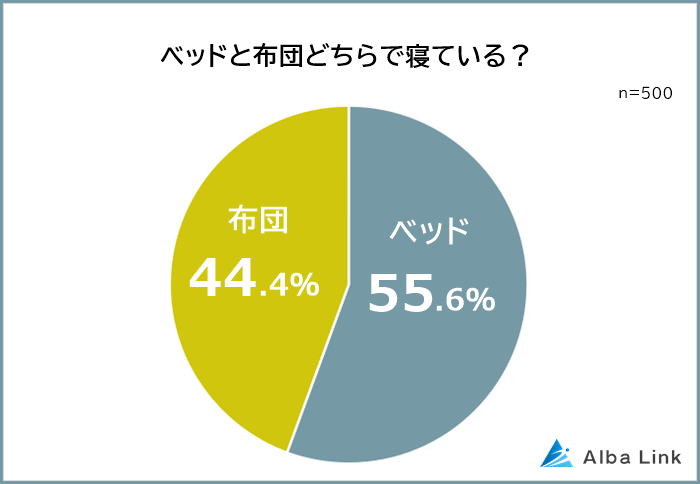
From here: The number of people sleeping in futons are in yellow and the gray is for bed.
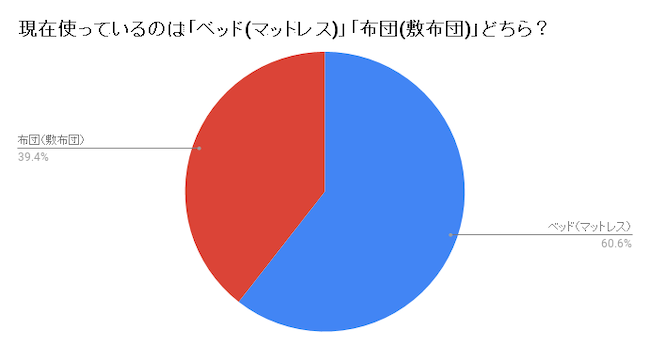
And here is another from here. Red for futon and blue for beds.
There are cultural differences as well. Japanese culture favors an aesthetic of impermanence and acceptance of flaws. Plus, there’s the whole earthquake thing. So it leads to a culture of building just enough to meet current needs, being prepared to rebuild it if requirements change or disaster strikes. Nobody really knows what any given house needs to be in 50 years, so rebuildability is an advantage.
There’s the whole earthquake and the whole fire thing. On my first visit to Japan, i went to a ton of temples and shrines. And most of them are built with interlocking timbers that rattle and can survive an earthquake. (They are the historical predecessor to burr puzzles, which were made by apprentice carpenters to learn how the joints work.) But every one of them had a plaque documenting how many times it had burned down and been rebuilt.
Residential property wasn’t built to survive those hazards, it was built to be cheap to rebuild.
That’s probably changed since the post was building boom, and i bet that more of the residential buildings are designed to last longer, especially large apartment buildings.
That sounds a lot like what I’ve familiar with from Israeli Arab communities, except there they don’t tear the house down, they just add more annexes and more stories to the building as the family grows. But again, this is reinforced concrete and cinderblock construction, not wood.
Agree on preference for thin mattress on hard surface for most comfortable sleep. Indians do that too, but on raised bed platform instead of floor.
I’m not a Japanese real estate lawyer, I’m just relaying my understanding.
If someone wants a mortgage for a property, I understand that the banks will deny it on the basis that there’s a “wreck of a building” on the lot. Someone could pay cash for the whole deal but, if the local government decides that the building is a risk to public safety, then they’ll condemn and demolish it.
So while there is some room to wiggle around it, only fanatics with lots of cash are likely to make use of it.
These are houses or apartments?
I never saw furniture when looking at apartments, while I lived there, but in TV shows they were pretty universally depicted the same way that I had mine, which was to have a futon that you put in the closet, a table with folding legs with floor pillows, and a legless/futonish couch.
That’s basically what was available for you to buy at the local furniture stores / Mujiryohin, as an apartment dweller.
For how old of a property?
Both. The house designer works with customers specifically to accommodate their needs and this asks what the customer is going to do.
And you can see the linked articles, the majority of people report sleeping in beds.
Again, as I understand what I’ve read, that varies by the construction type. A simple wood building might be 20 years, a concrete building with steel reinforcement might be more like 40-50 years.
If you know something else, I’m not understanding the purpose of being coy about it? I’ve explicitly said that I’m no expert.
Just going by the image in the article, I’m not confident that we have a shared understanding of beds.
But even if we take that a shift to tall beds, long legged tables, and tall couches has taken over, if we presume that lifestyle to be worse for your health, we wouldn’t start to see the impact of that for another several decades. It’s what the bulk of the recently dead would have experienced for most of their life that we’d be discussing.