Yup. Cf. the 1940 Disney song “Hi Diddle Dee Dee (an actor’s life for me)”:
I’ve eaten squab several times in the US. Mostly at Chinese places, but also at European restaurants. I think it’s delicious. Richer than chicken, more like pheasant.
One whole squab is a nice amount for lunch. The breasts are meaty enough to eat with a fork and knife, and most of the other parts are easier to pick up and chew on.
I assume “we” don’t eat it much any more because it’s not raised industrially. Most of our meat is basically factory farmed.
Chickens with access to bugs and weeds taste a lot better than factory farmed chickens. I’m happy to pay extra for that.
Having dissected a pigeon in college biology, I could see where it would taste more like liver than chicken. The meat was PURPLE because it had such a generous blood supply.
IIRC, the birds had been poisoned in some kind of pest control program, and whoever did this knew the professor and passed them on to us to use in lab.
Chickens raised for meat, (here) are not on the ground. Or outside.
Organic chickens:
They don’t frolic in a nice clean pure pasture. Sunning themselves. Picking flowers.
It will be a nasty muddy farm yard with other critters. Smells the same as any chicken raising endeavor. Just dirtier.
If they are organic you can’t be sure what they’re eating. If you’re ok with them pecking bugs, ticks, worms, dead carcasses, or poo that’s fine.
Not me.
I want a youngish fat bird. Clean. With a nice blue label saying USDA inspected.
Not paying extra for a golden “organic” sticker.
NM
I didn’t see the mod note several replies down.
It’s been a few years since I’ve been to one, but here in Chicago the live poultry places would often have pigeon available. There’s still a few of them left. I do see a review for one of the places from three years ago mentioning pigeon availability.
I think one barrier to successfully (i.e., profitably) raising pigeon/squab commercially is that the nestlings must be fed by their parents. They are fed “pigeon milk”, a goop that the parents manufacture in their crops. Compare this to chickens: the chicks are running around very soon after hatching and pecking up their own food. They don’t even need a parent around; they basically raise themselves.
I’ve had squab and I love it. As mentioned upthread, it tastes like a richer, more flavorful chicken thigh with a hint of liver about it. I think the flavor is like foie gras. I wish I could have it more often, but it’s very difficult to find.
I raised chickens as a kid - they can fly. I had to keep one wing clipped to keep them out of the trees. Chickens bred for food might not have this ability, but then if pigeons were equally bred, they might not either
The extinction of the dodo, which were basically pigeons that took on a flightless ecological niche on a remote island, was a missed opportunity. They were apparently excellent eating.
Precisely the plot of Howard Waldrop’s The Ugly Chickens, a Nebula Award-winning novelette.
Where do you get the idea they were excellent eating? I’ve heard otherwise. Most reports I’ve seen said it was not good tasting, but mostly what it had going for it was being fresh meat during a long voyage.
What’s SEA, in this context?
Goat meat is easy to find in my city, although we do have a lot of immigrants from South Asia, Africa, and the Levant. It tastes like roast beef but is awfully tough, so into the Instant Pot it goes whenever I get some. Maybe it’s the toughness that makes it unpopular?
My maternal grandparents kept goats during the Depression, mainly for milk because that’s what babies who weren’t breastfed usually got.
p.s. I have read that weight-wise, goat is actually the most popular meat on earth.
30 years ago when I lived in Texas, goat was quite popular especially in south Texas.
Goat is close to venison is taste(so I’m told).
There’s a big goat market around here. We have a large thriving community of Mexican farm workers. They eat it.
Deer hunters like to BBQ it. They eat it.
I’m assuming they buy directly from a goat farmer.
Lotta goat gets sold here in SoFL. The various Caribbean folks use it as a staple meat in stews, curries, etc. My go-to dish at any Caribbean eatery is something goat. I pretty much alternate lamb and goat when eating Indian.
I call BS on that one. Cite:
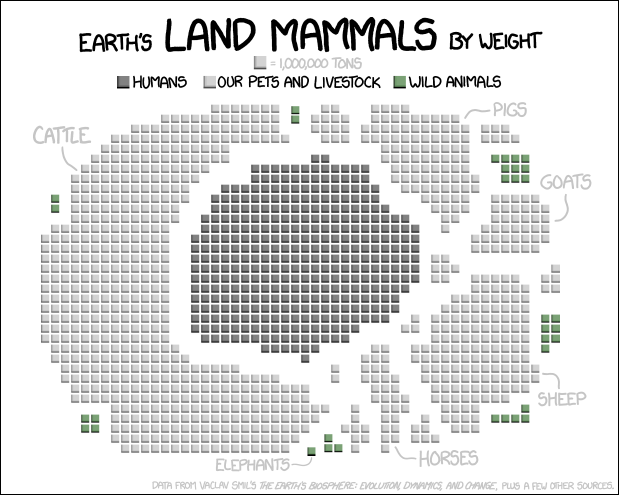
from xkcd: Land Mammals. Yes, not a strictly serious cite, but Randal doesn’t publish made-up BS.
That just shows how much the various types of land mammals weigh, in total. It doesn’t show how much weight, in edible meat, each type provide to humans.
Nope. The Dodo’s common name was walchvögel= disgusting bird-
Is it wrong to ask if dodos tasted of chicken?
Yes it is, but no, it didn’t. Dutch sailors carried the dead birds back to their ships, where they chopped them up and turned them into stews. The meat was described as ‘offensive and of no nourishment.’
Five names the dodo didn’t deserve
The Dutch sailors of the day dubbed dodos as ‘dodaersen’ or ‘fat-arses,’ because of the birds’ generously-proportioned backsides.
Seafarers who ate dodo meat, described it as tough and unpleasant. They called the dodo ‘walchvögel’ or ‘repulsive bird.’
Mind you, if you have had nothing but rotten salt meat and hardtack full of weevils, anything might be better. However, the pigs and rats found the eggs and young birds very tasty.
Right.
My buddies hooked me into going dove hunting, I gave them my take, so they invited over for a dove dinner. The breast was like a small chicken thigh in size and flavor, but more gamy, and the wings were like the last joint of a chicken wing. I was never a big fan of hunting anyway, so that was my last dove hunt.
I kinda like goat meat tacos.
This probably comes closest.
Playing with the data table, it looks like as of 2023 (final year of data), world per capita consumption of sheep or goat meat (undifferentiated) is 2.30 kg, whereas beef/buffalo is 9.35 kg, pig meat is 15.35 kg, and poultry is 17.32 kg.
Goat and sheep beat out only “Other meat”, whatever that is, at .79 kg per capita. And that’s both goat and lamb/mutton.
I wonder if squab counts as “other” or “poultry”? I would guess the latter.
ETA: I was responding to @kenobi_65 and these other folks slipped in between us. Sorry to partly duplicate @gnoitall 's work just above mine.
Granted.
But the edible fraction of a ton of live goats versus a tone of live cows is not nearly different enough to overcome the vast difference in the number of tons of cows vs goats.
Now there is a valid question in that the graphic is the number of tons on the hoof. So it’s the static supply of growing meat, not the annual consumption rate of that meat. How much fuel is in the fuel tank is different from what’s the fuel flow rate out of the tank.
But as long as the total volume is more or less constant over a scale of years, the production of new goats and cows is roughly matched by the consumption of those slaughtered for dinner.
An additional factor is age at slaughter. If, counterfactually, it took 20 years to grow a cow to harvest weight, but only 20 days to grow a goat to harvest weight, then you’d need a LOT of cow weight in the pipeline of the growing phase to be able to harvest what you need 20 years later. So looking at weight on the hoof would be a misleading comparison.
But in the real world, goats take longer than 20 days and cows take less than 20 years to get ready to eat.
These folks What Age Do Cows Get Slaughtered for Meat? - Biology Insights say cattle are harvested at 18-24 months. These other folks Goat Harvesting: Understanding The Timeline For Meat Production | PetShun suggest 6-12 months for goats. So cows have a pipeline 2-3x as long as goats. Which suggests to convert weight on the hoof to annual production we ought to cut the size of the cattle area of xkcd’s graphic by 1/2 to 1/3rd.
Cows still win.
Setting aside all my Feynman estimating …
A quick Google ask about worldwide annual goat production offers up a number of 6.37 million metric tonnes. Beef? 60 million metric tonnes = ballpark 9x as much.
Cows still win.
This cite Meat and Dairy Production - Our World in Data is interesting. If you scroll down to the third graphic, it’s world meat production broken down by animal type over the last ~65 years. It’s not perfect for our purposes in that they combine sheep & goat, and they also lump buffalo in with cattle. But it’s unequivocal that the cows, plus a rounding error worth of buffalo, greatly exceed the goats even after you bundle the sheep in there to help.
Asking Google about world sheep meat production comes up with ~9 million metric tonnes. So even sheep meat production is ~1.5x larger than goat meat production.
Cows still win.
This contradicts the xkcd graphic above, at least generally. Reliable information is hard to identify.