When I was married, my wife and I loved places where the Caesar salad was for two, and prepared tableside. We enjoyed watching it being made, and in one place, it was so good, my wife asked the server for the recipe. The server took the trouble to write it down and give it to us. I still have it somewhere.
Tableside service is a treat. You want to feel special, you get a dish served tableside. Crepes or Caesar salad, or whatever, there’s nothing like watching the preparation, having what you saw prepared served to you, and then enjoying it.
As for horse. Yes, some people eat it. I wouldn’t. Nothing wrong with it, I guess, but having once owned a pleasant riding horse, I would not feel comfortable eating a part of my old friend, even if what is served is not a part of my old friend. If the French wish to eat horse, then let them, I guess, but I won’t be partaking. It would be like eating one of my cats, fercryingoutloud!
Yeah, per capita consumption is about 1 lb/year in the US vs about 6 in the UK. Obviously that’s because a lot of people don’t eat it at all in the States. It’s pricier for one thing - production is low here and demand is traditionally met by imports, particularly from Australia and New Zealand. Flavor is another on people raised overwhelmingly on chicken, beef and pork.
I was raised on imported boneless New Zealand leg of lamb roasts that my father made and it is locally easy to find those in places like Costco (mutton on the other hand is quite rare). So I cook and eat my fair share - duck and lamb are also staples at local Indian and Thai restaurants I frequent. Even many local Chinese places. So it wouldn’t be considered rare in my little area. But I imagine it’s a different story in places like Boise or Peoria.
Totally understand this! I ate horse in Italy when I was going through a hyper adventurous phase, but I wouldn’t rush back. Bit chewy and gamey. I cook now and then with rabbit and try not to have a fluffy bunny image in my head when I do so (basically like chicken, makes a nice slow cooked ragu for pasta). I’m fine with snails - the garlic drowns out everything. Frogs legs were a bit like chicken wings and totally not worth the effort of eating.
I recall being in France and seeing an old bloke pluck a snail off a stone wall and eat it there and then. I also used to have a Spanish neighbour whose visiting mother raced up and down the street with a carrier bag in total glee at all the snails just waiting to be plucked off any wall she found - she didn’t understand why the English locals weren’t gobbling up this free bounty.
It’s probably relevant that the “big four” animal proteins in the U.S. – beef, pork, chicken, and turkey – are all typically farmed on extremely large “factory farms.” There is certainly a niche market here for those meats (and others) which are are raised on smaller farms, and “free range,” but the big corporate food companies are raising and processing animals for meat on an absolutely massive scale here. The individual small/family farmer, raising their own flock or herd, is a tiny portion of the market in the U.S.
Here, lamb tends to only be seen in ethnic dishes (particularly Mediterranean cuisines), and as noted above, tends to also be relatively expensive.
We had raclette with cheese and potatoes, also “fondue bourguignonne” with beef, but do people think of those as French? Maybe more likely to be found in a Swiss restaurant.
Definitely Swiss, though I have yet to discover a Swiss restaurant in the US. Our neighbor is Swiss, so we are invited over for raclette several times a year whenever she gets cheese from home.
Local lamb farmers have told me that mutton isn’t cost-effective to produce, compared to lamb, because you have to bear the expense of feeding and caring for the lamb for at least an additional year, at the end of which you’re getting slightly more meat that has far less consumer appeal. So you’re not going to break even on the additional expense of rearing.
And the traditional production of mutton from wool-breed sheep, which have “paid their way” for a few years by providing fleeces and lambs before being slaughtered for meat, has mostly disappeared in a lot of places. Apparently this is largely due to the divergence between specialized wool breeds, bred for fleece characteristics, and specialized meat breeds, bred for taste characteristics.
AFAICT commercially available meat called “mutton” in the US is almost entirely from goats; apparently demand for it is on the rise.
Most of the sheep and goats in my area (CA Central Coast) are dairy animals - mostly for cheese. The large Mexican supermarket in Santa Maria carries cheap frozen mutton joints. I don’t know where they are sourced from but I use them in place of goat in tacos.
Apparently, sheep don’t do well in factory farms. They panic too easily or something. So most sheep in the US are pastured, which means they cost as much as other pastured meat. I mostly buy pastured meat, and lamb costs about the same as the standard meats. But that’s a LOT more than what you pay for cheap factory-farmed meat
I think that’s the main reason it is less popular. But also, Americans tend to prefer bland meats with strongly-seasoned sauces. And lamb has a distinct flavor. I like lamb, and duck, which is also more strongly flavored than deli turkey. I also buy pastured chickens that are tough and a little rubbery and have tons more chicken flavor than the supermarket birds.
Being in Chicago I can find leg of lamb, lamb chops and ground lamb in pretty much any of the local supermarkets. I assume this has to do with the fact we have a large number of people who are of Greek descent. I don’t see it as much when I’m in other parts of the country. Pity as I really enjoy a good lamb burger with feta cheese on it.
I would agree with the issue with French food has more to do with the perception of it as fancy and the names of dishes seeming too frou frou. The more peasant dishes are very basic and would have wide appeal if people had a different perception of them. We just need a modern Julia Child to demystify these dishes.
The proportions of people vs. sheep has completely reversed over the past century. In 1918, there were six times as many sheep as people. Now there are almost ten times as many people as sheep.
Sheep are surprisingly common on a worldwide basis. “Worldwide” of course includes the Jewish and Islamic parts where pork is forbidden, so sheep and goats more or less substitute for the pigs eaten elsewhere.
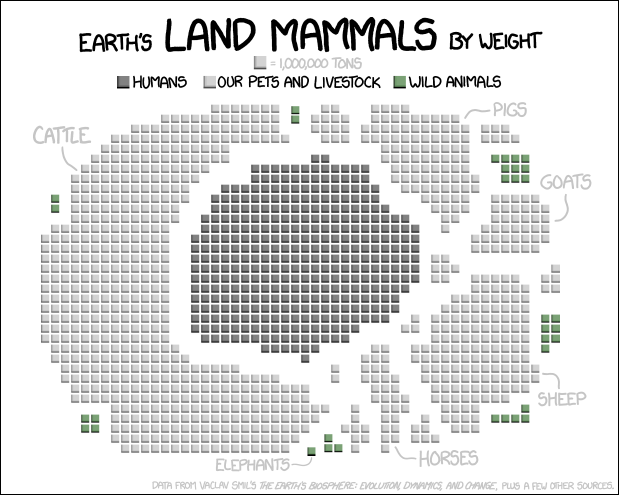
from xkcd: Land Mammals.
It’s only because they aren’t great for factory farming that makes them relatively expensive to eat in the US. With traditional farming methods, they are fairly low maintenance livestock and efficient grazers. They produce milk and wool as well as meat. And they are small enough that you and your family and friends can realistically eat one before the meat goes bad.
The old coot ate a raw snail, like ‘yay, a free snack!’??? Plucking snails off a wall? (I hope in this case she went home and cooked those.) Snails carry parasites, flatworms, lungworms! … They sell a can of escargot and a tube of the shells here in a grocery store, to make at home, I guess.
(We all seemed to have pet rabbits in the back yard when I was young. My cousin had one named ‘Stew’. )