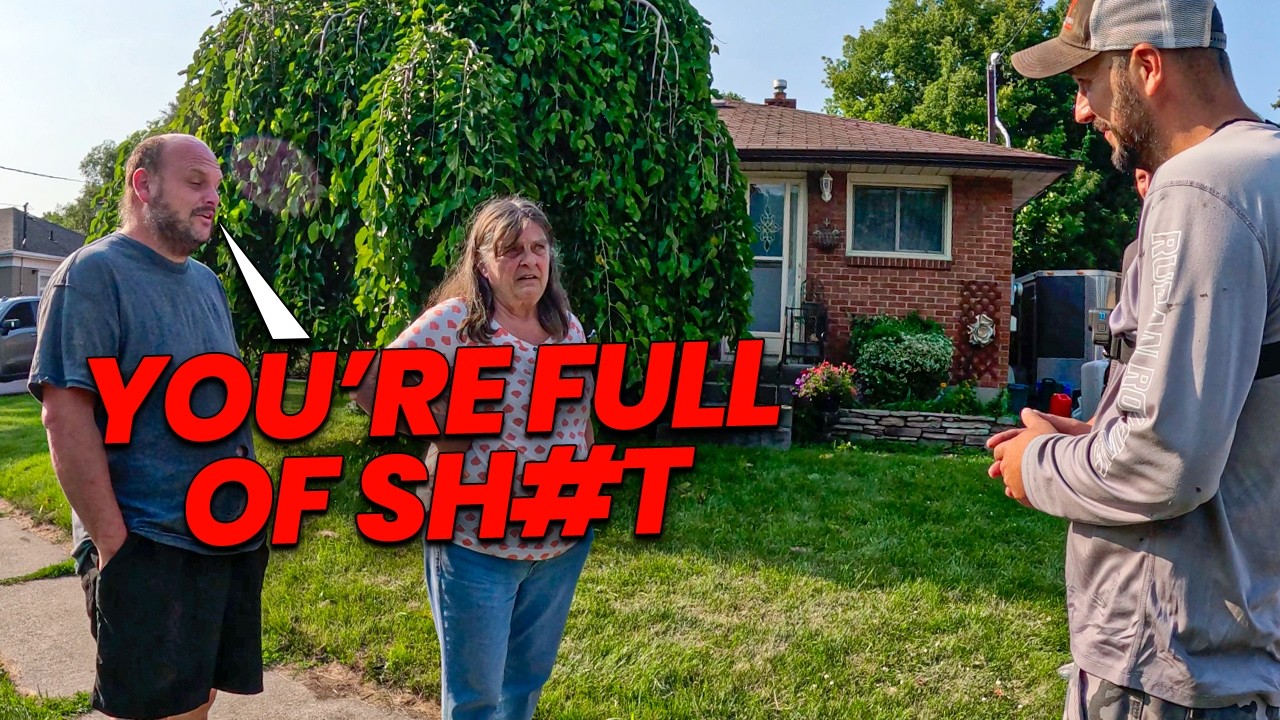
I have been watching many videos of YouTubers who appear to perform free services for customers they don’t know (at least at first), like Midlife Stockman, Rodan Brothers. Such work can include installing entire new roofs, gutters and major yard cleanup on residential properties. From the videos, it appears that there is no catch and the recipients do not pay for this work/service.
If true, this is wonderful. The contributors make lifelong friends, often from those who are struggling with existence and need help. The recipients seem grateful, and sometimes other community members voluntarily assist.
My reason for posting here…is this really altruistic? Are the 3 Rodan Brothers really donating their time and materials with no monetary compensation?
My guess is that they are supported by donations and YT advertising. Possibly YT viewers will hire them (for a fee) for other jobs (I certainly would if they were local). Nothing wrong with that, and if true, that’s a valid business plan, and I wish them all the best to continue.
They’re almost certainly doing it for the clicks/money. Otherwise, they could do whatever they do (I’m not familiar with them) and just not film/publish it.
I’ve seen it argued that altruism doesn’t exist anyway - that even when people do the most well-intentioned and benign things out of what they believe to be the purest motives, there’s really some underlying motive to elevate their social standing or just make themselves happier and thus, it’s always ultimately about them, not the person they helped.
I’m not entirely sure I believe that to be absolute, but even if it is, and even if it’s all virtue signalling, I think sometimes it’s good for virtue to be showcased, or at least, displaying virtue is better than a lot of the alternatives. It might inspire others to help people around them and even if they are doing that out of hidden selfish motives, that doesn’t negate the good deed.
If you feed a homeless person because you want to think of yourself as a good and special person, the homeless person still has a full stomach.
I watch a lot of videos of people doing free house cleaning/decluttering/de-hoarding. A lot of the ones I see are generously supported by ScrubDaddy, and they make a point in thanking ScrubDaddy during the videos and usually show themselves using the products (sent for free by ScrubDaddy). That has GOT to be some serious marketing ROI for ScrubDaddy - “If their products can clean that rat-infested, grease-soaked mess, then they must be good! And they’re so kind!”
People who do yard cleanups say “your clicks and likes help pay for this!” so they are making enough off the videos to do some stuff for free. Their trucks would be parked outside of the job for hours on end, and neighbors are usually abuzz with excitement seeing an overgrown property taken care of. No doubt they get tons of business exposure from that.
I don’t see how it’s not altruistic. People see a need, they have the tools, they use their skills and tons of labor. They probably do start doing it at a loss - you don’t just start out with sponsorships or a large following. They do have to hustle so they can get where they start to be compensated for their work. In reality, they can only do those big jobs BECAUSE they are filming themselves doing it. But I’m sure the work-to-income ratio is quite a ramp over time.
I’ve seen videos of this guy that goes to random houses and fixes up their yards. Mowing, trimming, edging, and sometimes minor repairs. The video is a sped-up time lapse showing everything getting done.
The way I see it, it’s the same formula as “makeover” shows that have been around for years. A clothing/style personal makeover, house renovation, restaurant rescue, vehicle makeover, etc. It’s free for the recipient, but it’s still a transaction of sorts; your time, likeness, and so on are being granted to the content creator in exchange for the services they provide. And the person providing those services is able to monetize the content they create in recording what they’re doing, to the point where they profit from it.
It’s kind of clever when you think about it. If you had a business where you fix up yards, for example, you could just record yourself doing it for free and make a lot more money putting the recording online.
And it’s not like just anyone can do this and be successful. You need to market yourself well. You need to find something interesting to provide (just mowing a random lawn isn’t going to be interesting; you want something that looks crazy and overgrown, with an old rustic well hidden that you can reveal and restore, and so on). You need to do a quality job of recording the video. You might have to narrate and/or appear on camera to present. You aren’t just doing your old job, you’re producing a show, and you have all the stress and risk and work involved with that.
Heck, just think of game shows, where people come on, play some game, and win thousands of dollars in prizes. That format has been around for getting close to a century now (the oldest game show is believed to be Spelling Bee from 1938 in the UK), and you can argue that they’re just giving away free money to contestants. There’s no effective difference between that and these recent “do stuff for people for free and broadcast it” videos.
I think there might be some altruism here, maybe more than at first evident. But altruism doesn’t pay the bills. Nothing wrong with the apparent game plan as Dopers have suggested; I find it quite admirable. It would make Ayn Rand proud – no one is forced (thru taxes) to contribute to anyone else, but the charity is still quite a factor.
I myself have contributed (in a much smaller way) to neighbors and friends who need help, or need something that I can easily provide. It’s the right way to live.
If I had greater resources, I would set up scholarships, as some of my neighbors have done for local HS graduates.
The underlying reason they are doing it is that it creates an income for them. YouTube pays somewhere from a few dollars to tens of dollars per 1000 views. With some of their videos getting 1M views, they’re likely making multi-thousands of dollars per video just from YouTube revenue. They are also on Instagram, which means they are also getting revenue for views over there. And because they have so many subscribers and viewers, companies may be paying them to be influencers. This means they may be getting paid to use certain tools, wear certain clothes, drink certain beverages, etc. while on video. If they weren’t getting all of this revenue, it’s unlikely they would be doing all this pro-bono landscaping and cleanup work. That doesn’t mean they are just in it just for the money. They may be altruistic people who want to help those who need, but the revenue they get from it is a major reason why they are doing it.
I think the truth here does not matter one tiny bit. If what they are doing is genuinely net beneficial I don’t care what they themselves get out of it, whether it’s YT clicks, or feelings that are buried so deep they don’t even recognize their true motivation. Stuff got done, and someone else benefitted from it. Why does it matter what the doer is feeling about it? It’s pretty much impossible to know the whole truth about motivation anyway.
I as a third party have to decide what I think and how I feel about what I’m witnessing. My reaction to somebody doing a good deed is different from my reaction to somebody doing a greedy act that happens to have a surface beneficiary. Motives matter.
As I often say:
The person who pushes you down to stop you from walking in front of a bus is your friend. The used car salesman who brings you coffee is not.
When you can tell what they really are. Often even the person doing the act is not fully aware of their own motives. And I did make the proviso that the action is net beneficial to the recipient. In your examples, that is the entire difference between “who’s your friend” and who isn’t.
You can decide all you want to about how “good” other people are, based on what you can see and find out. Most of the time you’ll never know the whole story, so your conclusions may well be faulty a lot of the time. Or you can cultivate a more non-judgmental attitude, where you note what is going on but reserve judgment about the person doing it.
I learned at a certain point that I like helping people. It gives me a dopamine rush. I don’t need to be thanked either; I will sometimes do something for somebody and they don’t even know I did it, like picking up a neighbor’s trash can that fell over, or taking shopping carts out of the handicap area at a grocery store. It just feels nice to think I helped somebody.
Does that make me a good person? I’m not even really doing it for anyone but myself. I’m not even seeing a person actually benefit from it, I just assume it’s helping someone. I’m doing it because it satisfies me. So, isn’t that just acting in self-interest?
Would it be more altruistic if I hated helping people, but did it because I logically felt that it was my responsibility, and the responsibility of every person to help people? Then I’m actually doing something I don’t like to do, something that doesn’t make me feel good, because I know it’s better for society. Is that being more altruistic? Or am I just being pragmatic? Is there a difference?
These are not simple philosophical questions to answer, and people are going to have different answers that are probably all equally valid.
You make precisely my point, I think. Your actions don’t have to make you a good person for them to be good actions. That’s assuming we can even define what a good person is.
Think of an example like finding a wallet with cash. One altruistic option is to return the wallet to its owner personally. And another altruistic option is to return the wallet anonymously. The first option gets you the benefit of being showered with in-person thanks from the grateful owner. The second option you just get the internal satisfaction of knowing that the wallet’s owner is happy to have it back. The first option is more about you using the wallet as a way to gain external validation, while the second option is more about returning the wallet and it just happens to have a bonus of making you feel good about doing a good deed.
I feel that many of the charitable videos on social media are primarily done much more for external validation and recognition rather than purely altruistic reasons. It’s great that people are helped by these creators, but they are mostly likely doing it because it’s essentially their job. For instance, what would a social media landscape crew do if the homeowner didn’t want to be filmed? Would they put away their cameras and clean up the yard out of the goodness of their heart? Or would they go find another house where the owner would allow them to film so they could make revenue from their views? Most likely, they would seek out a house where they could film rather than trying to help the most needy homeowner. That doesn’t necessarily mean it’s bad. But it’s more like a makeover TV show where they seek out families with a compelling sob story that will bring in ratings rather than a more needy family that viewers won’t watch.
filmore, in your theoretical example, it seems to reveal more what YOU would do than what might actually happen. Would they put away their tools if they couldn’t record the situation? You could be wrong – why don’t you ask the relevant parties rather than speculating?
Remember, these YTers aren’t making money per incident, but for their overall channel. If that is true, helping someone without recording the encounter wouldn’t diminish their income from YouTube, but possibly enhance it through goodwill and word-of-mouth.
Seems to me that in general these sorts of things would be ‘enlightened self-interest’. They’re clearly business tactics but they benefit others too so what’s not to like? Although I do feel a little more cynical about the videos where a ‘celebrity’ does something nice for someone, via a third party’s (eg) youtube channel. You know the ones, like where they turn up at someone’s party or whatever. They come across a little more ‘oooh look how nice I am’ sometimes.
Yeah, it’s tricky, on the one hand we might decide it’s not great to enable and support people who are doing superficially good stuff just for attention, but on the other hand, perpetually suspecting that to be happening might cultivate excessive cynicism - and if that cynicism emerges in the form of vocal critique toward people that you (incorrectly) suspected of putting on a show, then damage is done where it wasn’t deserved.