No. There are certain features that tend to show up in certain geographical areas. These features do not in any way line up like Neanderthal ones do. Again, one morphological feature does not make a race.
Also, there are studies that show that some of the medical differences between races, besides the obviously genetic ones like sickle cell anemia, are due to culture, not race. For instance, black American women have babies of a lower birth weight than white American women. Black Caribbean women have babies of a similar birth weight as the white women, until they move to the US, where the weights drop to that of the American-born black women. Birth weight is partially a cultural phenomenon. Again, not every black person is susceptible to sickle cell anemia, and not every white person is immune. Evolution - The theory of natural selection (part 2)
Well no, but I’ve never heard anyone suggest that neanderthals/moderns are the benchmark for racial groups. One morphological feature doesn’t make a race, but definitions look at sets of features that reflect shared ancestry.
I didn’t mean they were the benchmark. I was just pointing out the sort of thing you do see when there’s a discernable difference between two groups.
Also, that article leaves out Ousley et al’s actual conclusions, which are that you can get a better than 80% chance of distinguishing between different groups of Europeans, or southern and northern Japanese. Why aren’t those, then, different races? We are good at placing people in their area of geographical origin (or their families’), but that doesn’t rely on race. We’re just as good if you think there are 3 races, 5, 11, or 500. So why is your racial classification system correct, and not a more fine-grained one?
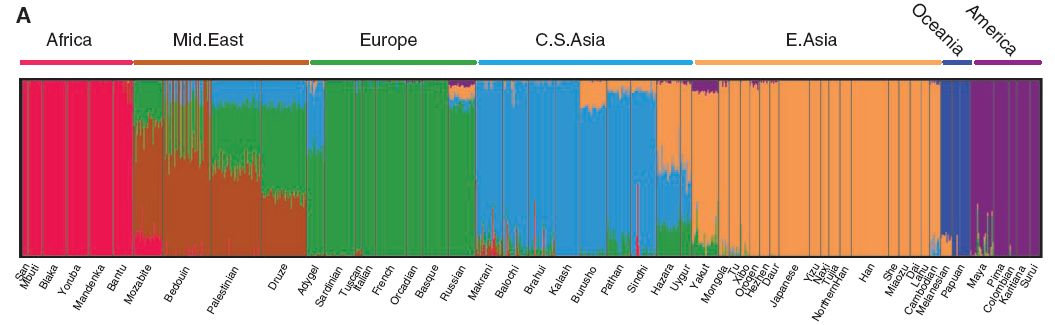
You can easily find more fine grained groups within the larger continental groupings. I’m just saying those major continental categories do reflect actual clusters because there was low gene flow. So someone from within those clusters is going to be more genetically similar to someone else from that cluster than someone from another cluster/population. And the social categories you mention do correspond to these pretty accurately.
The four subgroups that last article used were for extremely disparate populations: Europeans, African Americans (who are generally west African mixed with white and maybe some American Indian), East Asian, and Hispanic. Those are, not coincidentally, the same groups that gave rise to the race concept. Of course they look different and have a discrete set of traits. You’re looking at people who evolved thousands of miles away from each other! I am saying that, within those thousands of miles, the boundaries of the various traits get a hell of a lot more blurred. What would happen if they had tested people every hundred miles from Paris to Bangkok? There is no reasonable place to put a dividing line there, genetically or morphologically. You know the difference between red and orange, right? Where do you draw the line, though? What’s orange-red, what’s red-orange, where’s coral, and so on? Hell, many cultures don’t even distinguish between red and orange. Really, no one except really intense artists and decorators give a shit about those kinds of differences color-wise, but it makes a real impact when you talk about people.
And that’s not even getting to the original argument, which is that IQ isn’t determined by your racial genetics. To recap: IQ is a flawed concept. Race as a biological category is a flawed concept. The idea that intelligence is purely or even mostly genetic, also flawed.
Well, again - you get clusters because there are points of geographic separation (across oceans, the Himalayas, and the Sahara etc). That is why those clustersarise. As Rosenberg writes:
You’re right that there are blurry or fuzzy boundaries you’re not talking about different species. That doesn’t mean there are no meaningul groups or categories.