I like “esoteric” myself.
My bold. (Sorry - cocked up the last attempt at this post.)
OK, here’s the thing - I started writing down this whole bizarre story - and it truly is bizarre - with the intention of posting it, but as I got towards the end, I thought to myself: this all seems a bit…bloggy. Thing is, it’s just a story - maybe there’s nothing to discuss. And I don’t want to post over a thousand words for it to just sink into the abyss - that would be embarrassing.
So here’s what I could do - I’ll finish the story and post it if you promise to read it and reply. Do we have a deal?
j
(I should clarify, that’s a question for @purplehorseshoe, not the world.)
j
Rotundity
Oratorical rotundities
Huh, I always thought it was kerfluffle. --hmm. Upon investigation it appears that I’m mostly wrong (yes, that does happen sometimes) but some sites do recognize it as an alternative.
Coolerator 
I reckon a kerfluffle is when you raise a ruckus about farting or soft pillows.
I used to have a cold-weather jacket made of Berber cloth. I often thought of the sound of that when I went out into the cold.
palimpsest
snarge
grawlix
absquatulate
aposiopesis
spifflicate**
perseverate
** nothing to do with ‘Spaceman Spiff’ from the Calvin and Hobbes cartoons, but it should be…
I seem to recall in the tenth or twelfth worst episode of the original Star Trek series, Catspaw, Sylvia had a magic wand that was identified as the transmogrifier. And, of course, in an apex episode of Red Dwarf, DNA, the machine on the alien ship did its thing and announced in a deep and sonorous voice, “Transmogrification Complete”.
“Sonorous”, now that is a good word.
I use set screws often. Never heard them called “grub screws.” Is that a British-ism?
Doesn’t seem to be:
Set screw or setscrew in the UK refers to a bolt which is fully threaded, with no smooth shank. These commonly have a hex head, but are also found with socket or screw heads.[2] This contrasts with usage in the US where a set screw is almost universally a grub screw or small-headed bolt.[1] A fully threaded bolt is commonly called a cap screw in the US.[2]
I also notice that McMaster-Carr recognizes the term:
But another source implies that it is a British term:
A blind set screw (known in the UK as a grub screw, quite possibly from its figurative resemblance to a soil-dwelling grub)
Grub Screws are used in a tapped hole and tightened to hold an exterior object in place within or against another object, via friction between the point or end of the screw and the material that is being fastened.
So my exceptionally confident answer is … no idea 
I’m just trying to wrap my head around what the things ARE and how they’re used. I see all these drawings, but have no concept of how it could be used to fasten Thing A to Thing B.
There are a couple examples on this page that may give you a better idea:
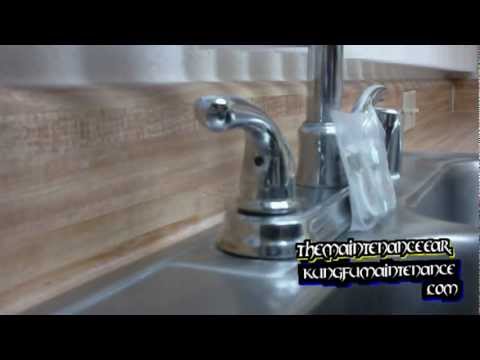
A very common use is to attach a faucet handle to the valve:
Excellent link!
I had heard the term ‘grub screw’ before. I did assume it referred to the type of set screws meant to dig into an interior piece to keep it from moving but according to the links it’s a complete synonym for ‘set screw’ including the smooth and round point types.
FWIW, I hate the things. IME they don’t hold very well, and can’t be counted on to hold at all.
IME, Loctite is your friend. Just be careful about which strength to use.
Interestingly, I wouldn’t think to use high-strength threadlocker for most set screw applications (the way they recommend). They tend to be small and strip out easily. Heat and hand tools could require more torque than I’d probably want to apply to remove one.
Grease is a good substitute for locktite in many situations. If you can high-torque the bolt or screw, grease on the threads will do what you need done. Sounds kind of counter-intuitive, but it works well, especially if it is a bolt you might have to break loose some time.
Bamboozle
I’ve ever on alert for the opportunity to exclaim “I’ve been bamboozled!”
I applaud your penchant for celebrating every bona fide bamboozling.
OTOH, I hope you’re never flimflammed.
OhByTheWay: flimflam is a cool word, too 