It’s the one that is the standard custom for the place in which you are choosing to eat. Not the one you think it should be. Not the one the waiter wants it to be. Not the one the government wants it to be. The one it actually is.
There is no debate as to what our standard custom is for tipping your waitress. There is debate for other types of servers (baristas, etc.) but not wait staff at a sit down restaurant.
I will offer up one caveat. If your goal is punishing your waitress for supporting a terrible compensation scheme simply to line her own pockets, then docking her tip is a perfectly appropriate response.
There are lots of places where you pay different prices for different levels of service - but they don’t typically involve customers tipping the staff. They involve the business itself charging more- for example, many years ago, my bank was going to charge for using a teller window rather than an ATM.
By “customer service staff” , I meant the people at the customer service desk ( or guest relations or whatever they call it ). I’m not expected to tip someone at that desk for acceptable service.
I’m not talking about what I should do- I’m talking about what are the underlying reasons for the custom and why it should be continued or discontinued.
Almost always the first justification for tipping is that servers are paid a sub-minimum direct wage that assumes they will receive enough in tips to bring them above minimum. OK , fine. Someone doesn’t like the whole scheme and would prefer that employees are required to pay servers at least minimum wage , as is required for virtually every other business. Then someone says “servers don’t want to work for minimum wage” as if requiring employers to pay at least minimum wage means the employers couldn’t pay more.
I will follow the custom - but that doesn’t mean I have to agree that the custom should exist and should continue no matter how much a restaurant pays its servers- even if the pay is $25-30/hr
Honestly, it IS both. If you are working at a high end, popular restaurant, on good shifts, you can make a decent income waiting tables. There are some Disney World servers who - pre-Covid - were rumored to make around $100,000. Those people would be really screwed by a “must pay minimum wage” and get rid of tipping culture.
On the other end, you have someone who gets weeknight bar close shifts at a 24 hour Denny’s. Half the tables don’t tip at all, and there are nights where its you and the cook there all night. By federal law, the restaurant is required to make up wages to the minimum wage - not per shift, but per pay period. But its one of those laws that is seldom followed.
We’ve always tipped very well. We are now tipping well for DoorDash and when we do curbside. We have done restaurant meals during Covid - outside - and tipped extra then as well. Heck, I tipped at a restaurant that was hosting a Toys for Tots drop off and I didn’t even order food, just dropped off toys. I don’t tip at the Starbucks counter.
Pre-Covid (and hopefully post Covid) one of our favorite restaurants had a note on the menu. All servers were paid a living wage (Knowing someone who worked there, $15 an hour, and a small staff of servers so you got your hours - the other problem with that sort of job is that three four hour shifts a week isn’t going to pay your bills). Tipping was appreciated, but at your discretion. We always had excellent service, we always felt we were getting good value (it was an expensive fancy place, but wonderful food), so we always tipped on top of that. I REALLY hope they make it through. (They aren’t a Door Dash type of place).
That’s kind of what I mean by “as if requiring employers to pay at least minimum wage means the employers couldn’t pay more.” . I mean, presumably those Disney World servers were making that $100K based on an average tip of 15-20%. There’s no reason why Disney can’t raise the prices 20% and pay the servers $50/hr - yet there always seems be an assumption that requiring a restaurant to pay MW means they will never pay more than minimum when that’s not true for any other job.
Yeah, but that is one of the huge issues with capitalism. You go for the lowest cost at the minimum quality needed for your inputs - whether that’s the hamburger McDonalds uses, or the waitstaff at Disney. Of course, if you are selling a $15 burger at a hipster pub, you are not buying the same beef, but you are not selling the same burger. A few restaurants run like like the owners of the restaurant I know who pay a living wage up front, but that is an unusual choice in capitalism. Quality waitstaff can be had for $20 an hour. So those waiters who are making $40 an hour would see their incomes undercut by people willing to work for half of what they make. Disney itself would see increased profits.
I do prefer the “we pay our waitstaff a living wage - tipping is at your discretion” model. But I don’t think we are going there. And paying waitstaff minimum wage is a non-starter. You can’t live on minimum wage and the uncertain hours of waiting tables.
You have it backwards. The reason wait staff are paid sub-minimum wage is because the custom is to tip 15-20% of the bill. If that wasn’t the custom the staff would be paid differently.
The pay structure isn’t justification for tipping, it’s a result of tipping.
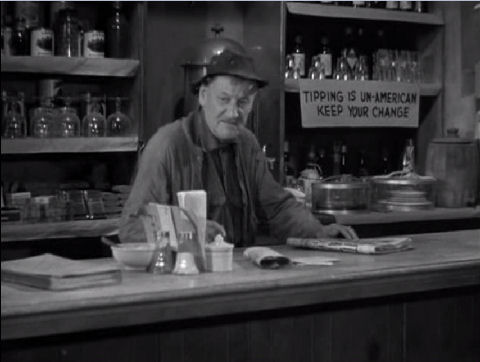
Bumping this thread because we’re watching The Petrified Forest (1936). Early in the film, there’s a sign that reads ‘Tipping is un-American. Keep your change.’
From IMDb’s Trivia:
A sign in the restaurant says “Tipping is Un-American. Keep Your Change”. The opposition to tipping in America began in the 1890s and continued through the 1930s. Before the Civil War, tipping was uncommon in the U.S. By the late 1800s the custom was imported from Europe and caused Americans to worry that tipping would create a master-servant relationship between the customer and the worker and undermine the ability for workers to earn a fair, agreed-upon wage. It was considered “un-American” because it resembled European aristocratic and class-conscious customs. Some workers resented being given tips because they associated tips with low-skilled or unskilled labor (e.g., the shoe shine boy vs. a restaurant owner), but the largest argument against tipping was about concerns for fair wages and workers’ rights. The argument against tipping aimed to support workers’ rights to a fair wage provided by employers. In essence, tip-dominated jobs, such as restaurant work, allows employers to divert the responsibility to pay their workers to the customers and their whims. In the early 1900s, editorials against tipping appeared in major newspapers, and in 1904, the Anti-Tipping Society of America was formed in Georgia. Its 100,000 members signed pledges not to tip anyone for a year. Leagues of traveling salesmen opposed the tip, as did most labor unions. In 1909, Washington became the first of six states to pass an anti-tipping law, but tipping persisted. The anti-tipping laws were rarely enforced, and when they were, they did not hold up in court. By 1926, every anti-tipping law had been repealed.