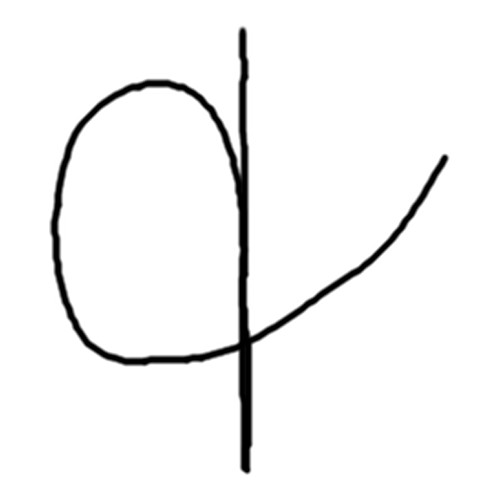
I showed this to two of my co-workers and they have no idea.
When handwriting, you could use this for “and”. It’s NOT “&”.
Imagine a “+” sign. Now imagine a line that connects the left point to the bottom point. Since it’s handwriting, it’s going to be more curvy as opposed to sharp corners. But that’s basically it. Do you remember ever using this as shorthand for “and”?
Found this with a quick google search, but can’t find a pic:
Handwriting Abbreviation for “And”: People often write a shorthand symbol for the word “and” that resembles an upside-down “4” (or a cross without lifting the pen). This is an informal variation of the ampersand \(\&\). [1]
@Dewey_Finn nailed it. I remember reading and writing that symbol often as a kid or college student. I’d instantly recognize what it meant.
On the very rare occasions I put pen to paper I now use the simplified ampersand that is sort of a backwards 3 with a vertical line through it. The complicated curlicue ampersand & that resembles a simplified treble clef is far more elaborate than anything I’ve ever written by hand. Whether printed or cursive.
Going back to the OP @Grrr I’m wondering about the ages or educations of the cow-orkers who don’t recognize that symbol.
I would consider it a common simplified ampersand. The only reason I don’t use it as much is simply that I don’t write things as much.
If I’m quickly writing something down where an ampersand is needed, I use this symbol. (I do occasionally take the time to write an actual ampersand when writing neatly, because it’s fun.)
I also know the the backwards 3 with a line through it (or just on top and bottom) like a dollar sign. That one takes longer.
So is mine. I wouldn’t think anybody else would know because when would they see such a casual handwriting use even in the old days?
Anyone who loves words and type should find a copy of Keith Houston’s Shady Characters: The Secret Life of Punctuation, Symbols, and Other Typographical Marks. Sounds dull but I found every page a delight. That includes the chapter on the ampersand. Yes, there’s a whole chapter to be said on that one character, which includes lots of images of its use throughout history.
I’ve seen it plenty while in school (graduated HS in 2003), both from teachers and classmates. I favored the backwards 3 with vertical line mentioned above, myself. I didn’t see the traditional & symbol in handwriting very often at all.
Yep. I got marked down for using it in school on the regular. I was one of those kids whose hand just couldn’t move fast enough enough to keep up with the thoughts.
I use the traditional form &, which kind of looks like a backwards treble clef sign to me. I am very used to it, since the ampersand is very common in the programming languages that I taught. When you write it on a whiteboard hundreds of times, it’s easy to do. That’s one instance that you wouldn’t want to confuse students (or your cow-orkers) with a variant.