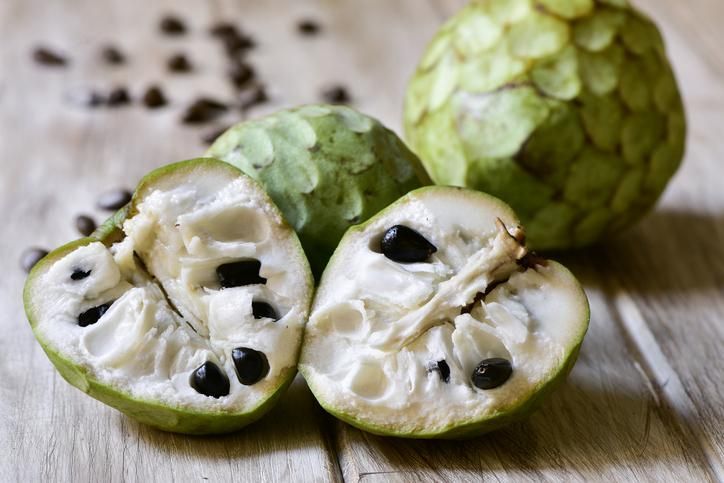
When I came to Chile (late last century), I found all kinds of what I’d call “global” fruit (banana, apples, oranges, cherry, stuff that you find pretty much in supermarkets all around the globe) …
but there also was some fruit that I haven’t seen/known before:
Chirimoya:
tastes and has the mouthfeel of a very ripe pear … soft, juicy “meat” - very likable, but quite messy to eat (sweet, sticky juice running down your hands)
anything that grows around your area, but is not widely available otherwise?
That reminds me of the fruit called pawpaw (Asimina triloba) that grows in Kentucky, and surrounding states, but is not widely available elsewhere, and I am not sure I have ever seen one at a super market anywhere. Quick google search says pawpaw is a botanical cousin of Chirimoya (of which I have never heard before your post). I would describe the pawpaw as being similarly soft and kind of a cross between banana and.. uh.. tropical…
We get pawpaws around here, too (or maybe another close relative), also sometimes called “custard apples”. When fully ripe, they do indeed have about the texture of custard. You sometimes see them at farmers’ markets, but almost never in a grocery store. Unsurprisingly, they don’t ship well.
We also get something called serviceberries (among many other names) here. I’ve never seen them sold anywhere, not even at farmers’ markets, but lots of folks grow the trees as ornamentals (apparently not realizing just how delicious the berries are). The closest comparison I can give for the flavor is cherries. They look like blueberries, but they go red (when partly ripe) or purple (when fully). The red ones are a little bit tart, but still pretty good (or maybe even better, if you like a little tartness).
In Oregon they grow a lot of unique varieties of strawberry, but the best is probably the “Hoodies”, named for the Hood River area where they grow. They’re early in the season and super sweet and flavorful. We do miss them. We get a lot of apple varieties here in MN, but I’m sure they are available elsewhere.
I’d never heard of a pluot (a plum / apricot hybrid) before I moved to California and discovered them at local farmers’ markets. But I’m not sure if that’s because they’re not widely available other places, of if they simply didn’t exist anywhere before I moved here, since they were apparently only developed in the late 20th century.
I’m in Cape Town, which is a huge grape and apple farming area - not much in the exotic. A little further north, peaches, plums, and quite a bit further, citrus of every variety. But nothing native to the region.
My home in Zimbabwe: we had mazhanje (Uapaca kirkiana), mutsamvi (Ficus burkei, a local fig) and matohwe (Azanza garckeana, also known charmingly as “snot apple”) growing wild all around in the bushveld. Baobab was often available in markets.
There have been studies that show the first three could easily be cultivated, but it seems no one has ever tried; perhaps there is insufficient demand.
Your post made me realize: I recently passed a farmer selling produce produce out the back of a truck. Next time I should stop and see what they have; maybe it will not be the exact same selection of fruit manufactured by megacorporations and shipped to all the supermarkets. In some of the local bodegas non-“global” fruit turns up occasionally, but it costs a fortune. Some (but not all) of that, however, is just stuff that does not grow locally and is obviously imported, like fresh coconuts or whatever.
That reminds me then: I should have counted waterblommetjies*, though, are they a fruit or a flower? I think we eat them before they form a fruit, I think we eat the flowers. I’m not certain though.
Wow! We have them – in fact a most productive tree sheds its berries on our lawn. I have to try eating them! And to think I’ve ignored the berries for over 40 years! I did once read that the native people here used them to improve the taste of pemmican.
Upstate NY prides itself on its local and specialty apple varieties.
We also have the seasonal spring specialty of fiddlehead ferns and ramps (ramsons, wild leeks). I don’t know how widespread those are botanically, but I haven’t seen them elsewhere as a culinary/commercial trend. (They are not, it must be admitted, fruits.)
Real Concord grapes don’t grow everywhere and don’t ship robustly AFAICT, and many people don’t like the seeds, but I’m so glad this is one of the places they grow them!
We (Virginia) get these too - I love them. But they’re only good for a week or two each year, usually June, it seems, then they get destroyed by a fungus called rust.
Serviceberries, also called juneberries, Saskatoons, and shadblow (botanical name Amelanchier) grows wild across most of North America. There are some cultivars that are grown for commercial fruit production, developed (i think) by the University of Saskatchewan. They are very tasty, although I’m often a little disappointed, because they look like blueberries, which i like more. They don’t taste much like blueberries, except for being sweet and a little tart. I’ve never seen the fruit for sale, but I’ve picked berries.
Pawpaw can be grown where i live (North East), barely, and I’ve even seen one locally in someone’s yard. I’ve never seen the fruit, though.
I’ve grown an edible dogwood, cornus mas. It has long red berries with a seed like an olive pit. They are sour and have a fairly dry flesh, and I like them a lot, but the birds have learned they are good to eat. I sometimes snag one or two from my three bushes.
I’ve also grown currants. Red currants and clove currants (which might be a US native?) Europeans may be surprised to learn that currants are almost never sold commercially in the US. And i don’t know if clove currants are sold commercially anywhere. They have a “flowery” flavor that’s hard to describe. I enjoyed them mixed with apple in pie, but i didn’t love them, and wasn’t too sad when the birds started harvesting my crop.
Chirimoya is called “anona” in Mexico. This is also the genus name (Annona). The other important species is called soursop in the Caribbean (or “guanábana” in Mexico); it has a similar taste, but is bigger and shaped like a Seven Dwarves’ cap. In Mexico, it’s most often seen in a juicy drink, or a popsicle.