No, but keep them old- no pun intended!
I remember in the 1970s, there were stories in the media about 150+ year old men in rural Russia. Counter claims were that these guys had escaped into the hills to avoid being drafted into Napoleon’s army, and lied about their age.
There were yogurt commercials on TV exploiting it.
Rural Georgia (Soviet Georgia, to be exact), as I remember the Dannon commercials.
.. and it was Georgia because that’s where Stalin came from, so of course it Had To Be Special.
All these places are poor and poorly documented, so it’s mostly done for pension fraud and aggrandisement.
And the SCTV version:
This time of year the “fact” keeps getting passed around the interned that Jingle Bells was originally meant to be a Thanksgiving song. Not true, according to a story on NPR this morning. Apparently it wasn’t intended to be a holiday song at all. It was part of a “sleigh song” trend from the 1850s (sort of like how car songs were big in the 1960s). The one horse open sleigh was like the 1850s version of the little deuce coupe.
And yet it established the custom that every fucking popular Christmas song must include jingles to announce that it’s a Christmas song.
It certainly is a seasonal song however, along with several other songs played during the Season. “Let It Snow! Let It Snow! Let It Snow!”, “Winter Wonderland,”.
Specifically, it was a minstrel song, performed in blackface, which satirized black participation in northern (read white) activities.
James Pierpont, who wrote the song, was born and raised in Massachusetts. When the Civil War broke out, his 60-plus-year-old father joined the Union Army as a chaplain. By then James had moved to the Southeast, where he became a rebel through and through–wrote and published a number of now-completely-obscure pro-Confederate songs during the war. I expect he’d be very surprised to know that the one song he wrote that has lasted (though today’s chorus has a different melody) was “One-Horse Open Sleigh.”
This is not the myth. Medieval people absolutely didn’t bathe as much as modern people and were pretty damn dirty by modern standards. The myth is the didn’t bathe because they thought bathing was sinful or unhealthy.
My bugbears are things that are associated with medieval era in the popular consciousness (and movies) but are actually from later eras.
The big one being witch trials which were very rare in the medieval era. The kind of mass witch trials, with witchfinders, etc., that modern people of think of when they think of witch trials are a modern phenomenon not a medieval one.
Also the whole thing about water not being safe to drink. In the medieval period when the vast majority of the population lived in rural low density communities water bourne diseases were much less of a problem (outside of armies on the march). It was only with the rise of the urban population it became a problem.
Oh and the plague doctors wearing beaked masks, also not Medieval.
Kinda like this? …
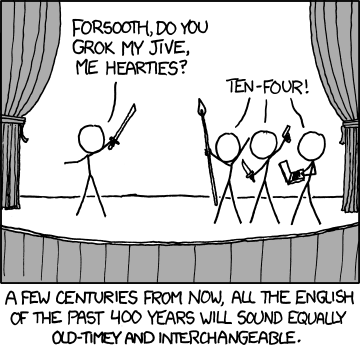
from xkcd: Period Speech.
17th century, not really what i would call Modern. But also not medieval.
Historians traditionally refer to anything after the Renaissance to be the Modern Era.
17th century is generally included in the Renaissance. But others have it starting in 1500, which is certainly Renaissance. (in that case, they include the Renaissance as part of the “modern era”.).
YMMV.
A loose consensus of historians generally consider it the ‘early modern period’ in Europe. It’s probably worth defining so it doesn’t get confused with more colloquial senses of “modern.” But personally I have no issue with referring to the 16th-17th centuries as modern in that context.
The peak witch mania/mass hunts/mass executions coincided heavily with the religious wars in the 17th century, particularly the Thirty Years War in Germany and the English Civil War in the British Isles.
Traditionally (like when I got my History degree in 1986) it was:
Anything before 3,000 BC: Prehistory
3000 BC - 500 AD: Antiquity
500 - 1500 AD: Middle Ages
1500 - Present: Modern Era
That lumps in the Renaissance with the Modern era.
Yeah. I should have said since, not after. Point is, the witch hysteria was mostly a product of (or reaction to) the Protestant Reformation which occurred in the Modern Era.
Yes, it is. You’re talking about a subset of the myth, I’m talking about the overall myth - one you see in almost every film or tv show set in the era, with its dirty peasants.