I worked for a pretty good sized government agency (around 20,000 people, all in) that had a legacy system written in a programming language that had not been taught in years. The system had been developed in-house, and by the 1990s, all the original developers had long since retired. We tried to hire outside consultants to do updates, but nobody could decipher the coding or the agency was unwilling to pay them for the time it would take for them to learn it, so we continued to slog on with our in-house staff trying to keep it running with baling wire and wet tissue paper. As the agency undertook a massive Y2K effort, our programmers realized that this particular legacy system absolutely could not be updated, because the date field was limited to two digits for the year, and there was no way to expand it. Their solution? Redefine the century. They realized that the earliest date in the database was something like 1932, so that became the first year of the century. Any date ending with 32 or later would return a value of “19XX”, while any date ending in 00 through 31 would show as “20XX”. They have just over six years before that system goes tits up.
Don’t want to derail the thread, but is this system still in operation? And is the language COBOL?
There was a popular TV series called Wagon Train which depicted the wagons as being pulled by horses. Almost all the wagons in the westward migration were pulled by oxen, which are much easier to drive until they drop, and then when they drop, they are much tastier. Wagon Train was most certainly not the only instance of this error.
Which any Gen Xer who played the OG Oregon Trail should know. (Well, ok, not the OG but the Apple II iteration that we all know.)
I don’t know. I retired eight years ago, and one of my main responsibilities was to ride herd on the programmers who actually worked on the system. I lobbied for years to get a new system up and running, but there was no sense of urgency after the Y2K “fix”, since the eventual collapse was still three decades away. Considering that this particular agency didn’t spend money to fix things until they broke, they’re probably still using it. It was not COBOL. I could have done it if it was written in COBOL. And most of the consultants who we tried to hire assured us that they had keyboard monkeys who could read and write in whatever code we had, only for them to throw up their hands and give up OR increase their proposed rates substantially when we actually gave them some of the coding.
Depends on what you’re talking about. The captain of a British privateer, yes.
But good old Black Bart, who was elected rather than appointed, supposedly only took a double-share. Caribbean pirates during the so-called ‘Golden Age of Piracy’ could be far more democratic and egalitarian as there was no government backing up the captains. They could be usurped and to some extent had to play to the crowd like a good politician.
Now the source of that double-share claim is not exactly impeccable. It could be wrong. Also the captain likely got the best choice of everything and lived larger. But considering it was a purportedly elected position, I imagine it is at least closer to the truth than the massive prize takes of more normal government-sanctioned privateer captains.
The post says it was a language that had not been taught in a long time. It is almost certain that C***L was being taught in the mid-to-late '90s, just so that the armies of programmers dispatched to deal with the y2k bug would have some understanding of how to approach the systems they were working on. It is really not terrifically different from FORTRAN or C or BASIC or most of the other procedural languages, it just has a few annoying little quirks and is cumbersome to write.
or elder Millennial.
(Side note: I’m partial to the fan theory that “The Gal Who Got Rattled” from The Ballad of Buster Scruggs is actually a stealth Oregon Trail movie.)
Nice Jimmy Durante quote and good ones.
Another good one.
The contracts/guidelines did differ of course.
Revere was one of the organizers of that ride, and later a militia officer, ect-
Paul Revere (/rɪˈvɪər/; December 21, 1734 O.S. (January 1, 1735 N.S.)[N 1] – May 10, 1818) was an American silversmith, military officer and industrialist who played a major role during the opening months of the American Revolutionary War in Massachusetts, engaging in a midnight ride in 1775 to alert nearby minutemen of the approach of British troops prior to the battles of Lexington and Concord.
Tax Cut to the East India company, not the colonies. Or so wikipedia says.
Well debunked by more recent groups. So, not here.
Also- the Library of Alexandria was not burned by the Christians- it was looted and burned twice or maybe three times by the Romans. One minor annex was destroyed later by Christians- wiki-
Under the Christian rule of Roman emperor Theodosius I, pagan rituals were outlawed, and pagan temples were destroyed. In 391 AD, the bishop of Alexandria, Theophilus, supervised the destruction of an old Mithraeum.[112] They gave some of the cult objects to Theophilus,[112] who had them paraded through the streets so that they could be mocked and ridiculed.[112] The pagans of Alexandria were incensed by this act of desecration, especially the teachers of Neoplatonic philosophy and theurgy at the Serapeum.[112] The teachers at the Serapeum took up arms and led their students and other followers in a guerrilla attack on the Christian population of Alexandria, killing many of them before being forced to retreat.[112] In retaliation, the Christians vandalized and demolished the Serapeum,[114][115] although some parts of the colonnade were still standing as late as the twelfth century.[114] Whether an actual library still existed at this point, and if so how extensive it was, is not recorded. Jonathan Theodore has stated that by 391/392 AD there was “no remaining “Great Library” in the sense of the iconic vast, priceless collection”
And also mules, but oxen were most common.
I am curious, for the purposes of this thread is copy and pasting text directly from Wikipedia considered sufficient evidence for debunking? We don’t need to worry about any primary sourcing? Would a blog post also be ok?
How about 18 years? If so:
John McCain never sang the words “Bomb bomb bomb, bomb bomb Iran!” What he actually sang was “Bomb, bomb, bomb, bomb, anyway, ah …”

Well just check the sources, the sources that Wikipedia uses for the origins of “Drinking the Kool-Aid” directed to cult members still get the drink used in the Jim Jones massacre wrong IMHO.
Many sources still go for the new myth that “it was just Flavor-aid” the drink that the Jim Jones cult in Guyana used to poison everyone in the cult compound. (I still have the feeling that a lot of the media is weary to anger the Kraft-Heinz sponsors)
The whole truth is that Flavor-Aid was there, but there is video evidence that shows Jim Jones demonstrating his supplies in a storage room, Kool-Aid was there too. (And Royal gelatin, but I think Jones’ henchmen did not have time to make a jiggly treat with the poison. /jk)
It was reported recently that Guyana will reopen the place of the massacre as a historical museum. At first, I thought that it was a very gross thing to do, but I think now that just as many places of the holocaust are preserved and visited as a lesson to humanity, what Guyana is doing makes sense.
So if a pedant appears telling you that “it was not Kool-Aid, it was Flavor-Aid!” tell them to sod off! that it was both.
Maybe. I just watched this resampled version.
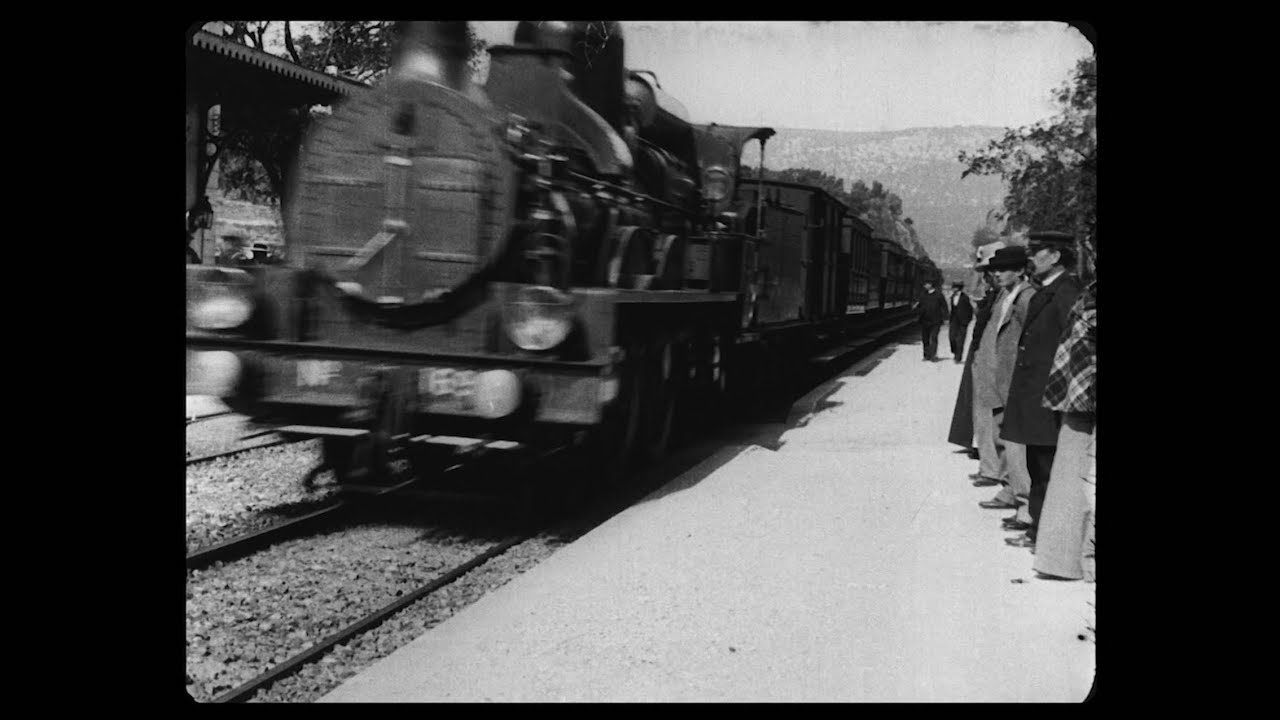
To us it’s a completely ordinary, if dated, scene. Watching a movie, any movie, occupies a weird mental state where you’re simultaneously in a seat in a theater and also somehow magically standing wherever the camera is, seeing whatever it was seeing. You know you’re experiencing both things and your attention is normally on the screen action, not the theater reality.
Someone unused to that duality might well find themselves thinking “Here comes the train. I’m in a theater. Yes, it’s not aimed right at me, but when it enters the building I’m in, with no tracks, there’s going to be a train wreck. And here I sit, right next to it.” Not that that dialog I’ve written occurs explicitly and consciously, but in that twilight almost-consciousness that goes along with movie-watching and willing suspension of your location, that dichotomy between train platform and movie theater is bubbling along not far below the surface of consciousness.
Did people run screaming? Probably not. Were there some uneasy people who were surprised at being made uneasy? Almost certainly. Folks barf from fear or motion sickness at IMAX theaters today. The building ain’t moving and there’s no actual danger from whatever images are displayed. Brains and perception are complex things.
Yes, I’ve experienced that myself. But there is a difference between a simulation of being on a roller coaster and a simulation of standing on a platform watching a train arriving on tracks several feet away from you. The first might scare people, the second not so.
Myth: Textile workers who protested against the new machinery threw their wooden shoes, known as sabots, into the machines to wreck them. This became known as sabotage. They were called Luddites after their leader, Ned Ludd.
The more accurate version:
-
Ned Ludd did not lead the Luddites. He is a legendary figure who supposedly lived decades earlier. There’s no conclusive evidence that he existed at all.
-
There is no record of the Luddites using their clogs to wreck machinery.
-
The word Sabotage does derive from the clogs known as sabots. It is first attested in 1907, decades after the Luddites were active. It originally meant an act of clumsiness, rather than malicious damage.
I was working for IBM during that time period. The first weekly report output from some major internal accounting program had the date 1/6/2000 formatted as 1/6/19100. It was fixed for the next report. In some departments, the thinking was let something break, and fix it later. Luckily, it wasn’t anything life-critical.
Generally, yes
Too soon.
Too recent also.
Good one, and something I got wrong.
One fire may have been started this way, but that fire broke out in FIVE places at approximately the same time, and it coincided with a large forest fire that nearly destroyed Peshtigo, Wisconsin. Ore boats on the Great Lakes also reported seeing “fire falling from the sky.” Most likely, an asteroid broke up in the atmosphere, and some of the pieces actually landed.
I think most Dopers likely already know this, but… Yes, Thomas Crapper was a real plumber in Victorian London. No, he was not the inventor of the flush toilet as many lists of “fun facts” have claimed. At most, he held a few patents related to improvements to the toilet.
Some people, who can also often be lumped in with Flat Earthers, believe that the technologically advanced culture was destroyed in Noah’s Flood.
How about the riots that allegedly happened after the “War of the Worlds” broadcast in IIRC 1938? I’ve actually heard it, and it was not in real time and I couldn’t imagine large numbers of people reacting that way.