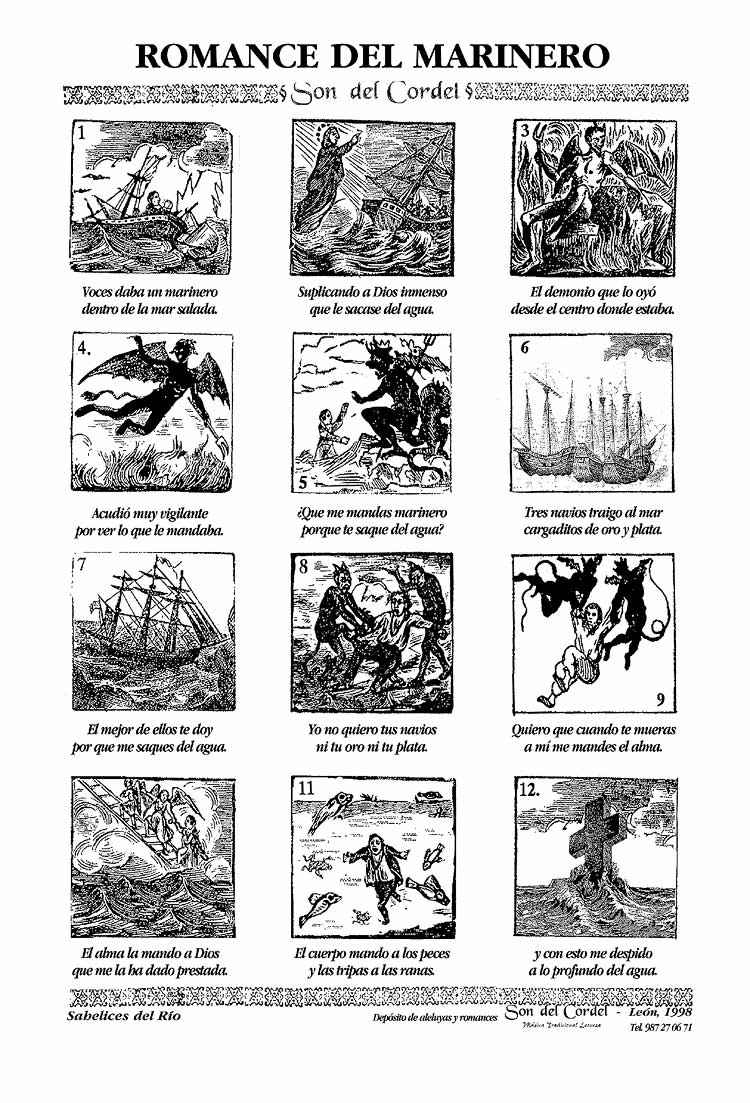
There is a form of proto-comic book called in Spanish romances de ciego, aleluyas or pliegos de cordel; aucas in Catalan, which I imagine must have existed also in other cultures but have no idea what they’re called in for example English. They consist of a series of pictures, each of them illustrating two-four verses of a poem (generally a story).
I’ve seen something like this for teaching the Bible to kids, but it didn’t have any specific name. However, I’ve never seen them outside that context. I think most English speakers would probably just call it a comic.
Well, I think I’ve seen that sort of thing — or know of that sort of thing — in the form of Chap Books ( in English, although I’m sure the Germans had that sort of thing as the centre pf printing ). Note the rough woodcuts, such as the fairy square.
I imagined there were things called Kit Books, but Google indicates not.
Somehow having a series of pictures makes me think of the 1820s to 1850s, particularly in French.
Not dissimilar to the English romance of Rupert Bear, which is now part of the Matter of Britain. Begun in 1920. Rupert is a bear who lives with his parents in a house in Nutwood, a fictional idyllic English village. He is drawn wearing a red sweater and bright yellow checked trousers, with matching yellow scarf. Originally depicted as a brown bear, his colour soon changed to white to save on printing costs, though he remained brown on the covers of the annuals.
… Bestall developed the classic Rupert story format, whereby the story is told in picture form (generally two panels each day in the newspaper and four panels to a page in the annuals), in simple page-headers, in simple two-line-per-image verse and then as running prose at the foot.
Romance, because in Spanish that’s the name of a particular poetic form: no specific length for the poem itself, all verses are the same length (very often, eight syllables), even verses have rima asonante (the vowels rhyme, the consonants don’t), odd verses don’t rhyme. The format became popular linked to this kind of poem.
de ciego, because one source of income for blind people was to memorize poems, songs or stories and recite them. These, specially made in the large format described below, became very popular for such recitations during the 17th centuries and were still used like that at the time radio rolled around. Pliegos de cordel, “documents on a string”, because they’d be like projector screens: they’d be transported rolled up, and on site they’d be hung up and the cord tying them untied, rolling down the pictures. The string could be stuck to the document itself with some wax.
Aleluyas, I’ve heard several different hypothesis. Because it’s what the reciter said when people put money in the hat seems to me the most plausible, but that’s just my opinion.
The catalan aucas gets muddled by politics, sadly. The political claims I get in sites talking about them (rather than sites which simply display some) are so absurd that I just can’t believe anything else, including the origin of the word.
Looking at the link I would say maybe a subset of chapbooks, though even that seems pretty iffy. None of the examples in the link have the regular array of illustrations that are shown in every one of Nava’s examples.