Isn’t South Korea also a big supplier?
Of course, they are a stone’s throw from China too with NK ever willing to come south.
Isn’t South Korea also a big supplier?
Of course, they are a stone’s throw from China too with NK ever willing to come south.
They sure are. I don’t think we should totally abandon Taiwan or ROK but just rebalance the supply chain a bit.
John Oliver did his bit on Taiwan this week. It doesn’t really answer the OP but figured it was worth including for fun:
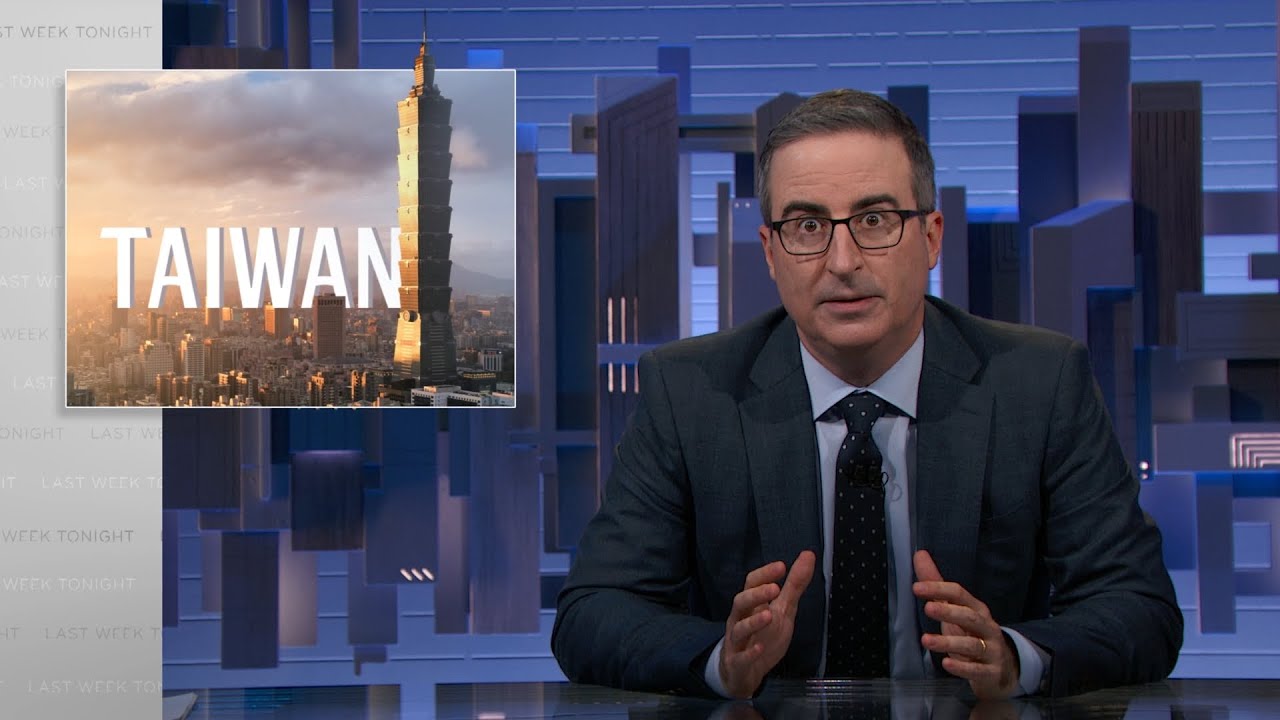
It was actually a bit of a puff piece as far as his stuff goes, but it was notable that he did it. I watched it earlier as I subscribe to his YouTube channel.
(small spoiler alert if you haven’t seen it but plan to watch it)
His main theme seems to be that Taiwan is just a chess piece in a great power game between China and the US and that it should be up to the Taiwanese people to make their own decisions. I agree with that, as far as it goes, but he doesn’t get into the fact that Taiwan has been screaming for weapons and training for years now, and far from the US using this crisis to boost our MIC, it’s been the US sitting on the fence and not wanting to anger China that has kept the flow of weapons, munitions and training to a minimum (in some administration to nearly nothing).
The biggest take from his show was the 86% stat…86% of the Taiwanese people do not want a change in the status quo. That means, they do NOT want to be part of the CCP’s mainland utopia. But they are smart enough to know that they would cross a line if they declared independence directly, both with the CCP and, ironically, with the US who is still holding onto this stupid strategic ambiguity thingy and won’t actually say if we’d defend Taiwan or not. I honestly don’t think ‘we’ know, regardless of who is in the Oval Office at any given time. I think that alone is a major factor in the instability wrt the CCP and Taiwan. If the US had just said, straight out we would not allow a non-peaceful solution to the ‘Taiwan problem’ and would support that by force if necessary, it would have spared all of this…IMHO of course. We could have even gone with the original joint communique and said we acknowledge the CCP’s claims to Taiwan, while disagreeing with them, etc etc.
So, this is just a blurb from one of the state-run Chinese news outlets, Xinhuanet, and probably won’t sound all that dire or even meaningful in the context of our own media and politicians, but I thought was worth posting:
BEIJING, Oct. 9 (Xinhua) – Chinese President Xi Jinping said on Saturday that the Taiwan question arose out of the weakness and chaos of the Chinese nation, and it will be resolved as national rejuvenation becomes a reality.
“This is determined by the general trend of Chinese history, but more importantly, it is the common will of all Chinese people,” said Xi, also general secretary of the Communist Party of China Central Committee and chairman of the Central Military Commission, while addressing a meeting marking the 110th anniversary of the Revolution of 1911. Enditem
More meaningless blather from Beijing.
Perhaps. I guess we shall all see, and IMHO the clock is ticking on the CCPs ability to do this, and they will need to have this resolved, assuming they can resolve it either peacefully or not, in the next few years. Especially if it’s not peaceful, they need to resolve this so it’s done with enough time before 2049 and their big celebration for the world to have forgotten and gotten back to liking Chinese money. Kind of like the lag between the anger over Tiananmen and the Olympics.
I don’t think it’s just meaningless blather. I don’t think it means “we begin bombing in five minutes.” I think the actual wording used is pretty significant:
That’s consistent with the CCP’s position that Taiwan is an integral part of China proper, and also consistent with my speculation upthread that Xi views Taiwan’s anomolous status as being a result of the “period of humiliation”, when China was weak and dominated by outside powers. Now that China is finally re-emerging as a world power, as “national rejuvenation becomes a reality,” a natural and necessary consequence of that is that Taiwan will be reunited with China proper, under the rule of the Chinese Communist Party.
President Xi could have decided to downplay Taiwan’s status, or just not mentioned it at all. Of course, he also could have issued a much more strongly worded statement. But the statement he did make seems designed to keep the “Taiwan question” on a low boil.
Does anyone know what the Chinese-language media has reported, if anything, about this statement? It’s not exactly unknown for Chinese leaders’ statements to be significantly different in English-language and Chinese-language official and semi-official Chinese news sources, or even for a strongly worded statement in one language not even be reported at all in the other language.
Agreed.
Exactly. It’s coded for the Chinese people and hits all the key phrases in a very short sentence. It’s loaded with nuance and meaning and is especially significant as it’s directly from one of their state-run media mouthpieces. It certainly doesn’t mean they have their hand poised over the gun and are ready to draw tomorrow, but it’s not meaningless blather either.
He’s not letting it go or ignoring it. Again, this is significant for exactly that reason…if this were simply about the same old same old, well, they had their big party, their big fly by of Taiwan, showed them who was boss so they COULD have just moved on. Instead, he’s keeping it rolling on a slow boil…and they definitely aren’t just dropping it and going back to business as usual, even though doing so right now would go a long way to patching things up with other nations who are worried about their aggression wrt Taiwan currently. But he…and they…aren’t doing that.
I think that statement was from today, so you’d need someone who is looking at this stuff in real-time in China and following their social media and other media closely. I generally ask my son’s partner’s family what they think but that usually has a bit of a lag since I don’t see them that often these days.
One way of reading that, and with my Western bias showing, is that this is very carefully crafted and provides a lot.
It provides a clear reason why imminent military action should not be expected by the Chinese people. That provides political wiggle room. There is an element of “Don’t you worry about that then - all is to plan and as expected.” *
There is an implication that in the fullness of time China will outstrip Taiwan in prosperity and rather than being a jewelled prize, Taiwan will be begging for a return to the motherland.
Whether the PRC will welcome them with the fatted calf or will be waiting in the corridor with steel capped boots and bits of lead pipe is another matter. Sadly, I suspect it will be the latter no matter what assurances are given.
The Chinese view of punishment seems to be transitive. If you transgress, even if you avoid punishment, you will know that your descendants will be made to pay for your crimes. Alexander the Great was no different. But this attitude only works in an isolated world. It becomes counterproductive when you don’t wield ultimate power.
* Australians of a certain age will recognise that.
The issue can be seen in light of the idea of Two Chinas:
That is, the claim by either that it is the real China vs. independence for Taiwan, which is not considered a sovereign state by most countries, including the U.S. itself.
I think there’s something to that reading - it’s pretty much been China’s approach since 1949. But China in 2021 is a very different country than it was even a decade or so ago.
For one thing, China has undergone a pretty radical internal political transformation, albeit one that isn’t always obvious to outsiders, particularly given how opaque China’s internal politics are. After Mao’s death, China became a pretty stable oligarchy, where the Chairman of the CCP was basically a first among equals, and ruled by a consensus among the oligarchical elite. Xi Jinping has consolidated power into his hands to an extent that no Chinese leader since Mao has even attempted.
Again, give how opaque China’s internal politics are, it’s difficult for an outsider to say for sure, but over the last decade, China really seems to have transformed from an oligarchy with some autocratic features to an autocracy with some remnant oligarchical features.
The other element is, as @XT has discussed at some length upthread, for decades the CCP has based its legitimacy on economic growth and improving standards of living, but that model is now sputtering out. In its place, Xi has been leaning heavily into ideas of Chinese national greatness.
The Belt and Road Initiative, for example, is at least as much about national prestige as it is about economic development and trade opportunities. And China has become increasingly assertive and belligerent in the South China Sea. And so on.
Or take a look at Hong Kong. When China regained Hong Kong in 1997, it very publicly declared a “One Country - Two Systems Approach”, and as a part of that declared approach, that it would take a “hands off” approach for at least 50 years. Now, less than 25 years later, while it hasn’t quite re-imposed direct rule, One Country - Two Systems is pretty much a dead letter. The central government has and continues to directly intervene in Hong Kong in a heavy-handed way.
Which directly speaks to the situation with Taiwan. China’s explicit approach to Hong Kong at the handover from the UK was exactly the idea that in the fullness of time, mainland China’s development would outstrip Hong Kong’s, and the people of Hong Kong would themselves want to be integrated into mainland China’s system, and there would never be a need to force the issue. It would all resolve itself naturally in due time. Instead, though, Xi’s government has effectively abandoned that approach in favor of heavy handed interventions.
The thing is, under Xi’s leadership, the CCP has increasingly tied its legitimacy, and Xi has increasingly tied his personal legitimacy and autocratic pretensions, to the idea that China is no longer a rising power, but has already arrived, and is a Great Power again. China’s period of weakness and chaos is over.
Xi is explicitly reiterating that Taiwan’s status arose from China’s weakness and chaos, and that reunification will occur as an integral element of China’s rejuvenation. But, again, he’s staked the party’s legitimacy, and his own personal legitimacy, on the idea that China’s national rejuvenation is a reality. That circle is going to be increasingly hard for him to square.
That was one of the best posts I’ve seen on this board on this topic.
Exactly. I can’t emphasize this enough as I think it’s critical to understand what’s going on here and be able to read between the lines of what’s being said…and why it’s being said. Right now, Xi and his faction are in a political struggle with Jiang Zemin (even though he looks like a toad and is like 100,000,000 years old…or at least 95) and his faction. Xi’s faction is slowly grinding Jiang’s faction down with his 'anti-corruption campaign, but the fight is far from done. At the same time, there are a lot of things impacting China right now. You have the continuing covid outbreak, and the CCP trying to deflect that to any country they can try and pin it on (the latest is cold water seafood from the US caused the outbreak). You have various financial crises going on…the long-expected downturn in their real estate bubble market, the self-inflicted wounds from their Australian tariff war, the US/China tariff war, a major energy crisis due to rising coal prices, the aforementioned Australia tiff, and issues with local and their coal production has really hurt their industrial production (this is a non-exhaustive list, just the highlights…you also have the tech company crackdowns, crack down on social media and other personalities, gaming industry, their chip manufacturing fiascos that seem never-ending, etc etc). Couple all that together and you have a lot of folks who are either out of work, are working but aren’t being paid fully (or in some cases at all), and many who are afraid that the houses or apartments they have bought are either not going to be built or are going to fall from the sky-high prices they were getting just a year or so ago…or are going to fall because they were badly made and falling apart new or that the CCP will allow them to be destroyed.
It’s a witches brew of issues that doesn’t even scratch the surface of all that’s going on internally in China. Your comment about tieing the expectation of the people to an ever-rising economy, and the Faustian pact the CCP made with the Chinese people (we will give you ever-rising prosperity, in return, there will be no reform and we are in charge and you won’t go against that) post-Tiananmen is especially on point, as that seems to be falling apart…really has been for a while, though again, it’s not talked about much in the West (the whole 9-9-6 work culture and the counter lying flat movement)
So, right now, Xi needs to distract the Chinese people and also beat the drums of nationalism, and he’s doing that by first taking control of Hong Kong as you noted and this constant pressure on Taiwan and the constant refrains about national rejuvenating and how Taiwan is part of China. I get that this has been going on a long time, but China has increasingly been applying pressure…with hammers, not just words…to international organizations, companies, and even countries to toe their line on Taiwan. And while it’s working in some cases, in others you are starting to see real pushback. The latest I heard is the Czech Republic brought in Taiwanese officials for direct talks…something that, again, has ‘angered China’ (this is China’s stock phrase that they have conditioned the world too…if you talk to Taiwan or mention them as something like a nation you will ‘anger the Chinese people’…can’t have that). Then you have Australia coming out and saying they will support the US and regional powers in maintaining the status quo wrt Taiwan. That’s about as close to a declaration as I think Australia has ever made, and they aren’t alone…Japan has said similar things.
So, there is tremendous pressure on this from all sides…and, as you indicated above, Xi et al have kind of painted themselves into a corner. Not completely…they COULD back out, de-escalate the situation and pretend this was just business as usual. But with everything going on, this would be a major hit to them internally if they did, as they have spent a lot of political capital stirring things up internally to this point. I don’t think they expected this level of pushback from the rest of the world, nor the US’s actions…I think a calculation was made that they needed to push Taiwan to the brink and get them to basically surrender and join the mainland. That isn’t happening for a variety of reasons, the biggest was their push in Hong Kong, especially the way they are doing it.
Where this goes at this time is just unknown…I doubt the CCP actually knows what it plans to or will do right now. That’s probably the most worrying aspect, to be honest. But I think it’s clear that they were building towards this for a while now…this isn’t either the same old same old or something they were only doing recently as a propaganda tool…it was part of a calculated plan. But their calculations were flawed and, I think, events overtook them wrt how things have turned ou.
Well…I guess this settles it. 
 Yeah, you can take that to the bank…it’s as safe as houses (in China)! Plus…man, I need a new irony meter now. And I had the newest, SDMB certified irony meter 2022 (a year ahead of schedule), and it still blew up like a big bear…
Sobering:
Just for clarification, that article refers to Taiwan-held islands far from Taiwan itself - a few specks in the South China Sea. It doesn’t mean the main island of Taiwan itself.
It would be like if someone said, “If Argentina seizes the Falklands, the UK has few good options.” (well, maybe not the best analogy, but you know what I mean)
Well, that’s true enough, but depending on how much you buy into the CCPs and PLAs propaganda on their weapons systems, the US might have few options that aren’t extremely costly even if we are talking about the island itself. Supposedly (and I think this is fairly realistic), the PLA rocket force can hit both Guam and our bases in Japan with missile strikes from the mainland. That will hamper our efforts to reinforce and prevent strikes on Taiwan if nothing else. Of course, that would definitely bring Japan into this, and maybe a bunch of other countries too, but it still needs to be put out there. Then there is the carry killer missiles they supposedly have in deployment and that work exactly as they say. IF that’s the case, then it pushes back our ability to move the fleet in for support, or at a minimum hampers our ability. While we could eventually work around both (for one, we’d be hammering those systems on the mainland, and degrading their ability to sustain the initial attack both against the US and Taiwan), it would take time and would probably cost the US quite a bit. The Chinese have built a military basically around a few very vertical capabilities…invasion and asymmetric modern warfare against the US Navy and US military in the region. As I was trying to explain earlier, the fact that they have the force mix and doctrine they have really is a red flag to their intentions, as it has come at the cost of a more balanced military force that can do more things, especially ground combat wise.
Taiwan’s President Tsai Ing-wen recently wrote an article for Foreign Affairs:
A reader may note that she discusses Taiwan’s democracy at great length and the threat Beijing and the CCP pose to that democracy. But she tiptoes around Taiwan’s precise legal status. She frames the conflict not as a threat to Taiwan’s independence as a separate sovereign state from a hostile foreign power, but as a threat to Taiwan’s democratic system by the Chinese Communist Party.
President Tsai has made statements, such as the one cited by Whack-A-Mole upthread, which come much closer to a de facto declaration of independence. In this article, she seems to be stepping back from such statements, and Beijing’s redline on independence, and to be re-framing the conflict as one between two systems, which is has been Beijing’s preferred framing for decades.
The article as a whole reads to me like an attempt to signal to Beijing both stalwart resolve to resist pressure from the mainland and also a willingness to step back from discussions of outright independence and return to the ambiguous status quo ante.
Yeah, she is a cagy one. Actually, she is freaking brilliant in threading the needle on this one at the same time trying to change Taiwan’s international image and get countries to engage with them more. By doing that, she takes Taiwan off the backburner and puts it on the radar of not only many countries but their citizens too. Taiwan has scored some real wins, especially in parts of Europe with this strategy.
Her stance has always seemed to be that Taiwan is de facto independent, so they don’t need a formal declaration to demonstrate what is already reality. I think that’s a good stance on this for Taiwan to take. Formally declaring independence would probably bring them into direct conflict with Beijing. This way, they don’t give the CCP any excuses outside of naked aggression which is going to instantly put China in the camp of an aggressor and the ones who are doing this solely for power and conquest. Won’t even be a false narrative.
Thanks for the link!