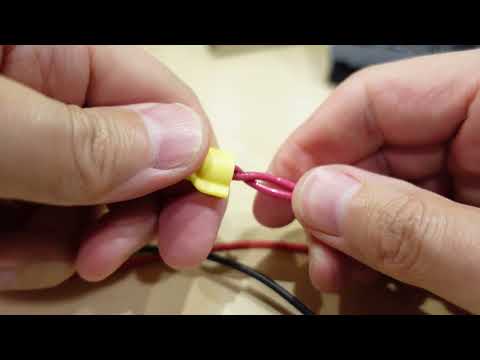
There’s a difference between a failure that results in something just not working, and a failure that can kill someone. That’s the difference between a failure in the hot connection, to downstream receptacles, and a failure in the ground or neutral connections.
If the hot connection fails, then you just don’t have power.
If the ground or neutral fail, then you have a significantly-increased risk of someone getting electrocuted.
Both wire nuts and Wagos are very good, and add only a fraction of a milliohm each. He doesn’t test screw terminals, but I have to imagine that a properly installed one would have similar resistance. Even with 20 items in the chain (10 receptacles * 2 terminals/receptable), the voltage drop should be negligible.
That voltage drop was not all in one location but spread out over over 20 locations But it still was not good.
Not so much workplace safety, but to make the job easier. If the outlets, lights, and light switches are labeled makes problem solving easier. If a tenant overloads a circuit and trips the breaker, If the outlet is labeled then it is just a matter of going to the right electrical panel and locating and resetting the breaker. If it is unlabeled, then I would have to find which panel room the power came from and which panel. The is either checking the blue prints if there are any or walking in each panel room checking each panel and locating a tripped breaker. Resetting the breaker.
Also If the outlets are labeled and an event is being set up with several high draw appliances, then it will be eassier to plug in the appliances and not over load the breaker.
Any failure that results in something not working is a significant risk that it’s a failure that’s building up to an electrical fire. Most electrical house fires from what I read are due to poor connections. You most certainly don’t want to nt notice or ignore an electrical problem. You don’t want to ignore a malfunction, and continuing to use a faulty circuit is probably not recommended.
6 volts for a circuit chain there and back that’s 100 feet long each way is not bad. (and technically, for a 15A circuit the typically max continuous draw should be 12A, 80%). If there is corrosion or a faulty connection, that’s all in one spot and that’s a risk of worse consequences.
My house built in 1962, in the late 90’s I had to call an electrician because the main breaker kept popping more and more often until at least once a week. He found that the copper wire feeding from the street had deformed over the years so the connection was not tight going into the breaker. He could, with the power off of course, pull the wire in and out by hand. Tighten it down, no further problems. But the heat of the connection in heavy use would pop the breaker. It was a vicious cycle - heat from a poor connection caused the wire to expand and deform more, then when it cooled it was still looser.
In the UK, we have traditionally had “ring final circuits” in which all the receptacles are connected in a loop that starts and finishes at the main circuit breaker. This is not the recommended method these days and “radial circuits” similar to those described above are the norm for new installations.
I looked it up and see that the regulations say that “If you adhere to the principles above e.g. a radial circuit running from a consumer unit with its own MCB of the correct rating can have as many sockets as you like, as long as it’s in an area not exceeding 50 square metres (or 540sq ft).” They do say that you should pay attention to what is likely to be plugged in.
A 16 amp MCB with 2.5mm T+E (twin and earth) wiring will be ample for any general domestic appliances such as TVs computers, washing machines etc, but for heavy-duty appliances, such as cookers, a more substantial cable is required. The size of the wire and MCB breaker that’s used will very much depend on the rating of the appliance that’s going to be connected to it.
Lighting circuits are usually made from 1mm T&E and a 5 or 6-amp breaker but may be 1.5mm on long runs or where ceiling fans are involved.
Sure, I’m not trying to imply that it’s a big problem. The wire gauge requirements are set so that the voltage drop is nominal. Any correctly functioning appliance can accept a 5% drop. It’s just not what I’d call negligible. Back when my lights were incandescent, I could always spot when a load came on the same circuit as some lights, as they’d dim slightly. Not significant, but still noticeable.
Yes, many appliances can’t make up their mind if they are nominally for 110V or 120V; there’s a certain latitude there. (Nowadays, many are 110-240V). I remember something similar, where things like my fridge’s compressor or the washing machine - when the motor kicked in the lights would blink. Lights were most apt to burn out with a big flash when you first turned them on. There would be a surge of current to start when the circuit first closed. I believe a lot of modern appliances have the electronics etc. to smooth out that surge.