What was your assumption, and how is it dispelled?
The security guards first heard the fire alarm at 6:20 p.m, so it’s possible the fire could have started at the end of a working day, perhaps at 6pm, after which the workers left and no-one noticed the fire until the fire alarm was activated twenty minutes later.
That a worker was doing something that accidentally started the fire.
Yeah, that seems possible.
I just watched (part of) the video of vespers from Monday, just before the fire, and I have to admit, I’m not a fan of the modern sculpture on the front of the altar.
As for the fire being caused by a worker, that of course seems likely. I think that was the cause of the Windsor Castle fire and there was, I think, a prominent synagogue in Manhattan that also had a fire related to construction or renovations. I read someplace that the workmen at Notre Dame were required to stay two hours past the end of their workday, presumably to spot any fires that might start as a result.
IF it started on the roof it would have a bit of time to take hold & grow before anyone noticed it. The first little bit of smoke would get carried off by the wind & be hard for people on the ground to notice. It’s not until it got large enough for someone on the ground to notice &/or the smoke to start seeping into the building to set off an alarm that anyone would catch it. Now add (at least) a couple of minutes to call emergency services, have them dispatched & go enroute, get there, get out equipment & get to the roof & that fire has another couple (to eight to ten) minutes to take hold. By the time the first fireman laid eyes on it, it was probably already ripping.
Were there any freight elevators in the scaffolding? Were the accessible to the firemen or only key-controlled by construction personnel? Do temporary, external, construction elevators have the same standards as interior elevators? Things like fire key overrides?
Did the firemen have to climb up scaffolding in order to even be able to see it then lug, unroll & connect hundreds of meters of hose just to be able to start fighting it?
According to Wikipedia:
So 23 minutes between alarms. + however long it was smoldering / on fire until it set off the first alarm + time for the firemen to get the call, get there, & then get to it. (Scaffolding is slower to climb than a regular, interior staircase; not sure about 800 yo staircases, though) That fire was rippin’ by the time the first fireman laid eyes on it!
I’m guessing the latter smoke was reflecting flames as I don’t think there was anything that toxic up there to burn.
What I’m wondering is how will the roof be rebuilt? Will they try to replicate the medieval wooden structure, or just use a modern steel frame? What happened when Windsor Castle had a fire a few years ago?
Just getting the scaffolding down is going to be a monumental task. Given some of it is clearly melted a lot of it is probably not safe; they’re going to need a crane(s) to take a lot of it down.
Trump offers aid to rebuild Notre Dame. Flint, Michigan and Puerto Rico ask, ‘What about us?’
At Windsor they adopted a combination of solutions. Much of the hidden roof structure was replaced in steel. But in some cases, such as St George’s Hall, what had been plaster ceilings were actually replaced with exposed wooden ones. Most amazingly, the roof of the Great Kitchen, which everyone had thought was nineteenth-century, not only survived the full force of the fire only partly damaged but it then turned out to be fifteenth-century. It was restored in wood but with a hidden load-bearing steel frame. Quite a lot of the most damaged bits of the building were the service areas around the kitchens. The tendency there was to strip things back to the medieval walls and then combine that with new, rather functional elements.

So does St. Landry Parish, Louisiana. They’re relying on GoFundMe.
That’s the pregnant question a lot of people are asking. There are basically 3 options : try and rebuild it exactly like it was before the fire (i.e. reproduce Viollet-le-Duc’s 1840s vision), or try and rebuild it like it *actually *was built back in the 13th century (which we now know *much *more about, compared to Viollet-le-Duc), or disregard the past and turn it into a more modern architectural masterpiece. All three choices are equally “valid” from an historian’s point of view.
That being said, before thinking about that there’s much work to be done inspecting the damage to the stonework - like 99% of Paris, N-D was built out of limestone and that doesn’t really react well to heat ; so even though the structure is still standing right now and there doesn’t appear to be a lot of damage, as the stones cool down they will likely shift or crack (in fact, some of it was already crumbling well before the fire…). If anything, the fire might have been a blessing in disguise, because it dramatically highlighted the shameful level of dysfunction and disrepair our national monuments have been in for a while.
We don’t - there are quite a few crowns of thorns (or thorns purportedly removed from the crown) in Europe, enough shards of the True Cross floating around to build a fleet of galleons with and enough holy nails to open a Home Depot. IIRC there are 5 or 6 Longinus’ spears out there, too. The Catholic Church isn’t big on letting scientists anywhere near its relics, for obvious reasons - enough “bones of Saint Something” have been revealed to have been pig, dog or cow bones as it is :).
This was already known back in the time of the Crusades, btw - trafficking in relics was a big industry back then, as was the making of sham ones. You’re right to be skeptical, and the people of the Middle Ages were often just as skeptical ! But in the end it doesn’t really matter, from the Church’s POV (modern, or back then) : relics draw in crowds of pilgrims, who tithe. That’s their value, and this is true whether or not the relic is “true”. As well believing in the power of these relics leads people on the path of the “true faith” and in contact with the priests guarding them, even if the relic itself is a sham, so no problem there either.
FWIW however, the particular crown of thorns that was housed in N-D wasn’t brought back by gullible crusaders - rather it was a gift from the Emperor of Constantinople.
I was wondering about the parts of the roof structure that wouldn’t be visible to someone standing in the cathedral, or standing outside looking up at it. Why not just built a modern, structurally sound and fireproof steel frame? That should allow more attention to the ceiling that can be seen from below.
And as for the existing damage, that was already known (see this eighteen-month-old article from the New York Times, for instance) and I assume that’s why the workers were present.
It’s most likely not. But it’s the symbolism that matters the most, what it represents. It means a lot to people.
And as Shodan said, because it’s so old, it’s a piece of history. Like the Shroud of Turin, even though we know it’s fake, it would still suck if we lost it.
IANAArchitect, but I suspect it could be a challenge for the same reason they built the roofing out of wood rather than do it all in stone way back back when : vaulted ceilings and flying buttresses are ingenious, they distribute forces really well… but there’s still an upper limit to how much sheer weight you can pile on top of them before they fail or the walls themselves crumple - the big selling point of external buttressing was that you could make the walls higher & thinner, and also have more window-holes in them to showcase that newfangled stained glass.That’s all very pretty, but it’s also structurally weaker than your typical Romanesque thick-ass, stumpy walls.
That being said, I agree that if doable it’s what should be done.
For the roof, there is no reason that it can’t be rebuilt to have the same look architecturally as the previous roof but using more modern materials - the wood frame was not an architectural feature, simply the material most suited to the application at the time. It was not chosen for any aesthetic value, none of it was visible from outside the attic (except through the windows in the attic).
The choice to use lead again as the roofing material is a little more difficult since it is a visible design element, but again chosen originally for practicality rather than aesthetics.
The spire raises another question. My guess is they go with Viollet-le-Duc’s version, but again with more modern structural materials. The copper statues were fortuitously saved, so re-installing them into the original design seems to make sense.
The outer surface was lead so that’s a non-starter. It will likely be trussed steel supports to take any lateral load off the walls and it will have fire walls spaced out to bring it up to code alone with a high pressure misting system. There’s really no good reason to use wood in the roof structure.
If the ceiling arches are of soft stone such as liimestone then all of that is going to have to be inspected/tested for weakness. The arches would have been covered in concrete to stabilize them so that would be a great heat insulator. Given the entire roof burned off above the ceiling I’m surprised only 2 of them collapsed. Maybe the falling spire did that.
I’m curious as to whether they will put the spire back on. It wasn’t original and I’m not sure it adds anything to it visually.
Huh. Speaking of, you made me realize I have no idea where all that lead ended up. I mean it must have melted pretty quickly obviously, but I haven’t seen a massive pool of gently solidifying lead on any of the pictures from after the fire was put out. I hope the firemen didn’t just flush it all down the Seine.
Don’t know about Windsor Castle, but the roof of the Chartres Cathedral burned in the mid-1830’s. They replaced the wooden beams with cast iron, and the external lead with copper. I think the result is actually quite beautiful
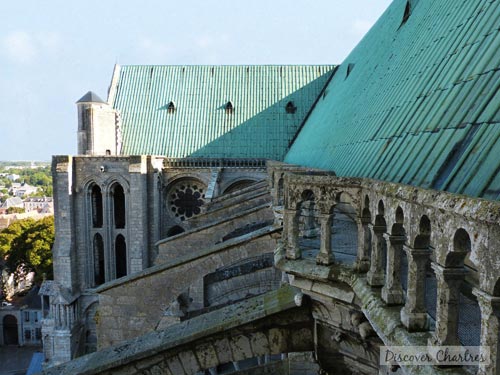
We’d probably use steel or aluminum these days, but there’s precedent for that approach and certainly from an exterior viewpoint it goes well with the Gothic architecture IMO.
That’s a key point - they used those things because those were things they had. Over the centuries there have been all sorts of things that occurred to buildings like this and all sorts of things done to repair them. I suspect that if the medieval craftsmen had had access to many of our modern materials and techniques they would have used them.
It’s limestone.
Yep, that’s pretty certain.
The spire wasn’t original, but it did replace an earlier spire - I think folks might want it back. Macron is saying something about a “modern” spire so I think they’re open to something new.